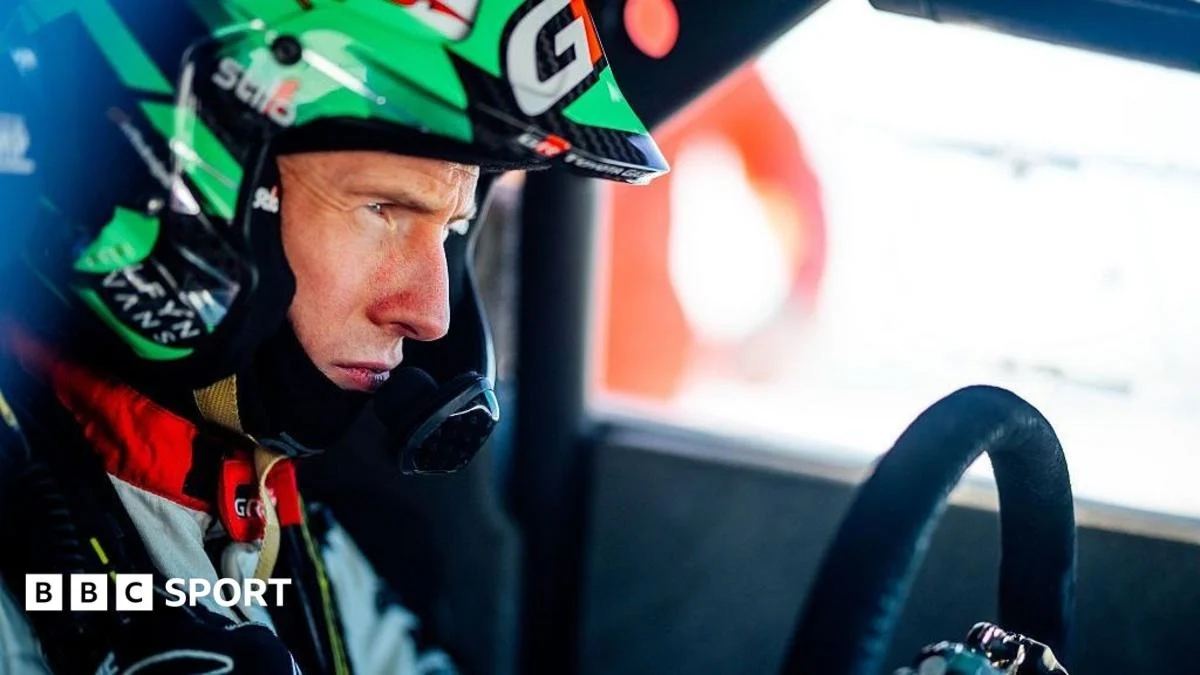
For what must have felt like an eternity, Elfyn Evans stood in the stifling heat of Sardinia, his eyes fixed on the horizon, braced for the familiar, hollow ache of heartbreak. At 3:05 p.m. local time on Sunday, the North Wales native was certain that history was repeating itself—a cruel, cyclical narrative he had lived through five times before. As he waited for Oliver Solberg to cross the finish line to secure the world title, Evans was already mentally drafting the runner-up speech that had become his unwanted hallmark.
How could this be happening again? The question hung in the air, a phantom of seasons past. Of his five previous second-place finishes in the championship, three had been decided on the final day, and two had slipped through his fingers after he had entered the final event with the lead. The pressure of the World Rally Championship (WRC) is a crucible, and for years, Evans had been forged in it only to fall short at the final hurdle. He was prepared to accept his fate once more, a perennial bridesmaid in a sport that demands perfection.
But at 3:06 p.m., the narrative shifted with a violence that left the rally world breathless. For once, the fickle motor-racing gods, who had so often conspired against him, decided to favor the Welshman. With just two turns remaining on the final stage of the final round, and with the championship trophy seemingly firmly in his grasp, Oliver Solberg committed a devastating error. In a moment of high-stakes pressure, his car careered off the track and into the unforgiving Sardinian sand.
The silence that descended upon the service park was broken only by the realization that the standings had been turned on their head. The mistake handed Evans his first world title in the most dramatic of fashions. At 37 years old, the North Wales driver had finally ascended the summit, becoming the first British winner of the World Rally Championship in a quarter of a century. It was a victory that ended a long, national drought, placing his name alongside the legendary British icons of the sport.
Since the inception of the WRC in 1977, only two British men had reached the pinnacle of the sport: the mercurial Colin McRae in 1995 and the gritty, precise Richard Burns in 2001. Their names are etched into the folklore of rallying, and Evans’s achievement finally brings that golden era into the modern day. While Louise Aitken-Walker remains a pioneer as Britain’s first world champion during the women’s version of the WRC in 1990, Evans now stands alone as the man to break the 25-year stalemate for British men in the top tier of global rallying.
To understand the weight of this achievement, one must look at the lineage of the man behind the wheel. Evans is, in every sense, a product of rally driving royalty. His father, Gwyndaf Evans, was a British champion and a formidable competitor who finished as a runner-up four times. Despite his immense talent and his reputation as a rugged, salt-of-the-earth farmer, Gwyndaf never quite received the breaks necessary to compete consistently on the global stage. He remained a local hero, a man whose skills were undisputed but whose career was defined by the very "near misses" that would eventually shadow his son.
The "curse" of the runner-up, if one were to call it that, seemed to pass seamlessly from father to son. Elfyn had already begun his journey as a professional driver by the time his father claimed the last of his near-misses in 2010. The younger Evans began to carve out his own path, clinching his first WRC stage win in Germany in 2014 and securing his first podium finish in Argentina just a year later. However, the path was never linear. In 2016, he faced the humbling experience of dropping down to the WRC2 class.
If that move was intended to break his spirit, it achieved the exact opposite. Evans later admitted that the demotion served as a crucible, fueling a deep-seated determination to prove he belonged among the world’s elite. The fire in his belly translated into results, and his first major breakthrough arrived in 2017 with a victory at his home event in Wales. That win was a watershed moment, confirming that he had the pace and the temperament to win at the highest level.
Yet, consistency became his greatest ally and his most agonizing enemy. Between 2020 and 2025, Evans became a permanent fixture on the championship podium, yet always one step below the top. He finished second for the title in 2020, 2021, 2023, and 2024. Perhaps the most painful of these chapters came in 2025, when he lost the championship to Sebastien Ogier by a razor-thin margin of just four points in the final race of the season. To lose a title by such a small fraction is a trauma that would break most competitors; to do so repeatedly is a testament to an iron will.
For years, it appeared that Evans was destined to be remembered as one of sport’s great runners-up—a driver of immense capability who lacked that final, microscopic edge required to claim the trophy. His career was a study in resilience, a long-form performance of keeping his composure while the world expected him to fold. He was the driver who could always be counted on for points, who never cracked under the pressure of the stages, but who could never quite close the deal when the season finale arrived.
The drama in Sardinia has finally rewritten that legacy. While critics may point to the late-stage misfortune of Oliver Solberg as a stroke of pure luck, it is a narrow view that ignores the years of attrition that brought Evans to that precise moment. In the world of rallying, being in the right place at the right time is not merely a product of chance; it is the reward for being in the fight until the very last meter. Few could deny that Evans had earned his place at the table, having pushed through a career defined by the thin margins between victory and a second-place finish.
As the dust settles in Sardinia and the celebrations begin, the focus turns to what this means for the sport in Britain. For 25 years, the WRC has felt like a distant horizon for British fans, a championship that once belonged to the legends of the 90s and early 2000s but had since slipped away. Evans has bridged that gap, validating the long years of hard work, the transition through the WRC2 class, and the countless rallies where he finished mere seconds away from glory.
The 37-year-old’s triumph is more than just a victory for a driver; it is the conclusion of a multi-generational quest that began with his father’s own pursuit of greatness in the forests and tracks of the UK. When Elfyn Evans stood on that final podium, he wasn’t just holding a trophy—he was carrying the weight of a quarter-century of expectation. He had successfully exorcised the ghosts of his previous failures, turning the heartbreak of past seasons into the foundation of his greatest success.
The WRC season, often described as the most grueling motorsport championship on the planet, demands more than just raw speed; it requires the ability to endure. Evans has proven himself to be the most enduring driver of his generation. Through the ups and downs, the near-misses, and the crushing defeats, he remained steadfast. Now, he stands at the top, a world champion who finally found the luck he needed to match the talent he always possessed.