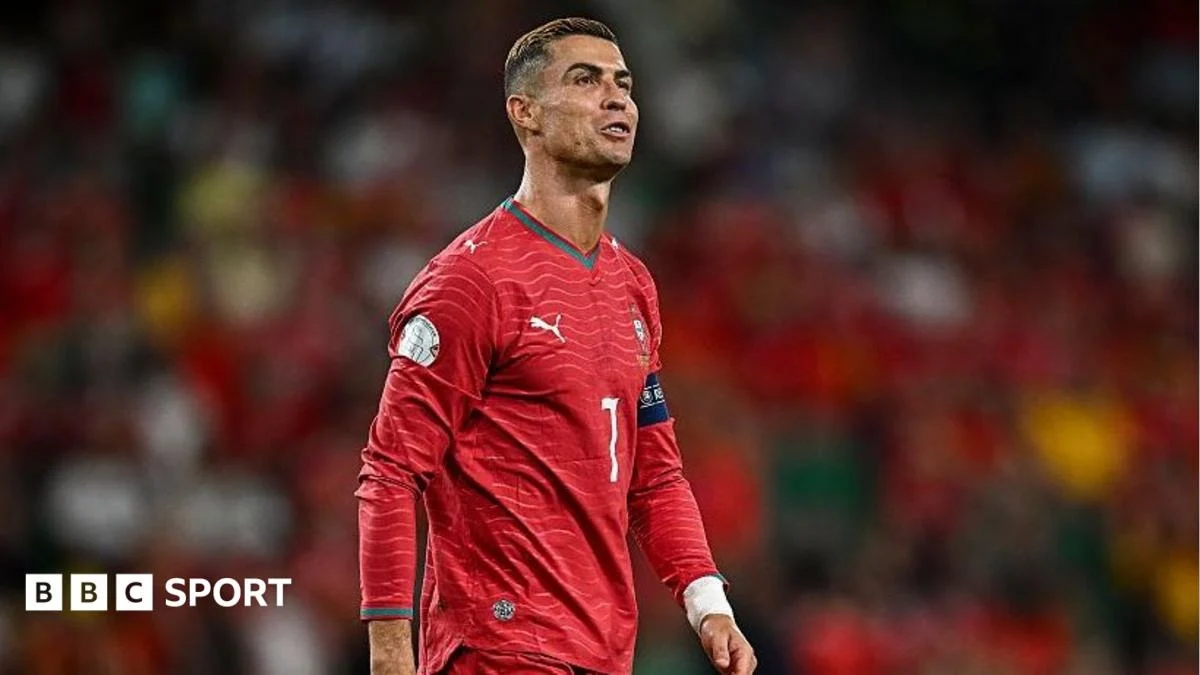
Cristiano Ronaldo, the talismanic captain of Portugal and arguably the most recognizable figure in world football, could still find his way back into the national team fold if he so desires. This is the firm stance taken by head coach Jorge Jesus, who has moved to quell speculation regarding the future of the 41-year-old forward following his abrupt departure from the team’s recent Nations League camp.
The veteran forward, whose illustrious career has seen him shatter countless records, including an unprecedented 146 goals in 234 appearances for his country, left the squad under a cloud of uncertainty. The sequence of events that led to his exit began when he was named an unused substitute in a match against Norway, followed by a conversation with the coaching staff in which he was informed he would not be in the starting XI for the subsequent clash with Denmark.
For a player of Ronaldo’s stature—a five-time Ballon d’Or winner who has been the centerpiece of Portuguese football for over two decades—the realization that his role had shifted from an automatic starter to a bench option appeared to be a turning point. Upon his departure from the training camp, Ronaldo took to social media to signal that his silence would not be permanent. "In due course, I will tell the truth to all the Portuguese people about my reasons for leaving the national team, to which I have always been dedicated," he wrote, sparking intense public debate across the nation.
Jorge Jesus, who previously managed Ronaldo at Saudi Arabian club Al-Nassr, had maintained a disciplined approach throughout the controversy. He had pledged to address the matter only after the conclusion of the team’s current Nations League fixtures, prioritizing the collective performance of the squad over individual narratives. Following a hard-fought 2-1 victory over Norway on Sunday—a result that effectively secured Portugal’s place in the last eight of the competition—Jesus finally spoke on the delicate situation.
"If he wants to, he’ll return to the national team," Jesus stated clearly. "We can talk before the next call-up, but Cris is the one who’s going to decide." By placing the ball firmly in the player’s court, Jesus has signaled that there is no formal banishment for the legendary forward, but rather a need for a mutual understanding of his role within a changing team dynamic.
The tactical friction reached a breaking point during the international window. While Ronaldo had started the opening-game victory against Wales, his treatment in the following match against Norway proved to be a catalyst for his frustration. Reports suggest the Al-Nassr star was particularly incensed at being instructed to warm up during the second half of that game, only to be left on the sidelines for the duration of the 90 minutes. It marked a rare and uncomfortable milestone: the first time in a competitive fixture since 2008 that the former Manchester United and Real Madrid superstar had been named as an unused substitute for his country.
The situation became untenable when, during a team briefing, Jesus confirmed that Ronaldo would not be part of the starting lineup for the upcoming fixture against Denmark. Shortly thereafter, the decision was made for the captain to vacate the camp.
In his absence, the tactical structure of the Portuguese attack has undergone a noticeable, albeit successful, transition. AC Milan striker Gonçalo Ramos has stepped into the spotlight, demonstrating clinical form by scoring in each of the three matches he has started in Ronaldo’s absence. The team’s ability to secure results without their longtime leader has provided the coaching staff with tactical food for thought, yet the emotional and historical weight of Ronaldo’s presence remains undeniable within the dressing room.
The squad’s reaction to the uncertainty has been one of respect for their captain, coupled with a focus on the immediate objectives. Joao Cancelo, who found the back of the net in the victory against Norway, spoke with admiration for the veteran leader in a post-match interview with RTP. "Cristiano is our captain, the best player Portugal has ever had," Cancelo remarked. "Things will certainly end in the best way [with him], but the important thing is the four victories."
This sentiment of continuity and welcoming was echoed by defender Nuno Mendes, who underscored that the door remains wide open for a reconciliation. "Any player who comes to the national team is welcome, obviously," Mendes said. "If Cris returns, we’ll be here to receive him with open arms."
The road ahead for Portugal remains demanding. As the defending champions of the competition look toward the knockout stages, their immediate focus turns back to the Nations League group fixtures. The team is scheduled to host Denmark on November 14, a fixture that will undoubtedly be scrutinized for any lingering fallout from the recent camp. This will be followed by a trip to Wales on November 17, as Portugal looks to maintain their momentum.
The current standings reflect a side that has managed to navigate internal turbulence with professional poise. Portugal sits six points clear of second-placed Denmark in Group A4, a commanding position that has allowed the team to weather the storm surrounding their captain’s exit.
The legacy of Cristiano Ronaldo with the national team is cemented in the history books. His contributions were pivotal in securing the nation’s historic Euro 2016 title and two Nations League trophies. As one of the most prolific goalscorers in the history of the sport, his influence has transcended individual matches, shaping the expectations and aspirations of a generation of Portuguese players.
Whether this recent episode represents the beginning of a phased retirement or merely a temporary impasse remains to be seen. The discourse between Jesus and Ronaldo in the coming weeks will be crucial. For now, the national team marches on, balancing the reality of a changing squad with the enduring legacy of a player who has defined their footballing identity for nearly two decades. The ball, as the head coach noted, is entirely in Ronaldo’s court, leaving the nation to wait for the next chapter in a story that has captivated the footballing world for years.
As the international break concludes and domestic leagues resume, the footballing community will be watching closely to see how the veteran striker responds to the situation. With the next round of fixtures looming in mid-November, the time for resolution is approaching. For Jesus, the objective is to maintain the harmony and form that has led Portugal to the top of their group, while for Ronaldo, the challenge is to determine how he envisions the final act of his international career. The pride of wearing the national colors remains a significant factor, but the dynamics of professional football at the highest level demand a clarity that both the manager and the player must now find together.