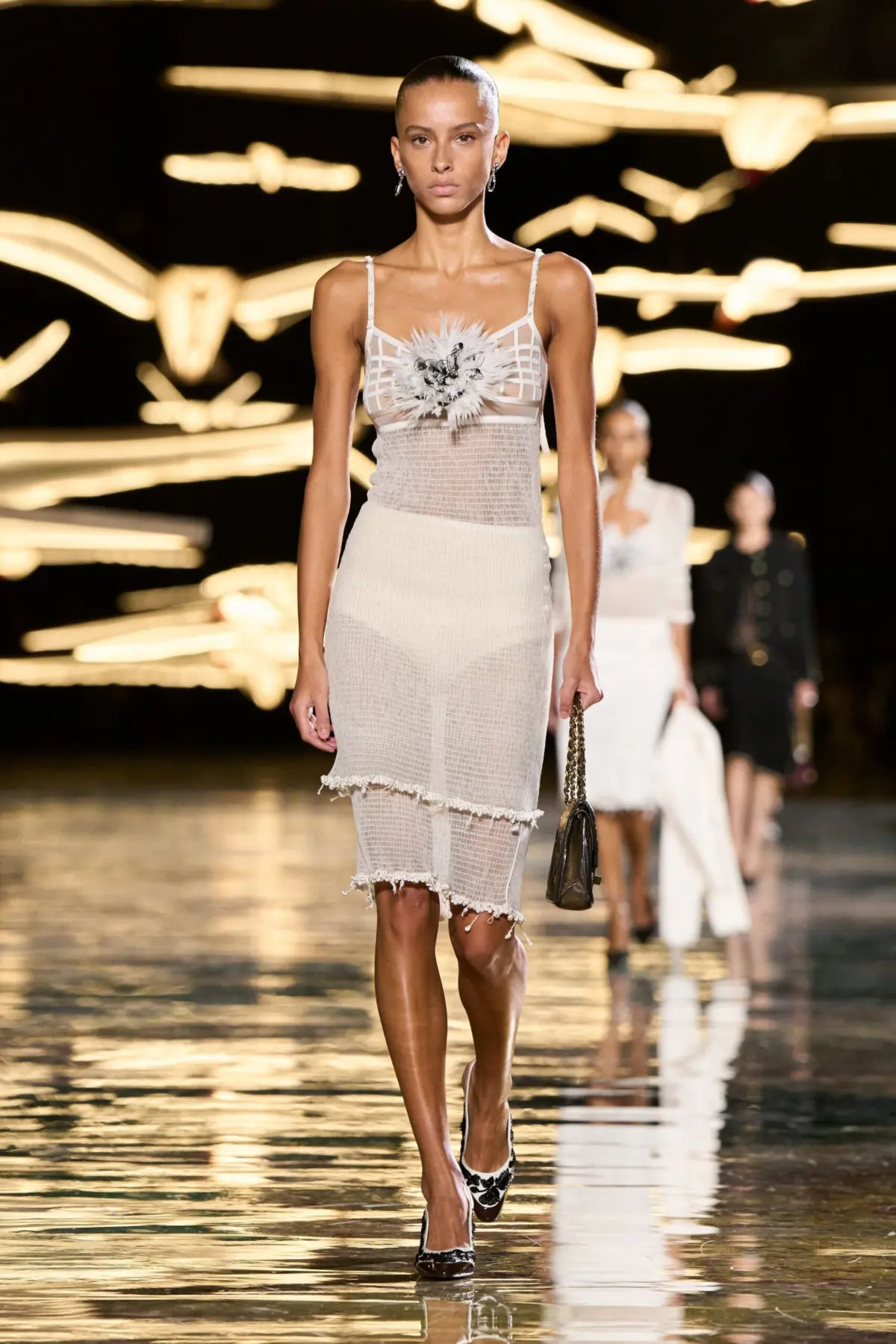
It has been a mere year since Matthieu Blazy unveiled his highly anticipated debut for Chanel, stepping into one of the most coveted yet pressurized roles in the global luxury fashion landscape. In that remarkably short span of time, it has become nearly impossible not to marvel at how thoroughly he has captured the hearts of fashion-loving women across generations. While the frantic mob scenes and frenzies outside the house’s flagship retail boutiques may have cooled slightly this season, the tangible evidence of collective, deeply personal affection for Blazy’s vision is everywhere one looks, from the glittering front rows to the bustling, historic streets of the French capital.
That deep connection was vividly illustrated on the eve of the runway show when a young woman was spotted effortlessly riding a bicycle around the Place de la Concorde wearing cap-toed Chanel heels. Though dusk was settling and the evening air was turning dark, there was no mistaking the unmistakable silhouette and heritage markers of the footwear. It was a snapshot of modern urban life intersecting seamlessly with elite Parisian luxury—a testament to the fact that Blazy’s creations are not merely meant to be archived behind glass cases in museums, but actively lived in, walked in, and loved.
For any creative director working in the industry today, taking the helm at Chanel represents the ultimate prize in fashion. As an independent, privately owned corporate entity boasting a rich, storied history stretching back well over a century, the house operates under a unique set of privileges and traditions. Undeniably, there is immense weight and heavy pressure accompanying Blazy’s prestigious position, yet looking at the resulting collections, all the audience sees is pure, unadulterated pleasure in the craft.
Reflecting on his philosophy and the mood of the current cultural landscape, Blazy offered a glimpse into his creative mindset ahead of the presentation. Noting that he preferred not to sound overly philosophical, he articulated a clear belief that there remains a vital, necessary space in contemporary society for poetry, beauty, and joy, framing it as a potent and much-needed remedy to darker, more turbulent times. In his view, fashion should actively endeavor to bestow these uplifting emotions upon women, rather than retreating into cynicism or sterile detachment. While other designers might comfortably coast on aloofness and an aura of manufactured cool, Blazy is deliberately and successfully bringing the soul back into fashion.
Coco Chanel herself once again served as the pulsating center of his narrative storytelling this season, inspiring a deeply personal exploration of the founder’s multi-faceted life and evolution. Blazy revealed that he recently came across a fascinating historical conversation between Coco and Louise de Vilmorin, the celebrated French writer who later collaborated on the designer’s memoir. During their exchange, Chanel made a poignant remark that resonated deeply with the current creative director: “The child I once was is with me today… No one is closer to me than she is. She owes me everything, and I owe her what I was able to contribute to my era.”
That remarkable observation provided Blazy with the conceptual spark and ideological framework needed to address the various distinct chapters of Coco Chanel’s extraordinary life. His research and designs spanned her youth spent suffering under the suffocating confines of Edwardian formal dress codes, her subsequent daring experiments wearing men’s clothing as symbols of liberation, the uninhibited fun she famously had with theatrical costumes, and finally, her industry-altering innovations surrounding the easy-wearing, liberating skirt suits introduced after the Second World War.
When discussing the nature of the collection, Blazy was careful to clarify its conceptual boundaries, emphasizing that it was never intended to be a literal historical retrospective or a museum-style costume exhibition. Instead, he described it as a show dedicated entirely to the multiple histories of Chanel. Despite this contemporary framing, the runway presentation unfolded chronologically in strict accordance with Coco’s personal trajectory. It began with delicate explorations of ornament, featuring bitty floral embroidery and a statement corsage delicately decorating a bare bustline.
From there, the narrative moved briefly into masculine-leaning design propositions. Several of these pieces were daringly deconstructed with raw, unfinished edges, alongside fresh, imaginative iterations of the runaway fashion hit Charvet shirt. The chronological journey culminated with numerous stunning examples of Coco’s iconic rounded-shoulder jacket. In true modern fashion, these signature jackets were worn sans shirt, paired with knee-length skirts slung daringly low on the hips, or alternatively styled with fringed, youthful miniskirts. In a poetic nod to the house’s unbroken continuum, the exact same model—newcomer Dyanira Hurbuscher—both opened and closed the runway presentation, carrying Coco Chanel’s very own personal 2.55 handbag, borrowed directly from the brand’s Patrimoine archives to bring the narrative full circle.
The overarching point of Blazy’s deep historical and technical explorations was to make transparent and entirely legible his unwavering commitment to making Chanel a welcoming, versatile destination for women of all ages and diverse generations, rather than catering to a singular, narrow, and exclusionary vision of womanhood. Alongside this inclusive ethos, he remains intensely dedicated to relentless modernization—mirroring the pioneering spirit of Coco herself.
This dedication to technological and stylistic evolution was particularly evident in a group of garments near the end of the presentation, which were the crowning result of a full year’s worth of intensive, painstaking efforts to develop an entirely new kind of tweed. The resulting material is a stretchy, re-embroidered organza and silk hybrid engineered to serve as the definitive answer to what the concept of "sportif" should mean within the modern vocabulary of Chanel. Collaborating closely with various specialized artisan teams, Blazy also helped develop entirely brand-new yarns and recalibrated the complex machinery used in textile manufacturing. These innovations allowed intricate embroideries to be integrated directly into the foundational process of knitting itself, rather than applied as an afterthought. A zesty, eye-catching yellow two-piece top and skirt set served as a brilliant, vibrant showcase for this newly developed technical know-how.
All of those intricate details, however, ultimately represent a considerable amount of technical terminology when the true brilliance of Blazy’s work at Chanel ultimately boils down to an immediate, visceral sense of desire—that fluttering feeling of absolute necessity that makes a collection an instant must-have. On that particular subject, fashion enthusiasts and loyal clients would be wise to prepare themselves accordingly. The expansive runway presentation featured a total of 83 meticulously crafted looks, and every single one of them was brilliantly accessorized with a distinct, beautifully realized pair of heels, cementing a triumphant sophomore chapter for the designer in Paris.