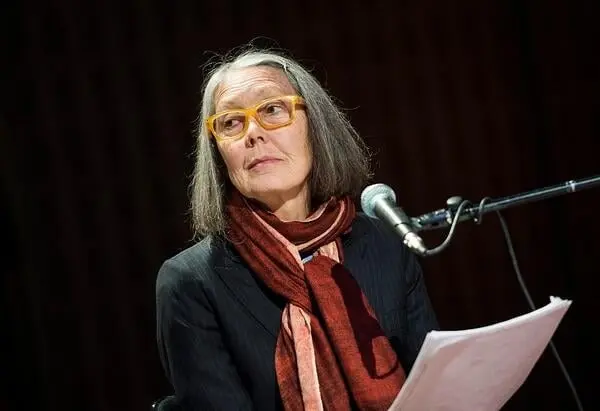
Anne Carson, the celebrated poet, essayist, and translator whose boundary-pushing works have redefined contemporary writing through a profound and playful engagement with classical antiquity, has won the 2026 Nobel Prize in Literature. The Swedish Academy announced the prestigious honor on Thursday, recognizing Carson for what it described in its official citation as a “bold and inventive oeuvre that, in playful dialogue with the classical tradition, has created new forms for contemporary literature.”
Carson’s extensive and varied body of work reflects an extraordinary range of themes and intellectual influences, drawing deeply from classical Greek and Roman literature, the pioneering modernist prose of Virginia Woolf, and the rich tapestry of her own lived experiences. Among her most widely recognized achievements is Autobiography of Red, a novel in verse published in 1998 that brilliantly reimagined the ancient Greek myth of Hercules and the monster Geryon as a modern, poignant love story. The groundbreaking book has resonated deeply with readers and critics alike, selling nearly 100,000 copies in the United States alone since its debut.
Born in Toronto in 1950, Carson has also established herself as a master translator, producing celebrated English renditions of numerous classical Greek poems and plays. Her translations have brought the emotional and dramatic power of antiquity to modern audiences, encompassing works such as Sophocles’s Electra and Antigone alongside Euripides’s Bakkhai. Through these translations and her own original creations, she has consistently bridged the gap between ancient philosophy and contemporary sensibilities.
Anders Olsson, chair of the Nobel literature committee, highlighted the unique nature of her contributions in comments to the Associated Press following the announcement. "Almost all her literary production has centered upon the intersection between the philologist’s obsession with words and the poet’s desire for new meaning," Olsson told the AP, capturing the rigorous scholarship and soaring artistic imagination that define Carson’s writing.
Carson’s path to literary acclaim is firmly rooted in a distinguished academic background. She earned her doctorate in classics from the University of Toronto in 1981, beginning a long and influential career as an educator that would take her to some of the most selective universities in both the United States and Canada. Over the decades, she has taught literature and creative writing at institutions including the University of Calgary, McGill University, the University of Michigan, New York University, and Princeton University, shaping generations of young writers and scholars.
Colleagues and administrators at the institutions where she taught were quick to express their admiration and pride following news of her Nobel win. Deborah Landau, director of New York University’s creative writing program, shared fond memories of Carson’s tenure and her profound impact on the academic community in a news release congratulating the newly minted Nobel laureate.
"The NYU Creative Writing Program was incredibly fortunate to have had the singularly brilliant and visionary writer Anne Carson on faculty for 13 years as Distinguished Writer in Residence," Landau wrote. She recalled how Carson and her romantic partner and artistic collaborator, Robert Currie, left an indelible mark on the program through their innovative teaching methods. Landau noted that the pair "famously taught a graduate workshop called ‘Egocircus,’ which allowed our M.F.A. students to collaborate with her on a range of artistic projects."
True to her unconventional spirit, Carson’s reaction to winning one of the world’s most distinguished cultural honors was characteristically understated and deeply tied to her artistic life. When Ingrid Carlberg, the permanent secretary of the Swedish Academy, managed to reach Carson by phone on Thursday to deliver the life-changing news, the author was far removed from the bustling literary capitals of the world.
"All she had time to tell me was that she is for the moment in Iceland, where she’s listening to the wind," Carlberg told reporters, painting a vivid picture of the writer in her element.
Carson, who currently lives in Iceland alongside Currie, later spoke with a local news outlet about the whirlwind of attention that instantly followed the Swedish Academy’s announcement. Describing the sudden influx of media inquiries, she noted that the initial phone conversation with Academy officials was "rather halting."
Reflecting on the international commotion caused by the prestigious award and the barrage of questions from journalists eager for her reaction, Carson offered a characteristically dry and poetic assessment of the situation.
"I think they’re all crazy," she said of the media frenzy. "They have the usual questions, and I have no answers."