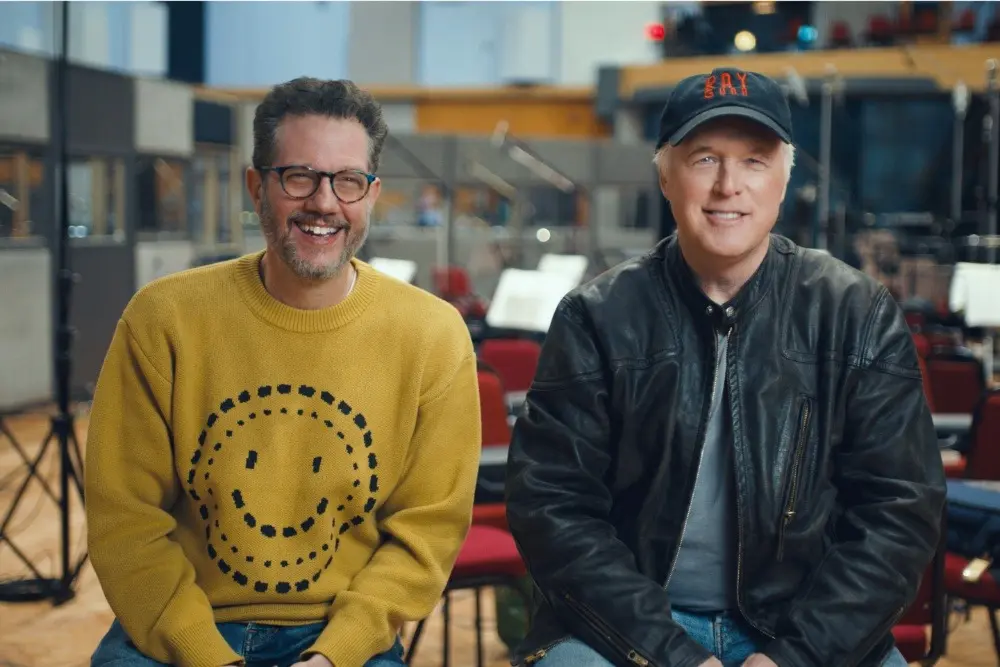
On a balmy April afternoon, the hallowed air of Abbey Road Studios’ Studio One—a space that has hosted everyone from Edward Elgar to Harry Styles—is filled with the sweeping, complex textures of a 74-piece orchestra. Violinists, cellists, flautists, and an organist are meticulously working through the score for Ray Gunn, a long-gestating feature animation from Pixar visionary Brad Bird. The iconic room, currently bathed in a vibrant “Toy Story” blue, serves as the perfect backdrop for a film that feels like a culmination of decades of creative dreaming. For Bird, the mastermind behind industry-defining hits like Ratatouille and The Incredibles, this project represents more than just another entry in his filmography; it is a labor of love that has occupied his thoughts for thirty years.
The film, which is set to premiere at the BFI London Film Festival on October 10 before a wide release on Netflix on December 18, is a Skydance Animation production. This shift away from his traditional home at Pixar is notable, marking a new chapter for the director. Leading the orchestra with surgical precision is Michael Giacchino, the Oscar-winning composer whose creative partnership with Bird has become one of the most storied collaborations in modern cinema. Ray Gunn marks their sixth project together, a professional alliance that began with 2004’s The Incredibles. For Giacchino, who took home an Academy Award for Up in 2010, this score is the product of over two decades of anticipation. “We talked about this movie during The Incredibles,” Giacchino reveals. “I’ve known about this for a very long time.”
The genesis of Ray Gunn is rooted in an unlikely source: a song. Bird explains that the idea for the film—a noir detective caper set in a “Jetsons-style” retro-future—struck him after he heard The B-52s’ song “Planet Claire.” To Bird, the track possessed a unique auditory quality that felt like a collision between the iconic, driving theme of the 1960s detective series Peter Gunn and the atmosphere of a 1950s sci-fi monster flick. “I went, ‘This is not Peter Gunn. What is this?’” Bird recalls. “And then I went, ‘It’s Ray-Gun.’ And then I went, ‘Ray Gunn: It’s a guy’s name. He’s a detective, but it’s in the future.’”
Despite this clear creative spark, the project spent years in the shadows as Bird’s career path took him through a series of high-profile assignments. Over the decades, his schedule was filled by his second Pixar project, Ratatouille, followed by The Incredibles 2, and live-action ventures such as Mission: Impossible – Ghost Protocol and Tomorrowland. During this period, he also navigated an abandoned attempt to adapt Will Eisner’s The Spirit. Bird, who describes his mind as a “big shop floor,” admits that he would frequently return to Ray Gunn to “tinker” with the concept, waiting for the right moment and the right home. The project had, at various times, been pitched to and stalled at other major studios, including Warner Bros., leaving the detective story in a state of suspended animation.

The path to completion finally opened through the Mission: Impossible franchise. After helming Ghost Protocol, which was Skydance’s second feature, the studio was reportedly pleased with the result. When the opportunity arrived to pitch a new concept to the team, Ray Gunn was the natural, long-awaited choice. The move also facilitated a professional reunion between Bird and Skydance Animation head John Lasseter.
The decision to take the film to Skydance rather than Pixar was a deliberate strategic choice by Bird. He candidly admits that he never pitched the concept to his former colleagues because he felt it fell outside the studio’s traditional “wheelhouse.” Pixar is world-renowned for its ability to cater to family audiences, and Bird was keenly aware of the brand expectations associated with the label. “If you put a Pixar label on it, people would go, ‘Oh well, it’s meant for the same audience that these other films were meant for,’” Bird explains. “And inevitably, some of them would go, ‘Well, my little Jimmy would be unhappy at this.’”
Bird views this as a systemic issue within the animation industry. He notes that while there are “10 billion animated films” produced for children, there is a distinct lack of animated content designed specifically for teenagers and adults, despite that demographic making up a substantial portion of the movie-going public. He argues that producing animated films for mature audiences “shouldn’t be a controversial decision,” yet it was a concept that frequently met resistance from the “ministers of resource allocation” at his former studio. Despite this creative friction, Bird maintains a strong relationship with his roots, as he is set to return to Pixar for a third Incredibles film.
For now, however, his focus remains on Ray Gunn. When asked about the level of involvement from Skydance CEO David Ellison, who serves as a producer on the film, Bird notes that while Ellison was very hands-on in the early stages, his focus naturally shifted as his responsibilities grew—a subtle nod to the intense corporate maneuvering surrounding Ellison’s efforts to acquire Warner Bros. Discovery. When pressed on the broader implications of Skydance’s expansion, including promises of high-volume theatrical output, Bird remains a pragmatist, steering clear of the boardroom politics. “All that stuff is beyond my pay grade,” he says.

This pragmatism has been a hallmark of Bird’s career. He reflects on his transition from the world of traditional hand-drawn animation—where he helmed The Iron Giant—to the “sexy new CG” of Pixar. He recalls that many of his former colleagues were initially frustrated by his move, viewing it as a betrayal of the craft. “And I said I don’t really care about the technology part,” Bird recounts. “I’m going up to Pixar because they protect storytelling.”
That commitment to protecting the narrative is central to Ray Gunn, which stars Sam Rockwell as the titular private investigator tasked with unraveling a complex conspiracy involving a superstar singer, Venus Nova, voiced by Scarlett Johansson. For composer Michael Giacchino, the challenge was to create a score that mirrors the film’s narrative web of intrigue without spoiling the mystery for the audience. “Probably the second toughest thing was just making sure everything was always in alignment thematically, so that I didn’t give the audience something that they shouldn’t be thinking about,” Giacchino explains. He notes that the most difficult sequence was an intimate, emotional beat between the two leads that required a precise, delicate musical touch.
Although the screenplay for Ray Gunn was written nearly thirty years ago, Bird asserts that the core themes—corporate greed, the intersection of art and technology, and the nature of human ambition—remain as relevant today as they were in the late 1990s. The script, he claims, has changed “less than you’d think” throughout its long journey to the screen.
“A lot of the things that people are saying that the film is dealing with that are contemporary right now in the headlines were in there 30 years ago,” Bird observes. “People are people and greed is greed, and the flaws of people make good subject material for films. If that’s what’s driving the story, then the story’s not going to age because it’s about eternal things rather than things that were in the news last week.” As the orchestra reaches the final crescendo in the cavernous room at Abbey Road, it is clear that Bird has finally found the right space for his noir vision to resonate.