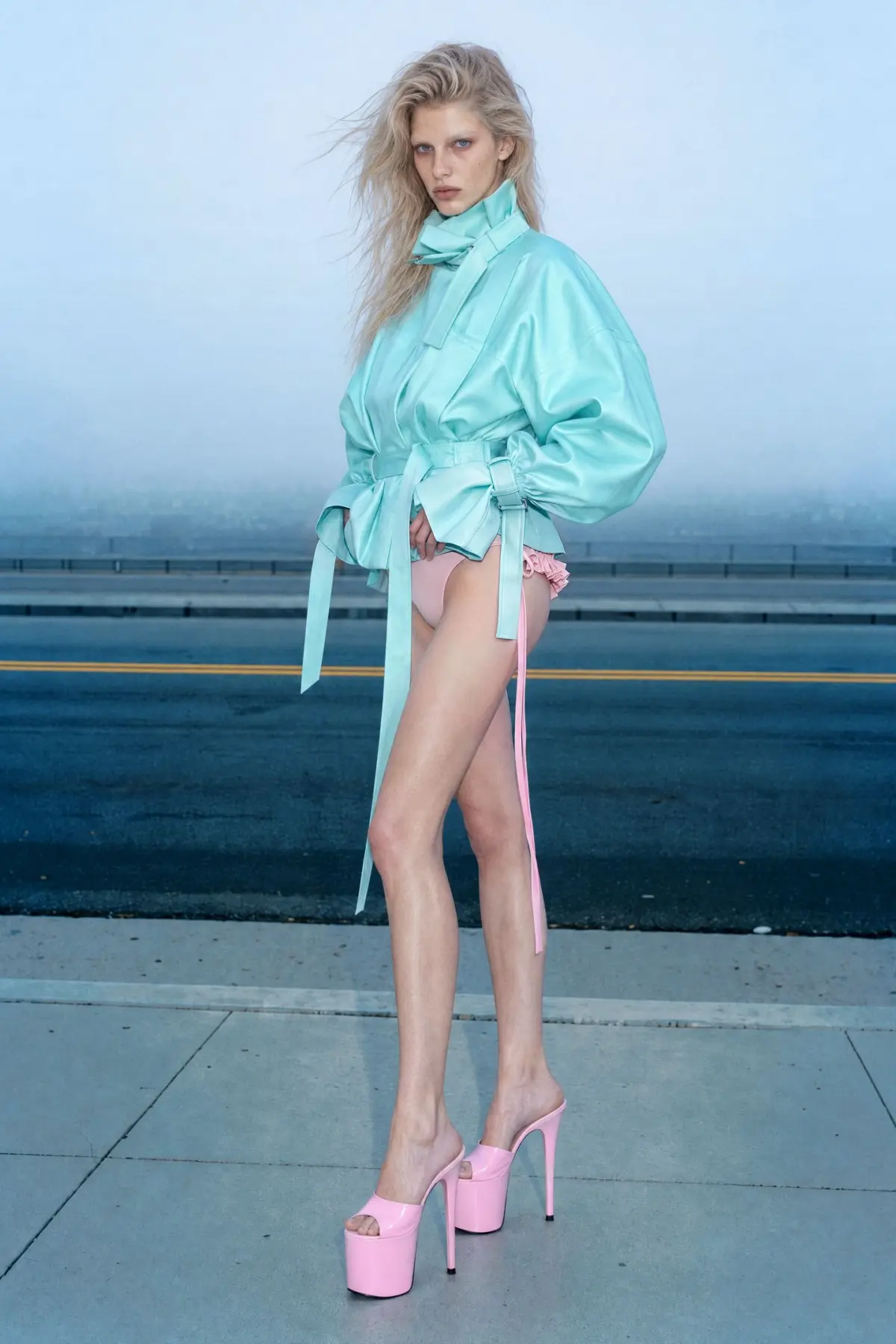
When designer David Koma sat down to conceptualize his latest collection, his thoughts began with a deliberate paradox: the idea of cool summers. This imaginative friction eventually drew him away from traditional warm-weather tropes and toward an unexpected arena of discipline, drama, and intense athletic pressure—the ice rink. Specifically, Koma found himself immersed in the fiercely competitive and theatrical world of 1990s figure skating, an environment where uncompromising athletic rigor is routinely draped in rhinestones, sequins, and a distinct brand of theatrical femininity designed to make the impossibly difficult look entirely effortless.
At the heart of this specific historical reference was Tonya Harding, not for the swirling media spectacle that historically defined her narrative in the public consciousness, but rather for a far more visceral human quality. As Koma described it, his fascination lay squarely in Harding’s undeniable "determination and rawness." This gritty tenacity provided the conceptual backbone for a Spring 2027 collection that moved with total fluidity through a traditional skater’s wardrobe. The runway presentation tracked an aesthetic journey from heavy, utilitarian warm-up layers all the way to the high-stakes rink reveal, ultimately sticking the landing with Koma’s signature design elements, including razor-sharp tailoring and delicate feather details.
The color palette deployed throughout the collection served as a crucial narrative tool, balancing opposing emotional forces to keep the garments grounded. The designer utilized a sophisticated interplay of inky black and milky ivory, which were sharply punctuated by satiny, sugary shades. This strategic juxtaposition ensured that the softer, more nostalgic elements of the collection never veered too far into the saccharine or overly sweet. Among the standout pieces was a minty blue bomber jacket featuring a technical neckline, paired dynamically with skirts that were either fringed or gathered meticulously like an everyday scrunchie. These pieces shared space on the runway with candyfloss pink knickers, sleek metallic column gowns, and sculpted, boned bodysuits that heavily abbreviated and modernized the traditional silhouettes of the sport.
As the collection unfolded, it became evident that Koma had also developed a deep fascination with compulsory figures—the painstaking, precise circles and figure-eights that skaters trace onto the ice surface and upon which they are rigorously judged. This technical and geometric obsession translated directly into the textiles and construction of the garments. One striking black minidress featured these exact concentric forms rendered meticulously in hand-beaded crystals, complete with mother-of-pearl centers that were inserted directly into the garment like fine jewelry.
These geometric shapes were not confined to a single dress; they appeared elsewhere across the collection as sharp hipbone cutouts that bloomed outward with cascading fringe, or as hidden internal metal constructions. These internal frameworks were engineered to pull and gather fabric tightly around the body, successfully capturing and echoing some of that high-octane showtime dynamism native to competitive ice skating. Even when garments were entirely at rest, they seemed to vibrate with stored energy. A succession of evening gowns and skirts relied on internal boning that extended gracefully away from the body, providing structural support for shimmering layers of silk fringe and extravagant feather plumes.
Explaining the philosophy behind these kinetic designs, Koma noted his desire to animate the wearer and establish a genuine sense of organic movement. It was an elegant, thoughtful way to translate the intense centrifugal force of skating into high fashion.
Beyond the theater of the runway and the closure of the imaginary rink, the presentation signaled a broader, more strategic shift for the brand: a concerted effort to give the David Koma woman a richer, more versatile life far beyond the traditional confines of the red carpet. While the collection certainly retained the high-glamour hallmarks that have long defined the designer’s aesthetic, these elements were increasingly embedded into everyday ready-to-wear separates, versatile knitwear, and thoughtful layering pieces.
Koma spoke candidly about his ambition for the collection, expressing a desire for the wearer to experience his distinctive world seamlessly across a wide variety of different categories and everyday occasions. Despite this expansion into more wearable territory, the core proposition of the brand remained firmly intact, championing glamour as a distinct and formidable form of strength. Reflecting on the evolving identity of his customer base and the challenge of pinning down a singular aesthetic, the designer noted that it is becoming increasingly difficult to definitively outline the exact parameters of the David Koma woman. For Koma, however, this ambiguity is not a flaw, but an exciting evolution, as he watches characters across the world interpret and translate his vision in their own unique ways.