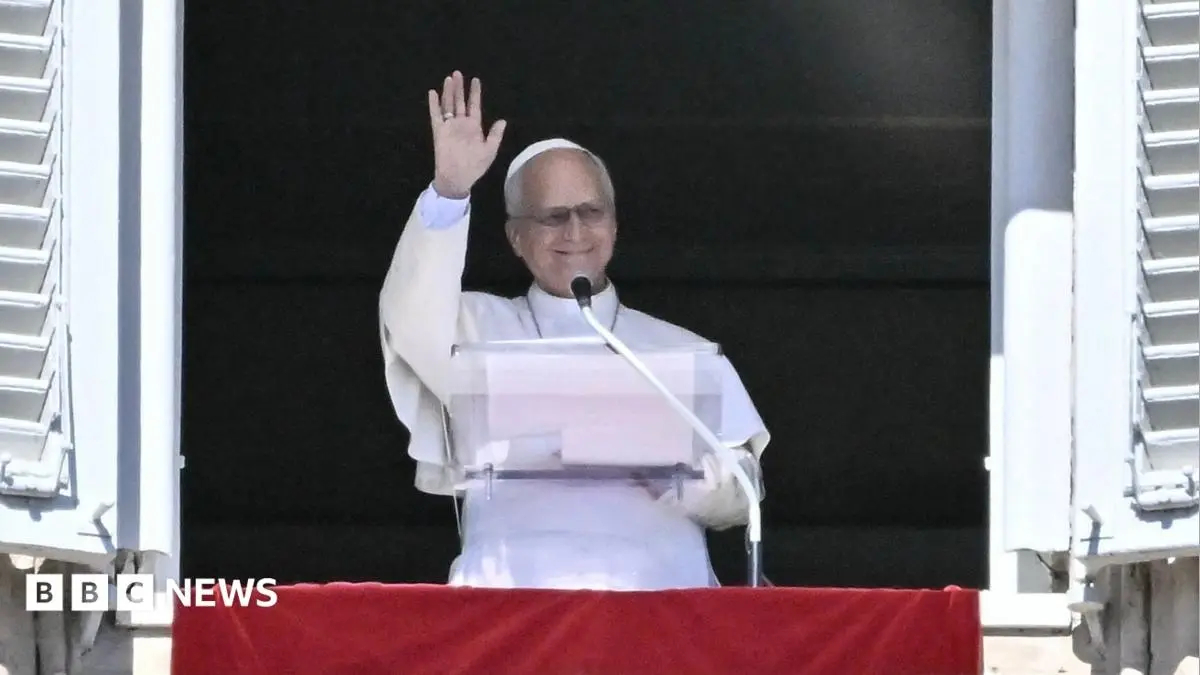
Pope Leo XIV has announced that he will undergo a surgical procedure in the coming days after a routine medical examination revealed the presence of a nodule on his lung. The 71-year-old pontiff shared the news personally during his weekly Sunday Angelus prayers, addressing the faithful gathered in St Peter’s Square in Rome.
In a calm and direct address, the Pope explained the nature of his diagnosis to the pilgrims and tourists assembled before him. "The doctors found an early, well-localised nodule on my lung," he stated. He emphasized that his medical team, after careful assessment, concluded that "it would be right to intervene." The Pope confirmed that he has consented to the procedure, while offering words of reassurance to the global Catholic community that the mass was "well-contained" and identified at a very early stage, which medical professionals generally regard as a positive indicator for treatment outcomes.
The news of the impending surgery comes as a significant development for the Vatican, occurring roughly eighteen months after the pontiff succeeded the late Pope Francis. The transition of the papacy to Leo XIV—born Robert Francis Provost—marked a historic moment for the Church, as he became the first United States citizen to occupy the throne of St Peter. Given the previous pontiff’s well-documented struggles with respiratory health, which required several hospitalizations during his tenure, the Vatican is acutely sensitive to matters concerning the lung health of its leaders.
As the Angelus prayer concluded, the Pope expressed his profound gratitude to the global community for their "spiritual closeness." He asked for the continued prayers of the faithful, a request that was met with a chorus of support from the crowd in the square.
Following the public announcement, Holy See Press Office spokesman Matteo Bruni provided further technical details regarding the timeline of the procedure. Mr. Bruni confirmed that the surgery is scheduled for the early days of the upcoming week. He added that the medical team anticipates a recovery period of approximately one week, during which time the Pope will remain under observation at the Gemelli Hospital in Rome.
The Gemelli Hospital has long served as the primary medical facility for the papacy. It is home to a specialized Papal suite, a facility that has been maintained and upgraded since it was first established following the failed assassination attempt on Pope John Paul II in May 1981. The suite is designed to accommodate the unique security and logistical requirements of a sitting Pope, allowing him to recuperate while maintaining a level of continuity in his duties.
The announcement of the surgery has prompted a wave of well-wishes from global leaders, underscoring the Pope’s significant influence on the international stage. Italian Prime Minister Giorgia Meloni was among the first to voice her support, expressing her "personal solidarity" with the pontiff as he prepares to "face the ordeal ahead in the coming days." Her sentiments were echoed by the President of the Italian Republic, Sergio Mattarella, who issued a formal statement offering his "sincerest wishes for a peaceful recovery and a speedy and full return to health."
Beyond Italy, the message of support has been truly international. Isaac Herzog, the President of Israel, joined the chorus of world leaders by wishing the pontiff a "full and speedy recovery," reflecting the diplomatic importance of the Vatican’s engagement with global affairs.
The Pope’s personal history offers context for his current role and his approach to his health. Born Robert Francis Provost, he is the 267th leader of the Catholic Church. His background is distinct from his predecessors, defined largely by his decades of service as a missionary in Peru. During his time in South America, he earned a reputation as a compassionate advocate for marginalized and impoverished communities, a period of his life that continues to shape his pastoral priorities today. He was ordained in 1982 and spent much of his career working in the field before his elevation to the papacy.
Despite the necessity of the surgery, the Vatican has signaled that the Pope’s official schedule remains largely intact. During his Sunday service, the pontiff confirmed that his upcoming apostolic journey to Uruguay, Argentina, and Peru, scheduled for November, will proceed as planned. This determination to maintain his international commitments has been welcomed by local church leaders in the region. The Archbishop of Montevideo, Daniel Sturla, noted that preparations for the papal tour will continue with "greater enthusiasm," while simultaneously calling on the faithful to keep the Pope’s health in their prayers throughout his recovery.
Medical experts note that the identification of a lung nodule is a relatively common occurrence in modern diagnostic medicine. According to the National Health Service (NHS), a lung nodule is a small, often circular, lump of tissue that is frequently detected incidentally during an X-ray or CT scan of the chest conducted for other reasons. Because such nodules are often asymptomatic, they are frequently caught during routine screenings, which often leads to more favorable clinical outcomes. The medical community emphasizes that the majority of these nodules do not cause symptoms, and their early detection is often the result of proactive health monitoring.
As the Vatican prepares for the week ahead, the atmosphere remains one of measured optimism. The efficiency of the communication from the Holy See, combined with the professional reputation of the medical staff at Gemelli Hospital, has served to temper concerns among the public. The focus remains on the surgical procedure and the subsequent period of rest, with the Vatican press office promising to provide updates on the Pope’s progress as appropriate.
For now, the thousands of pilgrims who visit St Peter’s Square daily continue to offer their support, standing in solidarity with a leader who, even in the face of his own health challenges, remains focused on his upcoming pastoral responsibilities in South America. The days following the surgery will be characterized by a period of quiet, as the Pope transitions from the public eye to the controlled environment of the hospital. For the Vatican, this represents another chapter in the life of the 267th pontiff, a man whose journey from a missionary in Peru to the head of the global Church continues to be marked by a deep commitment to both his faith and his duties.
As the international community awaits further news, the prevailing sentiment remains one of hope for a successful intervention and a swift return to the duties of the Holy See. The Pope’s own transparency regarding his condition has been praised by observers as a sign of his modern approach to the papacy, ensuring that the faithful are kept informed and involved in the life of the Church, even during times of personal difficulty. The upcoming surgery, while a significant event, is viewed by both his medical team and the Vatican administration as a manageable hurdle in the broader context of his papacy and his mission.