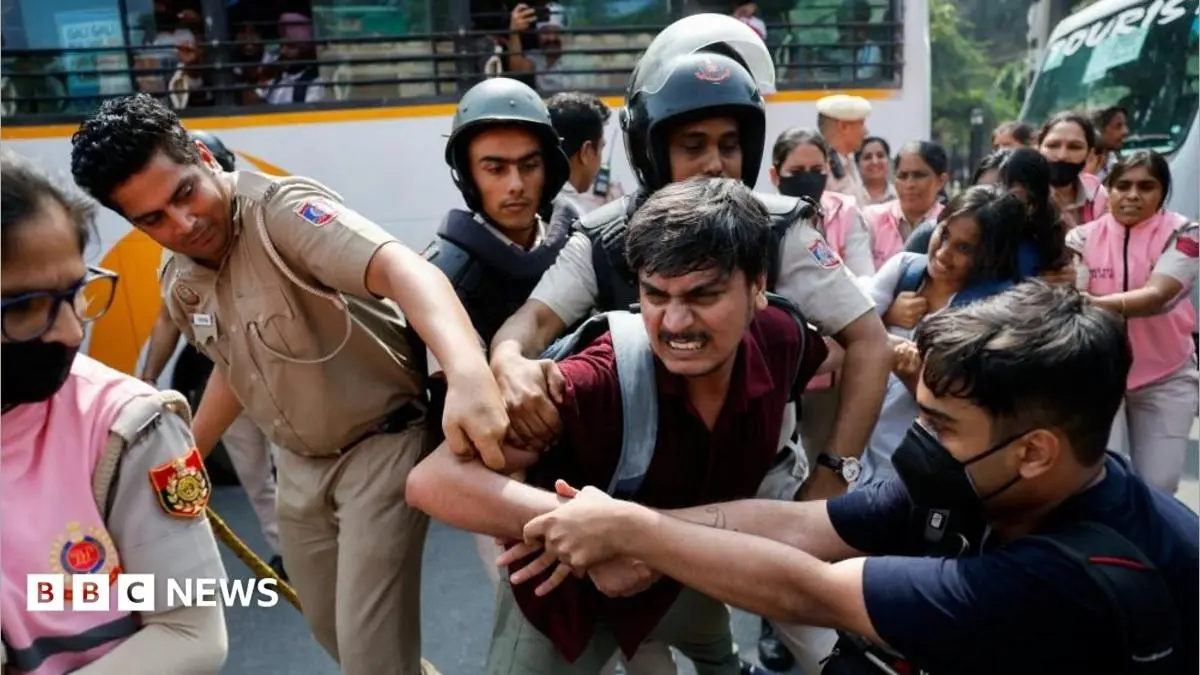
Hundreds of protesters were detained in Delhi on Saturday as the Gen-Z led political movement known as the "Cockroach Janta Party" (CJP) attempted to stage a demonstration demanding sweeping electoral reforms. The capital city saw an unprecedented security lockdown, with tens of thousands of security personnel deployed and critical transit infrastructure shuttered, as the administration moved to suppress a protest it had explicitly refused to authorize.
The movement, which has gained significant traction among India’s youth, was founded by activist Abhijeet Dipke in May. The party’s provocative name stems from a controversial remark made by India’s Chief Justice, who had likened jobless young people to "cockroaches." Rather than shying away from the pejorative, the movement adopted it as a badge of defiance, framing their struggle as a grassroots challenge to systemic apathy and political exclusion.
The tension reached a breaking point on Saturday morning when the CJP’s leadership, including founder Abhijeet Dipke and fellow organizers Saurav Das and Ashutosh Ranka, were detained by police immediately upon landing in Delhi from Mumbai. Sources within the movement reported that the trio were whisked away to an undisclosed location, a move that sparked immediate outrage among supporters already gathering across the city. The Delhi Police have remained silent regarding the whereabouts of the leaders and the specific legal grounds for their detention.
A Capital Under Siege
In the hours leading up to the planned demonstration at Jantar Mantar—the historic protest site in the heart of the capital—Delhi was effectively paralyzed. Authorities implemented a massive security cordon, barricading roads and restricting movement to prevent the gathering from taking place.
Despite the denial of formal permission for the protest, the CJP had signaled its intent to proceed, framing the demonstration as a critical stand for the sanctity of India’s democratic processes. However, the sheer scale of the police deployment rendered the planned assembly point largely inaccessible. Announcements blared across the city, urging citizens to cooperate with security forces, while the closure of numerous metro stations and the cancellation of several trains disrupted the lives of thousands of commuters, creating an atmosphere of palpable anxiety throughout the capital.
The police response was systematic and swift. Throughout the day, buses were seen ferrying away groups of detained protesters who had attempted to reach the protest site. Among those caught in the sweep was student activist Neha Bora, who, prior to her detention, issued a defiant call to action. "Hold the line," she urged her fellow demonstrators, emphasizing the urgency of their cause.
Allegations of Electoral Manipulation
The CJP’s grievances are rooted in the upcoming state elections, which the group argues are being jeopardized by a lack of transparency in the electoral process. Central to their platform is the demand for the resignation of Chief Election Commissioner (CEC) Gyanesh Kumar. The movement, alongside various opposition parties, has leveled serious allegations against Kumar, accusing him of facilitating the manipulation of voter lists to favor the ruling Bharatiya Janata Party (BJP).
The controversy centers on a massive nationwide exercise undertaken by the Election Commission to update electoral rolls. The Commission has maintained that this is a standard, routine procedure designed to identify and remove dead, duplicate, or ineligible voters from the registry. However, in several states, the exercise has become a flashpoint for public anger. Tens of thousands of citizens have reported that their names were removed from the rolls without explanation, leading to claims of widespread disenfranchisement.
Critics of the Election Commission argue that the patterns of deletion are not random, suggesting that the process has been weaponized to weaken the opposition’s voter base. The CJP, while not a formally registered political party, has emerged as a vocal critic of this perceived bias. Both the Election Commission and the BJP have categorically denied these allegations, dismissing them as politically motivated attempts to undermine the credibility of India’s electoral institutions.
The Spirit of Defiance
The detention of the CJP leadership has done little to dampen the resolve of its supporters. In the vacuum left by the arrest of Dipke, Das, and Ranka, Ajinkya Shinde has stepped forward as the group’s designated spokesperson. In a video message circulated widely on social media, Shinde issued a rallying cry to the movement’s followers, declaring, "If Delhi Police tries to stop you, wherever they stop you will become your Jantar Mantar."
This sentiment reflects the broader ethos of the CJP—a movement that seeks to redefine the nature of political dissent in India. For many young protesters, the act of showing up in the face of imminent detention is a personal statement of commitment to the nation’s future.
Sabika Muzaffar, a protester who spoke with the BBC shortly before her own detention, described the harrowing reality of participating in the demonstration. "On the way to the protest site, instead of reciting hymns and verses as we usually do, my mother and I were rote learning our lawyer’s number," she said. Despite the clear and present danger, Muzaffar expressed no regret. "Showing up to protest is my way of defending the country and its democracy," she asserted, moments before being taken into police custody.
An Uncertain Path Forward
The crackdown in Delhi underscores a growing polarization regarding the health of India’s democratic institutions. As the state elections loom, the CJP’s struggle highlights a deepening divide between the government’s assertion of institutional integrity and the youth-led movement’s demand for greater accountability.
For founder Abhijeet Dipke, the threats of incarceration have served only to solidify his resolve. Before his departure for Delhi, he had challenged the authorities, stating, "If you think you can stop us by threatening us with jail or trying to intimidate us with the fear of imprisonment, you are mistaken."
As the sun set on a city under heavy guard, the situation remained fluid. With key leaders in detention, mass arrests continuing throughout the day, and the core demands of the protesters left unaddressed, the movement faces a critical juncture. The CJP’s insistence that their cause transcends the physical location of a protest site suggests that the conflict over electoral integrity is unlikely to dissipate simply because the streets of Delhi have been cleared.
The events of the day have left both the government and the activists in a standoff. While the authorities have demonstrated their capacity to maintain order through restrictive measures, the persistence of the CJP and the support it has garnered among the youth signal that the underlying issues regarding voter lists and institutional transparency will continue to be a defining feature of the political discourse leading up to the state polls. Whether the government will engage with these concerns or continue its current strategy of containment remains to be seen, but for the hundreds detained, the struggle for what they define as a free and fair democratic process has clearly only just begun.