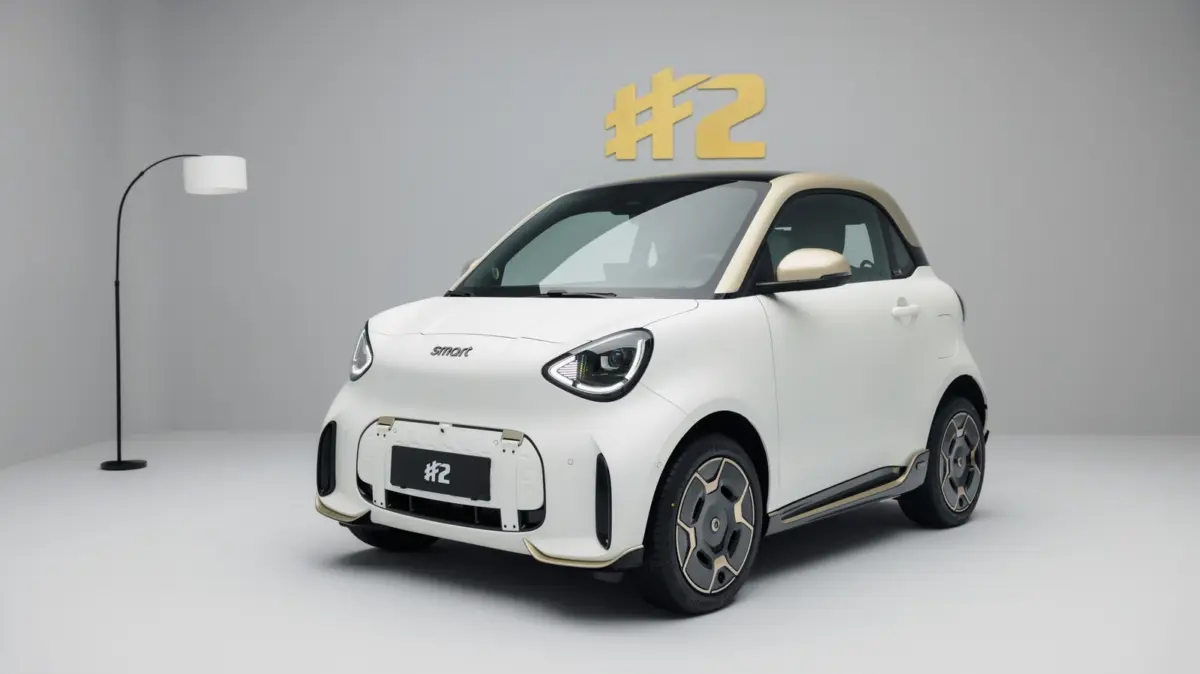
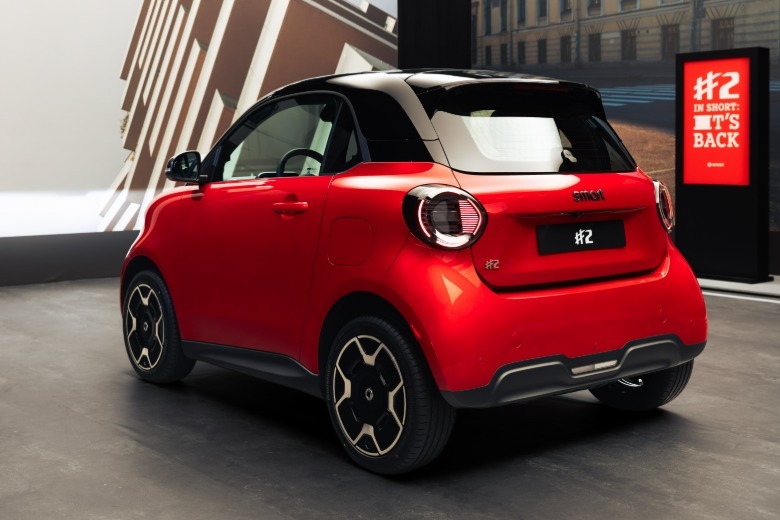
The Smart Car is officially back, carrying forward a legacy of ultra-compact urban mobility with a thoroughly modern, all-electric twist. Following a prolonged series of teasers, prototype testing glimpses, and design previews stemming from the joint venture between Geely and Mercedes-Benz, the production-spec Smart #2 has finally made its global debut at the Paris Motor Show. Formally pronounced "hashtag two," the production model remains strikingly faithful to the concept vehicle initially unveiled earlier this year. With its soft edges, rounded proportions, and distinctive lighting elements, the micro-EV looks like a playful puffer fish of a car—and it represents precisely the kind of thoughtful, space-efficient transportation that could transform densely populated urban landscapes if adopted on a massive scale.
Styled under the direct guidance of Mercedes-Benz design teams, the #2 succeeds in honoring its iconic predecessor, the original Smart Fortwo, while forging its own contemporary path. While it drops the manic smile and impish eyes of the earliest Fortwo generations, overall design traits such as the signature roof profile, the compact stance, and the box-within-a-box proportions evoke a strong sense of nostalgia. Most notably, the classic Fortwo split tailgate—a clever utility feature typically reserved for much larger utility vehicles and premium SUVs—has been successfully integrated into the rear design of the new #2. By combining these retro styling cues with a prominent debut in Paris, Smart is deliberately drawing a direct historical line from the original Fortwo introduced at the Louvre decades ago to this new zero-emission city car.
The splitgate is back!
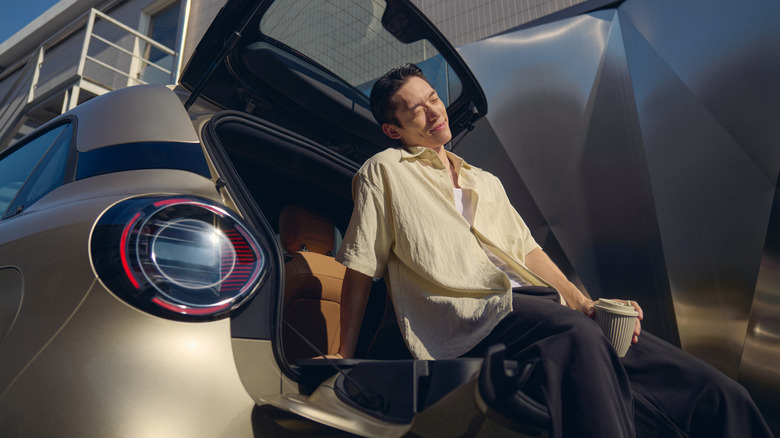
The signature split tailgate serves as one of the defining exterior highlights of the new Smart #2, flanked by rounded rail-style taillights that sweep inward toward the center. This lighting arrangement naturally directs the observer’s attention toward the rear hatch, which Smart explicitly encourages owners to use as a makeshift bench when parked. According to official specifications, the lower section of the splitgate is engineered to support up to 264 pounds, provided the vehicle is completely stationary. The automaker emphasizes that this feature is strictly meant for resting while parked, serving as a casual seating area rather than a dynamic load-bearing platform.
The rear-three-quarter views emphasize the vehicle’s tidy dimensions, while the interior cabin introduces a few quirky surprises of its own. Inside, the production #2 inherits the front bench seat configuration first seen on the concept vehicle. However, the center section of the bench is notably narrow and lacks a dedicated seatbelt, functioning primarily as an aesthetic centerpiece designed to house an integrated armrest and dual cup holders. While the omission of a functional middle seatbelt limits its practicality for transporting an extra passenger through the city, the absence of a traditional center console or physical gear shifter leaves the floor remarkably open, maintaining an airy feel across the front row.
Ahead of the driver sits a slim, pill-shaped digital instrument cluster complemented by a prominent central touchscreen interface. Physical controls have been kept to a functional minimum, though designers incorporated tactile round air vents, intricately styled steering wheel button clusters, and circular door panels featuring oversized grab handles that give the cabin a distinct personality.
Couture
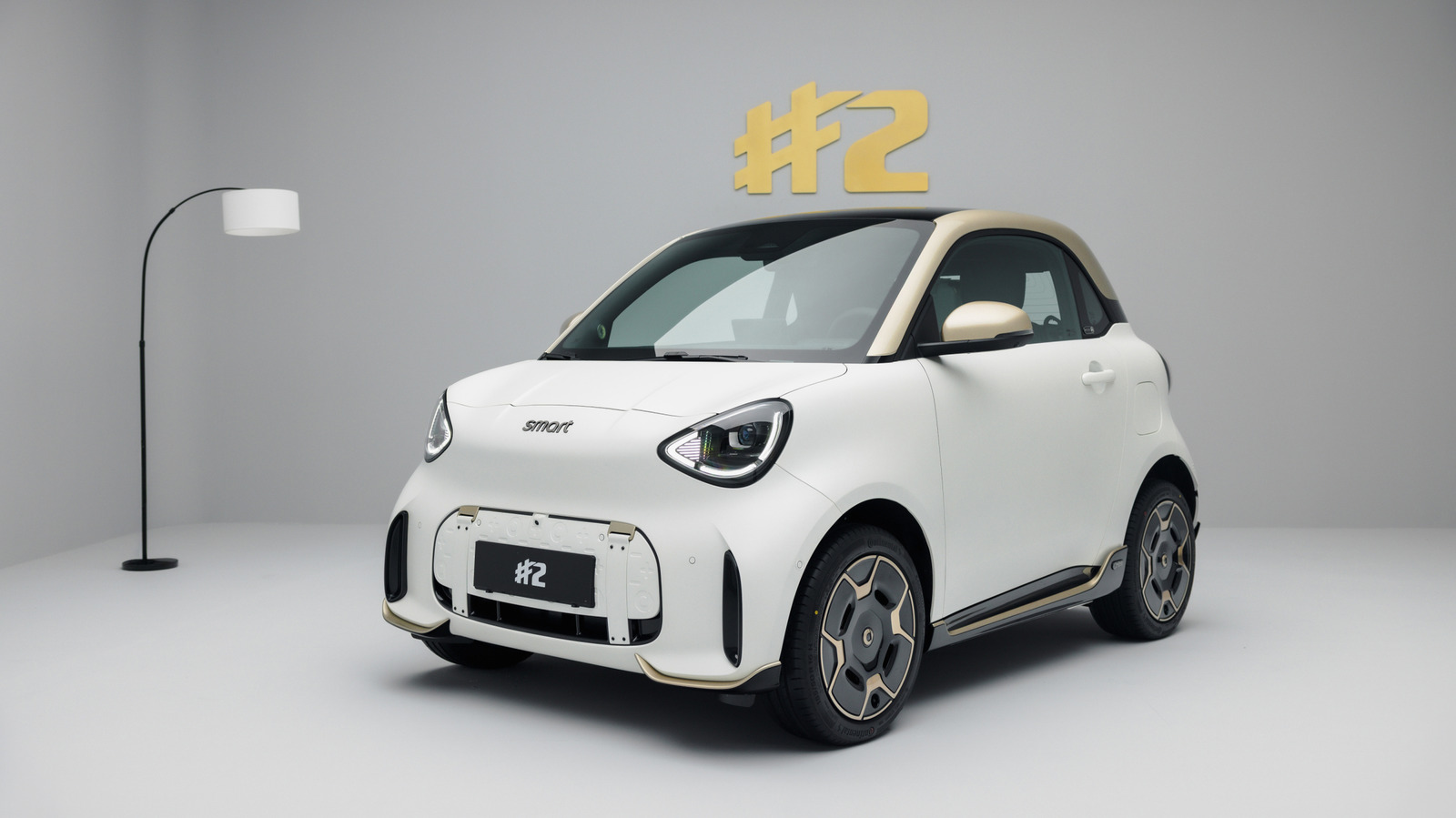
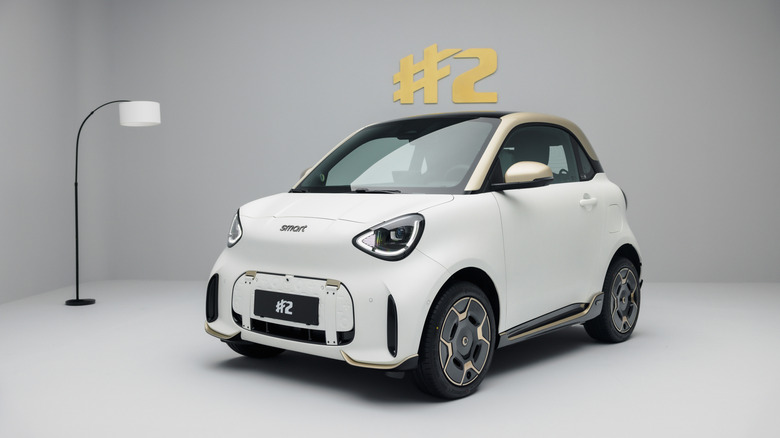
Complementing the standard production lineup, Smart also pulled the covers off an exclusive Couture Edition of the #2. This limited-run variant will be strictly capped at 999 units for the European market and another 999 units for China. Finished exclusively in a pristine white paint scheme, the Couture Edition features contrasting gold detailing applied across the roof pillars, alloy wheels, and lower body accents. Adding an extra layer of eccentric luxury, the exterior styling incorporates a unique grille design adorned with straps reminiscent of high-end travel luggage—an aesthetic flourish that leans boldly into the absurd.
Beneath the playful exterior and fashion-forward trim pieces, Smart has detailed the technical specifications that underpin the vehicle. Measuring just 108 inches in overall length, the #2 is shorter than a first-generation Mazda Miata and only marginally longer than the most recent generation of the traditional Fortwo. Power is supplied by a rear-mounted electric motor generating 80 horsepower and 96 pound-feet of torque directed strictly to the rear wheels.
For the European market, the vehicle is equipped with a 35.8-kWh battery pack. Smart estimates this setup will deliver a driving range of up to 180 miles under the Worldwide Harmonised Light Vehicle Test Procedure (WLTP). Furthermore, the electrical architecture supports rapid DC fast-charging capabilities, allowing the battery to replenish from 10 percent to 80 percent capacity in just 20 minutes. These performance metrics make the vehicle well-suited for navigating congested metropolitan areas across Europe and China.
Despite its clear appeal for narrow streets and tight parking spaces, the Smart #2 has not been confirmed for the United States market. Automakers have not announced plans to bring the micro-EV to American shores, and industry expectations suggest it will remain overseas. With order books officially open in China and Europe, drivers elsewhere are left to observe from afar as urban centers across the pond gain access to a new generation of purpose-built city EVs.