
If you live in the United States, you may notice the inherent subjectivity of that first word: "united." When it comes to the rules of the road—specifically the practice of left-lane camping, where drivers cruise slower than prevailing traffic and force faster motorists to pass on the right—the states are far from unified. This behavior is not merely an annoying habit that frustrates fellow commuters; in many jurisdictions, it is explicitly unlawful. The enforcement efforts can be substantial, as evidenced by Colorado, which issued 2,540 tickets to drivers in 2025 alone for camping out in the leftmost lane.
Yet, defining what constitutes unlawful left-lane camping remains surprisingly complicated, largely because regulations vary dramatically across state lines. Even within a single state, the legal framework can present confusing contradictions. In Colorado, for example, it is technically illegal to remain in the leftmost lane if you are not actively passing on roads posted with a speed limit of 65 mph or higher. However, an important exception applies: if that left lane is designated for high-occupancy-vehicle (HOV) use, a driver legally avoids the "camper" classification. Consequently, camping in Colorado—at least in the context of highway traffic—is a heavily qualified condition rather than a straightforward prohibition.
Cross the border from Colorado into Arizona, and the legal definition shifts entirely. According to Arizona state law, a camper is defined simply as someone driving "at such a slow speed as to impede or block the normal and reasonable movement of traffic." Noticeably absent from this definition is any specific reference to the posted speed limit; the statute is instead designed around the overarching principle of keeping traffic moving fluidly. According to data compiled by AAA, most states enforce similar limitations, requiring motorists to keep right and reserve the left lane exclusively for passing, merging, or preparing to exit. Outside of those specific actions, lingering in the lane often lands a motorist in the category of a left-lane camper—or so the theory goes, depending entirely on where your vehicle crosses the state line.

Let ’em merge
The confusion deepens when examining how different states handle highway merging and HOV designations. In Washington State, Montana, and Pennsylvania, the law explicitly permits motorists to move into the left lane specifically to allow another vehicle to merge safely onto the highway. While this makes immense practical sense from a traffic management perspective, it is not universally codified across the country, according to comprehensive surveys of state laws compiled by MIT researchers. Furthermore, Washington shares Colorado’s approach regarding HOV lanes, making a clear statutory distinction that preserves the leftmost lane’s primary purpose while carving out exceptions for multi-occupancy vehicles.
Even more intriguing are the states that take a more permissive stance on left-lane cruising. Alaska, Maryland, North Carolina, and Ohio all maintain regulations that permit left-lane camping under certain conditions. In Alaska, the law dictates that a driver must either match the speed limit or move over. Maryland enforces a threshold where motorists poking along at 10 mph or more below the speed limit are required to slide over to the right. North Carolina aligns closely with the Alaskan mandate, requiring drivers to move right if they are not maintaining the maximum authorized speed limit.
Ohio, meanwhile, takes a notably eccentric approach. State law permits left-lane camping as long as the driver maintains the prevailing speed limit. If they are traveling slower than that, however, they are only required to yield when being overtaken, provided the faster vehicle gives an "audible signal"—presumably involving the trailing driver tapping on their horn before attempting a pass. North Carolina similarly mentions an audible signal in its historical statutes, prompting questions about why these state legislatures seemingly overlooked the invention of the automobile horn as a standard communication tool.

These regulatory discrepancies highlight why left-lane lingering remains a perennial source of friction. According to transportation studies, improper lane usage ranks consistently among the driving habits guaranteed to provoke universal annoyance on public roadways. Yet, the legal recourse available to frustrated drivers behind a left-lane camper is remarkably restricted, with formal retaliation or alternative passing maneuvers legally sanctioned in only a select group of states.
Pass on the right — where it’s legal
For motorists accustomed to the foundational driver’s education rule that passing on the right is strictly forbidden, several states present a surprising exception. In Maryland, Minnesota, New York, New Hampshire, Utah, Wyoming, and Tennessee, passing on the right is entirely legal under specific circumstances. These permitted conditions often include navigating roads with a designated left-turning lane, but they also extend to any highway featuring two or more lanes traveling in the same direction.
Consider the legal language in New York State, where nothing in the statute appears to restrict motorists from bypassing a slow-moving left-lane vehicle on the right while traveling on the interstate. The state’s vehicle and traffic laws explicitly outline the conditions where right-lane passing is authorized, noting that it is permissible upon any street or highway with unobstructed pavement of sufficient width to accommodate two or more lines of moving vehicles in each direction, provided the space is not occupied by parked vehicles.
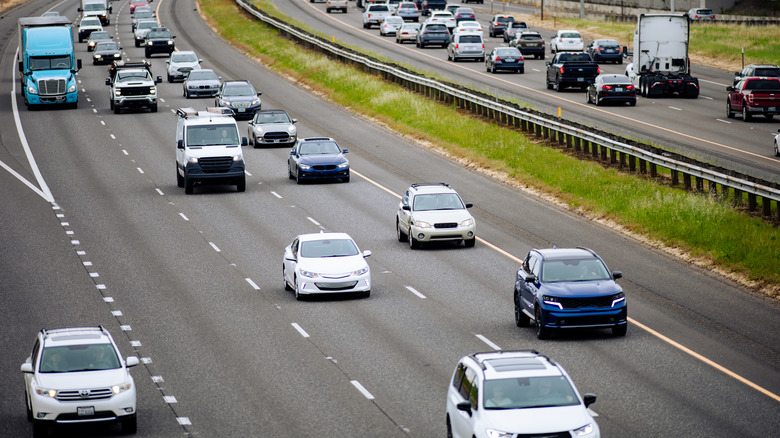
The New York State Department of Motor Vehicles driver’s manual reinforces this provision, stating plainly that motorists may execute a pass on the right as long as they abide by the broader statutory framework. Whether drivers choose to incorporate this maneuver into their routine strategies for avoiding traffic delays or circumventing highway bottlenecks where right-lane passing is technically legal remains another matter entirely. As regulations continue to vary widely from one jurisdiction to the next, navigating America’s multi-lane highways requires as much an understanding of geography as it does adherence to the rules of the road.