Featuring works by Yiyun Li, Eugene Debs, Bonnie Garmus, Lieke Marsman, and More
Navigating the bustling literary landscape can often feel overwhelming for even the most dedicated bibliophiles, but literary tracking platforms continue to offer a reliable compass. Brought to you by Book Marks, the premier destination for book reviews from Lit Hub, the latest weekly roundup highlights a diverse array of fiction and nonfiction titles that have captured the critical imagination. From bewitching, complex novels exploring the fragile lives of musical virtuosos to profound historical deep dives and searing critiques of modern scientific claims, this week’s selection showcases some of the most critically acclaimed releases making waves across major cultural publications.
Fiction
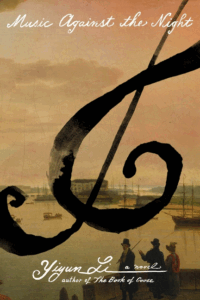
1. Music Against the Night by Yiyun Li (Farrar, Straus and Giroux)
Critical Reception: 6 Rave, 2 Positive, 2 Mixed
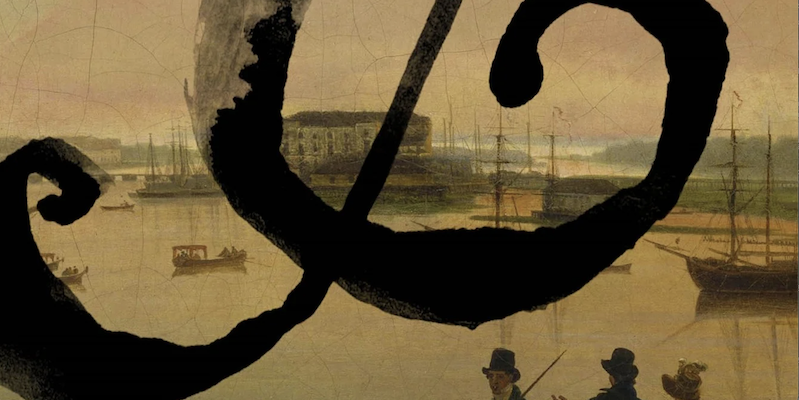
Leading the fiction category this week is Yiyun Li’s latest novel, Music Against the Night, published by Farrar, Straus and Giroux. The book has drawn widespread critical acclaim, securing six rave reviews alongside two positive and two mixed notices. Reviewers have been quick to praise Li’s distinctive narrative prowess and her ability to handle intricate emotional territory.
Writing for The Boston Globe, critic Cory Oldweiler described the novel as "wonderful and bewitching," noting that Li is "in complete command of her complicated, probing narrative here." Oldweiler further emphasized the rare nature of the work, calling it "the kind of sui generis novel that doesn’t come around that often, just like the virtuosos whose young lives it explores." Through meticulous prose and a deeply probing structure, Li’s latest offering cements her reputation as a master of contemporary psychological depth and narrative complexity.
2. Peck & Peck by Bonnie Garmus (Scribner)
Critical Reception: 4 Rave, 4 Positive
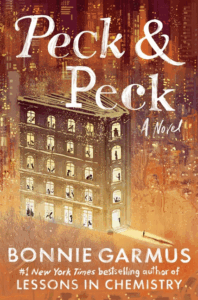
Following closely behind is Bonnie Garmus’s highly anticipated new work, Peck & Peck, published by Scribner. Garmus, who previously captured international audiences with her bestselling work, returns with a novel that has earned four rave reviews and four positive notices from critics.
In a review for The Guardian, Claire Clark praised the author’s distinct comedic and imaginative sensibilities. "It is impossible not to be beguiled by Garmus’s irrepressible humor and the freewheeling exuberance of her imagination," Clark wrote. She added that it is "hard to imagine a novel with more laugh-out-loud jokes about typography, harder still to dismiss her fierce exhortation to all of us to make words count." Garmus’s signature wit and engaging narrative style continue to resonate deeply with both reviewers and readers alike.
=3. Solace House by Will Maclean (Grove)
Critical Reception: 5 Rave, 2 Positive
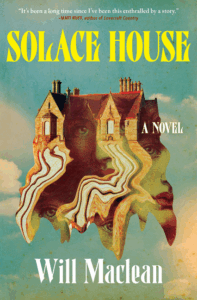
Sharing the third spot in fiction is Will Maclean’s unsettling and ambitious novel, Solace House, published by Grove. The book has struck a chord with critics, garnering five rave reviews and two positive notices for its atmospheric depth and intellectual rigor.
Drawing comparisons to modern dark academia classics, Julia Kelly of The Irish Times noted that the book features "faint echoes of Donna Tartt’s The Secret History: a close-knit group of students become increasingly absorbed by esoteric ideas that reshape their understanding of the world." Kelly went on to highlight the book’s immersive pacing, pointing out that although it spans more than 500 pages, Solace House "sustains its atmosphere with remarkable consistency. Thoughtful, unsettling and ambitious, it is less interested in delivering conventional scares than in evoking a slow, disorientating collapse of reality itself."
=3. Luna, Phoenix, Queen by Julie Orringer (Knopf)
Critical Reception: 5 Rave, 2 Positive
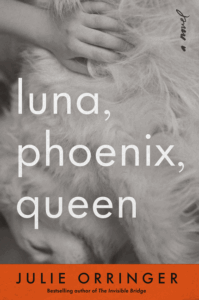
Tied with Maclean is Julie Orringer’s Luna, Phoenix, Queen, published by Knopf. This powerful narrative has similarly earned five rave reviews and two positive notices, establishing itself as a major highlight of the publishing season.
Writing for The New York Times Book Review, acclaimed author Meg Wolitzer offered high praise for the novel, describing it as "astonishing." Wolitzer noted that Luna, Phoenix, Queen "brilliantly emphasizes the agony of isolation in its various forms, and the relief that can only come in telling a story for oneself." Orringer’s sharp psychological insights and evocative storytelling continue to earn her widespread literary acclaim.
5. The End of Everything by M. John Harrison (Riverhead)
Critical Reception: 4 Rave, 1 Positive
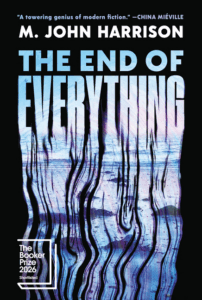
Rounding out the fiction list is M. John Harrison’s The End of Everything, published by Riverhead. The novel has secured four rave reviews and one positive notice, distinguishing itself as a work of uncompromising originality.
In his review for The New York Times Book Review, Dave Kim characterized the book as "a fascinating, sometimes frustrating and thoroughly original new novel." Kim praised Harrison’s distinct literary approach, describing the work as "a masterly exercise in restraint, unsettling beauty and elliptical writing that can enlighten even when it obfuscates." He concluded that this "grim but powerful book portrays the many incompatible states of existence, and the baffling collapse of time, that stem from extreme crises."
Nonfiction
1. On Another Planet They Can Save Me by Lieke Marsman (Catapult)
Critical Reception: 4 Rave, 1 Positive
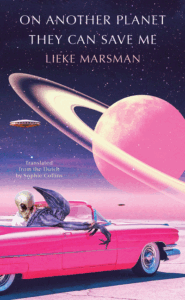
Topping the nonfiction selections this week is Lieke Marsman’s On Another Planet They Can Save Me, published by Catapult. The book has received high praise from critics, securing four rave reviews and one positive notice for its profound philosophical inquiries and emotional resonance.
In a review highlighting the book’s unique perspective, Publishers Weekly described the work as "cathartic and often wondrous," adding that "witnessing her altered mind grapple with some of humanity’s most sweeping questions is an undeniable pleasure." Marsman’s ability to weave personal reflection with universal existential themes has positioned the book as a standout nonfiction release of the season.
=2. American Socialist: The Life and Legacy of Eugene V. Debs by Shawn Gude (Simon & Schuster)
Critical Reception: 3 Rave, 2 Positive
Sharing the second spot in nonfiction is Shawn Gude’s exhaustive biographical study, American Socialist: The Life and Legacy of Eugene V. Debs, published by Simon & Schuster. The biography has earned three rave reviews and two positive notices from critics who have lauded its meticulous research and engaging narrative drive.
Writing for Jacobin, Matthew E. Stanley commended the book’s accessibility and intellectual depth, calling it a "charmingly penned and prodigiously researched study [that] both refreshes familiar stories and prods readers to reconsider common assumptions." Stanley further praised the volume as "a page-turning delight, American Socialist is an engaging and valuable tool for anyone who seeks to win a world where that kind of freedom reigns supreme."
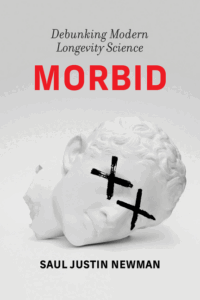
=2. Morbid: Debunking Modern Longevity Science by Saul Justin Newman (MIT Press)
Critical Reception: 3 Rave, 2 Positive

Tied with Gude’s biography is Saul Justin Newman’s provocative critique, Morbid: Debunking Modern Longevity Science, published by the MIT Press. The book has drawn attention for its sharp deconstruction of contemporary wellness trends, earning three rave reviews and two positive notices.
Reviewing the book for The Guardian, Rachel Clark described the study as "intriguing, eccentric," and noted its relevance in the current cultural climate. "In an age of incessant online grifting and conspiracy theorist Robert F. Kennedy as US secretary of health," Clark wrote, "Newman’s conclusions are refreshingly simple. Longevity ‘science’ is largely built on nonsense data." The work offers a timely and rigorous pushback against widely accepted scientific claims regarding human lifespan extension.
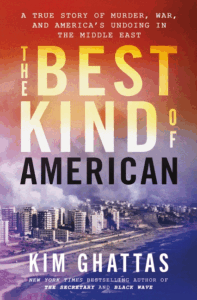
4. The Best Kind of American: A True Story of Murder, War, and America’s Undoing in the Middle East by Kim Ghattas (Henry Holt & Company)
Critical Reception: 4 Rave
Kim Ghattas’s investigative narrative, The Best Kind of American, published by Henry Holt & Company, has captured four consecutive rave reviews from critics impressed by its historical scope and analytical clarity.
In his review for The New York Times Book Review, Christopher de Bellaigue praised Ghattas’s deep understanding of regional geopolitics. "Ghattas is well qualified to tease out the insidious relationships of ideology, convenience and betrayal that have condemned Lebanon to half a century of instability," he observed. De Bellaigue added, "If the best kind of American is one whose view of the Middle East is disinterested, benevolent and untainted by thoughts of commercial or strategic hegemony, Ghattas’s excellent book commemorates a breed that is all but extinct."
5. Reds: A Global History of Communism by Paul Mason (Scribner)
Critical Reception: 3 Rave, 1 Mixed
Concluding this week’s literary roundup is Paul Mason’s comprehensive historical study, Reds: A Global History of Communism, published by Scribner. The ambitious global history has earned three rave reviews alongside one mixed response.
In its assessment, Kirkus praised the volume’s intellectual ambition and rigorous scholarship, describing it as "a deeply researched, thought-through, essential history of a protean ideology." Mason’s sweeping examination provides readers with a renewed framework for understanding the complex historical trajectory and enduring global impact of communist movements.