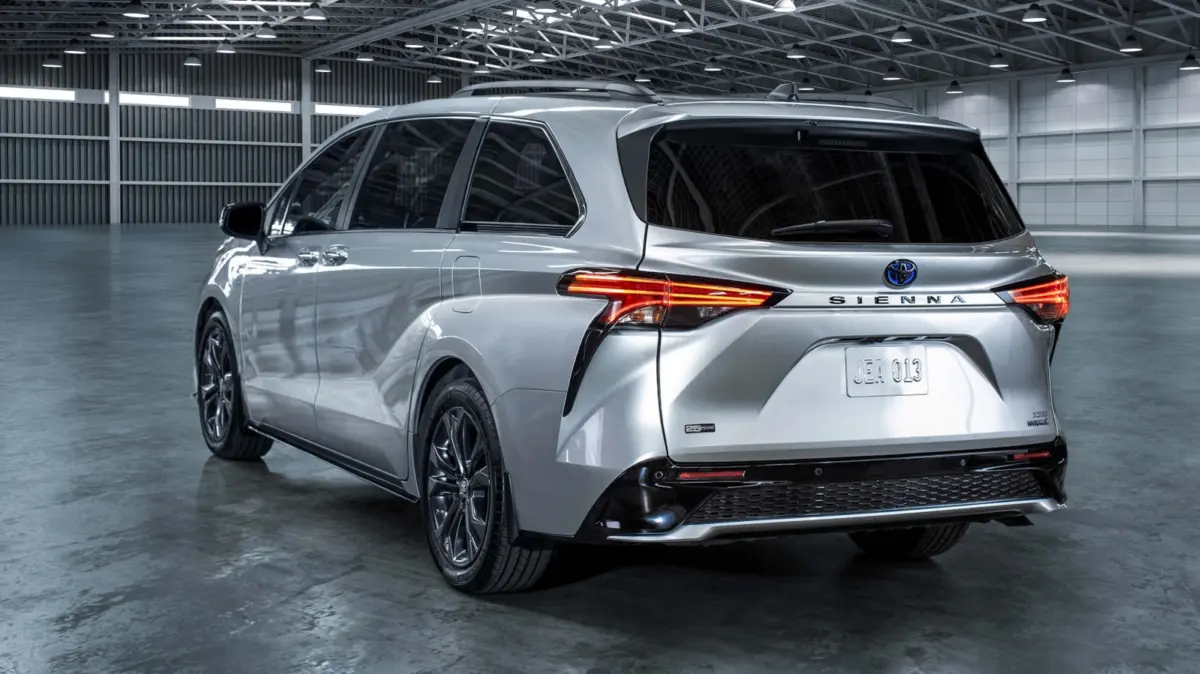
When it comes to the ultimate family hauler, a hybrid Toyota minivan easily ranks among the most rational and sensible vehicles on the market. Combining stellar fuel economy, immense interior cargo space, and modern safety features, the current-generation Toyota Sienna has established itself as a staple for families across the country. However, a brand-new safety recall has thrown a slight wrench into its otherwise spotless reputation as the quintessential family vehicle.
According to safety documents filed recently with the National Highway Traffic Safety Administration (NHTSA), Japanese automaker Toyota is officially recalling a massive fleet of 228,367 Sienna minivans. The recall impacts vehicles spanning several model years, specifically covering units built from the 2022 through the 2026 model years. According to the regulatory filings, these affected vehicles were manufactured over a lengthy production window stretching from September 16, 2021, through July 20 of this current year.
For context, the current, hybrid-only iteration of the Sienna first rolled onto the automotive scene for the 2021 model year. Based on the production dates provided in the federal safety report, it appears that those very first model-year vehicles have managed to dodge this particular bullet and remain unaffected by the current campaign.
The root cause of the recall, as described in the official federal safety documentation, points to a rather convoluted interaction of vehicle components. Per the NHTSA report, the issue involves "certain recliner assemblies by a certain supplier during a certain production period equipped with a seat containing a certain seat belt pretensioner by a certain supplier." While that phrasing reads with a heavy dose of legal caution, it underscores the intricate supply chain and engineering complexities that go into modern automotive manufacturing.
The Seat Belts Are Pushing on the Recliner Mechanism
To understand the actual mechanical problem, one has to look closely at the interior layout of the affected minivans. The defect specifically impacts current-generation Siennas that are configured with two captain’s chairs in the middle row, meaning the seven-passenger models. These specialized middle-row seats are designed to recline for passenger comfort and are equipped with seat belts featuring pretensioners, which are explosive or mechanical devices designed to tighten the belt instantly in the event of a severe collision.
However, Toyota’s engineering investigations revealed a critical safety loophole. During certain frontal collisions, the immense physical load produced by the seat belt pretensioner can trigger an unexpected oscillation effect within the recliner mechanism itself. This unwanted physical vibration and movement can potentially cause the seatbacks to shift or move around unpredictably during a crash. In a safety-critical scenario like a high-speed collision, unstable seating structures can compromise occupant retention and increase the risk of injury, prompting the automaker to take immediate corrective action.
The discovery of this flaw did not come from a crash on public roads, but rather from rigorous internal testing procedures. Toyota reportedly uncovered the issue last year while conducting prototype sled testing for an entirely new second-row seat and seat belt design intended for a future vehicle platform. Following that initial discovery, the company initiated extensive additional testing. Engineers even went so far as to recover second-row seat assemblies directly from the field to analyze how these recliner mechanisms have held up under real-world usage and wear over time.
Despite the large number of vehicles caught up in the recall net, the automaker currently lacks a precise estimate regarding how many of the 228,000-plus Siennas actually possess the physical defect. The initial percentage figures listed at the top of regulatory filings often serve merely as regulatory placeholders rather than exact risk projections. Furthermore, the company stated that, to date, it has not received any Field Technical Reports or warranty claims related to this specific defect from actual owners on the road.
To resolve the issue safely and permanently, Toyota has outlined a comprehensive remediation plan that will be provided to owners completely free of charge. For the vast majority of the involved vehicles, the remedy will involve a software update. Technicians will install an updated version of the software that precisely controls the operation of the second-row seat belt pretensioner, altering how the system responds during a crash to prevent the hazardous oscillation effect.
Meanwhile, a smaller subset of the recalled population will require physical hardware modifications. Approximately 200 Sienna minivans that are equipped with the specialized Mobility as a Service Package will receive entirely new seat backs featuring a different recliner mechanism altogether, ensuring that passengers utilizing those specific accessible configurations are fully protected. Affected owners can expect to receive official notification from Toyota in the coming weeks with detailed instructions on how to schedule their service appointments at local dealerships.