A single fossilized molar, unearthed from the soil of northern Israel, has provided scientists with an extraordinary window into a world that flourished nearly 700,000 years ago. This ancient elephant tooth, recovered from the archaeological site of Gesher Benot Ya’aqov (GBY-NBA), serves as more than just a biological remnant; it is a key to unlocking the complex environmental tapestry of the prehistoric Jordan Rift Valley. By meticulously analyzing this fossil, researchers have reconstructed a vibrant, lush landscape defined by sprawling forests, meandering rivers, and productive wetlands—a setting that not only supported the massive megafauna of the Pleistocene but also facilitated the survival and migration of early human populations as they moved between continents.
The findings, recently published in the journal Quaternary Science Reviews, represent a collaborative effort led by Hannah Farrell, a PhD candidate at the University of Haifa. The research team examined both the large elephant molar and several tusk fragments recovered from the site, which is situated just south of the modern-day Hula Valley. The excavation of the GBY-NBA site, which has long been recognized as a pivotal location for understanding early human technology, was spearheaded by Professor Gonen Sharon of Tel-Hai University, whose work at the site has unearthed a wealth of stone tools alongside faunal remains.
A Giant Elephant Tooth Reveals a Lost Prehistoric World
The fossils are attributed to Palaeoloxodon antiquus, commonly known as the straight-tusked elephant. This magnificent creature stood as one of the largest land mammals to roam the earth during the Pleistocene, an epoch defined by its dramatic climatic shifts and the repeated cycles of the ice ages. While the sheer size of the animal commands attention, the researchers chose to look beyond the biology of the elephant itself, instead treating its tooth as a sophisticated geological and environmental archive.
Teeth are remarkably resilient structures, and in the case of megafauna, they act as long-term records of the environments in which the animals lived. As the elephant grew, its teeth incorporated chemical signatures from the water it drank and the vegetation it consumed, effectively capturing a "snapshot" of the local climate and ecology. By utilizing a multi-disciplinary approach, the research team—including specialists in isotope geochemistry, archaeozoology, and palynology—was able to extract this latent data.
The methodology was exhaustive, incorporating high-resolution CT scans and 3D reconstruction to understand the internal structure of the tooth. Microscopic examination of the tooth’s wear patterns provided insights into the animal’s diet, while isotope geochemistry allowed the team to measure the specific chemical compositions that point to the availability of water and the nature of the local flora. Simultaneously, pollen analysis from surrounding sediments provided a botanical census of the area, confirming the existence of a diverse array of wetland and woodland species.
The resulting data paints a picture of a remarkably stable and persistent ecosystem. The environment was not a harsh or unforgiving wilderness, but rather a mosaic of woodlands, open grasslands, marshes, and flowing freshwater bodies. Carbon isotope measurements provided definitive evidence that the elephant had access to a highly dependable water supply, suggesting that the Jordan Rift Valley acted as a permanent sanctuary during periods when other regions might have been significantly more arid. The pollen records further enriched this understanding, identifying a variety of plant life including reeds, sedges, willow, and tamarisk, all of which thrive in moisture-rich, aquatic habitats.
An Ancient Oasis Along a Crucial Human Migration Route
The significance of this discovery is amplified by the site’s geography. The Hula Valley sits directly within the Levantine Corridor, a natural land bridge that has served as a primary conduit for the movement of animals and early human groups traveling between Africa and Eurasia. For decades, archaeologists have viewed this corridor as a critical intersection in human history, but the new evidence from the elephant tooth provides a clearer understanding of why this route was so vital.
The environment at Gesher Benot Ya’aqov acted as a functional ecological refuge. In a world where climate fluctuations could turn habitable land into barren zones in a relatively short timeframe, the Jordan Rift Valley provided a consistent, high-resource environment. The presence of water, lush vegetation, and abundant animal life would have been a beacon for nomadic early human populations.
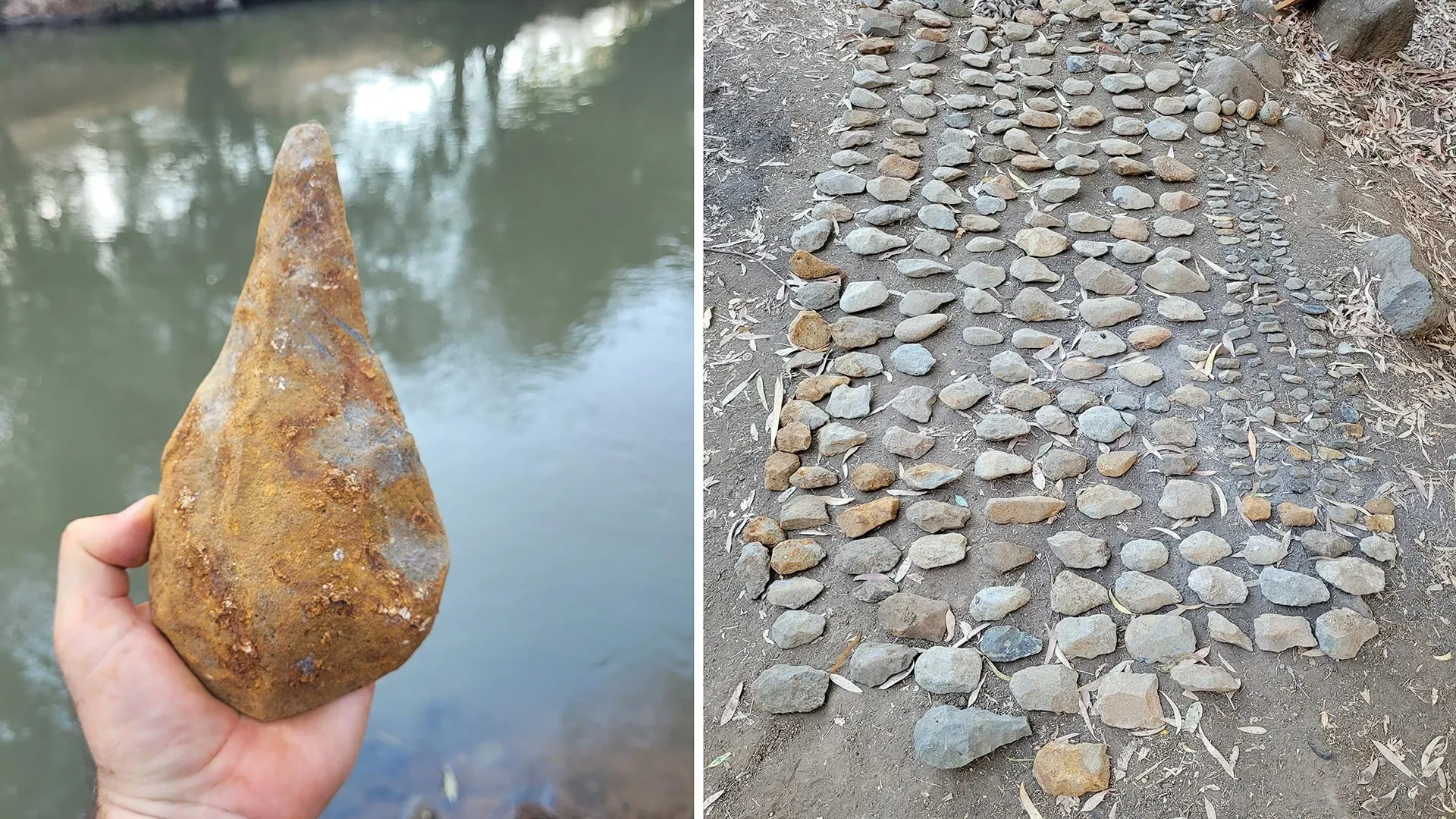
These humans were not just passing through; they were leaving behind a sophisticated technological legacy. The elephant remains were found in direct association with handaxes and cleavers fashioned from basalt, a local volcanic rock. These implements are classic examples of the Acheulian tradition, one of the most enduring and widely distributed stone tool technologies in human history. The proximity of these tools to the remains of Palaeoloxodon antiquus suggests a close relationship between early humans and the megafauna that shared their landscape, whether as scavengers or simply as co-inhabitants of the same life-sustaining resources.
For early humans, the ability to identify and utilize such oases was likely the determining factor in their survival. Navigating an unfamiliar landscape requires constant access to caloric and hydraulic resources; the Hula Valley, with its reliable water and diverse vegetation, would have provided the necessary buffer for populations to rest, thrive, and eventually expand their range. Understanding these habitats is crucial for researchers attempting to map the early chapters of the human story, as it moves the focus from simple migration patterns to the environmental pressures and opportunities that dictated human movement.
Understanding the Forces That Shaped Our Species
Professor Gonen Sharon emphasizes that the importance of this study lies in its holistic approach. "Understanding how humans and animals responded to environmental change hundreds of thousands of years ago helps us better understand the forces that shaped our species," he noted. By bridging the gap between archaeology—the study of human culture and tools—and paleoecology—the study of ancient environments—researchers are finally beginning to see the full picture of the Pleistocene world.
The study underscores a fundamental truth: the evolution and dispersal of human populations were not isolated events but were inextricably linked to the natural world. The availability of resources, the presence of specific plants and animals, and the stability of the climate created a roadmap for human expansion. The wetlands and woodlands of the Hula Valley were not merely backdrops to the human drama; they were active participants in the survival of early human communities.
The success of this research relied on a highly integrated effort across several Israeli academic institutions. While Hannah Farrell of the University of Haifa led the analysis of the fossil material, the study benefited from the expertise of colleagues such as Cheryl A. Makarewicz and Nimrod Marom, who provided critical insights into isotope studies and archaeozoology. Additionally, the botanical evidence was brought to light through the meticulous work of Minji Jin and Dafna Langgut from Tel Aviv University.
As this research continues to shed light on the conditions of 700,000 years ago, the team believes that more secrets remain buried within the layers of the Jordan Rift Valley. Each new artifact or fossil recovered from Gesher Benot Ya’aqov serves to refine our understanding of the Levant as a cradle of early human activity. By reconstructing the exact ecological conditions that allowed a giant elephant to thrive, scientists are effectively reconstructing the very world that allowed our ancestors to walk, hunt, and eventually inhabit the globe. The story told by a single tooth is, in essence, the story of how our species found the resources necessary to take its first, critical steps across continents.