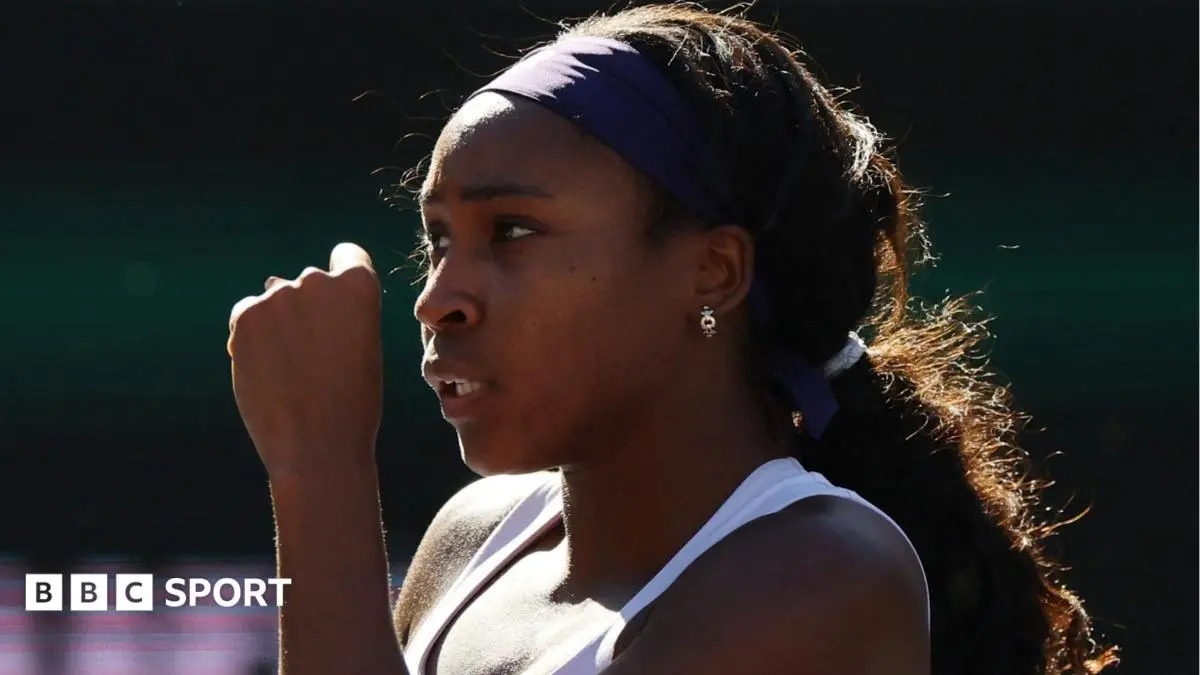
Coco Gauff showcased the fighting spirit that has defined her rapid ascent to the top of the sport, overcoming a painful lower back injury to defeat Marta Kostyuk and preserve her hopes of reaching the semi-finals of the WTA Finals. In a match defined more by sheer grit than technical perfection, the American star found herself on the precipice of defeat, only to stage an improbable second-set recovery that echoed her recent history in the tournament.
The victory, which concluded with a 6-4, 7-5 scoreline, was a testament to Gauff’s mental fortitude. For much of the encounter, the world number four was visibly hindered, frequently grimacing as she moved across the court. Mid-way through the match, the necessity of the situation became clear: Gauff needed a win to stay alive in the tournament, and with her body failing her, the challenge shifted from a tactical tennis battle to a test of endurance and pain management.
"Physically, I wasn’t at my best, which I’m not really used to," Gauff admitted in her post-match interview with Sky Sports. The 20-year-old, who has become accustomed to relying on her explosive athleticism, found herself forced to recalibrate her game on the fly. "It was like a mental challenge, learning how to play through that," she added, reflecting on the grueling nature of the match.
The struggle was not unique to Gauff. The grueling nature of the professional tennis calendar has left a trail of physical attrition across the tour, and the WTA Finals have been no exception. Her opponent, Marta Kostyuk, who earned a late invitation to the season-ending championships following the withdrawal of Elena Rybakina, was also operating at less than 100 percent. The Ukrainian has been managing a persistent wrist injury that has plagued her since August, limiting her ability to generate the pace and heavy spin that usually characterize her aggressive baseline style.
For Gauff, the match followed a script that felt almost surreal. Trailing 5-1 in the second set, she appeared destined to head into a decider, if not an outright defeat. Yet, in a display of resilience that has become a hallmark of her performances at this venue, she rattled off six consecutive games to snatch the victory from the jaws of defeat. It was the second time in just a few days that Gauff had overturned a 5-1 deficit, having pulled off a near-identical feat against Jessica Pegula on Sunday.
Despite the precedent she had set just days prior, Gauff revealed that she was far from confident that a comeback was in the cards. In fact, she had already begun mentally preparing for a third set, assuming her physical limitations would prevent her from closing out the match in straight sets.
"I asked my physio at 5-2 down, what can I do on the bathroom break [between sets] to try and loosen up," Gauff explained, providing a rare glimpse into the internal monologue of an athlete under pressure. "And then there was no bathroom break!" she laughed, referencing the way the momentum shifted so rapidly that the opportunity for a tactical reset vanished as quickly as it had appeared.
The physical toll was most evident in Gauff’s service motion. Throughout the match, she struggled significantly, producing nine double faults while managing only a single ace. Speaking after the match, she noted that the pain in her lower back made it difficult to complete her service motion fluidly. Without the ability to fully extend or rotate through her serve, she was forced to rely on her defensive capabilities and her ability to outmaneuver Kostyuk from the baseline.
The first set saw Gauff start slowly, dropping an early break to the Ukrainian. However, she managed to stabilize her game and work her way back into the set, ultimately taking it 6-4. As the second set began, the physical symptoms intensified. After falling behind 3-0, Gauff called for the trainer to address her back. Despite the intervention, she soon trailed by a double break, with Kostyuk showing flashes of brilliance as she saved three break points during a critical stretch of the set.
However, as the scoreline tightened, the energy in the arena seemed to shift. With the crowd firmly behind her, Gauff leaned into her ability to swing freely, perhaps emboldened by the knowledge that she had little to lose given her physical state. She stopped overthinking the mechanics of her shots and began to focus on the trajectory and depth, managing to outlast Kostyuk in a series of punishing rallies. The momentum turned, and the Ukrainian, hampered by her own wrist issues, began to misfire under the renewed pressure.
The implications of the result are significant for the tournament’s landscape. While Gauff has done her part to stay in contention, her path to the semi-finals remains out of her hands. She now requires a specific outcome in the final group match: Wimbledon champion Linda Noskova must defeat Jessica Pegula for Gauff to secure her place in the final four. It is a precarious position, but one that Gauff is familiar with, given the complex tie-breaking scenarios that often define the round-robin format of the WTA Finals.
The context of the season-ending tournament adds another layer of difficulty to the physical struggles both players are facing. After ten months of travel, competition, and intense physical exertion, players often arrive at the WTA Finals playing through niggles that have accumulated over the year. Kostyuk’s wrist issue, which has been a recurring theme since the late summer, was a reminder of the narrow margins between victory and defeat at this level of the game. For Gauff, the back issue served as a similar reminder of the fragility of the human body in the face of the relentless demands of the professional circuit.
As she moves forward—or potentially exits—the focus will undoubtedly be on her recovery. The ability to win matches while physically compromised is often cited as a trait of a champion, yet the long-term health of the sport’s top stars remains a topic of conversation. For now, however, Gauff can take solace in the fact that she pushed through one of the most challenging matches of her season.
The match highlighted not only Gauff’s technical growth but also her tactical maturity. To win while being unable to serve effectively, and while dealing with movement restrictions, requires a high level of court craft. Gauff’s ability to use the crowd, vary the pace, and stay mentally present despite the pain underscores why she is currently ranked among the top four players in the world.
Whether she advances to the semi-finals or not, the match against Kostyuk will likely be remembered as a defining moment in her tournament run. It was a victory earned through sheer force of will, proving that even on a day when her body was not cooperating, her competitive drive remained undiminished. As the tournament reaches its climax, the conversation will shift to the final group standings, but the image of Gauff fighting back from 5-1 down in the second set will stand as the lasting memory of this encounter.
The WTA Finals continue to provide a stage for such high-stakes drama, where the exhaustion of the season meets the urgency of the year’s final trophy. Gauff, win or lose, has once again demonstrated that she possesses the resilience required to navigate the highest echelons of the sport, even when the odds—and her own body—are stacked against her. For now, she must wait and watch, as the fate of her tournament rests on the final match of the group stage, hoping for a result that would allow her to continue her journey in what has been an unpredictable and physically taxing competition.