Ukrainian President Volodymyr Zelensky has disclosed that US negotiators recently floated a high-stakes proposal: a potential Ukrainian withdrawal of its remaining forces from the embattled eastern Donbas region in exchange for a fast-track pathway to Nato membership. The revelation marks a significant, albeit unofficial, development in the ongoing diplomatic efforts to bring an end to the full-scale invasion launched by Russia in February 2022.
The president’s comments, released by his office on Saturday, have cast a spotlight on the intensifying back-channel negotiations involving US envoys, the Kremlin, and Kyiv. While the US government has not officially confirmed the specifics of the proposal, a US official speaking to the BBC noted that while "many ideas continue to be discussed," any definitive agreement would ultimately require the consent of both warring parties.
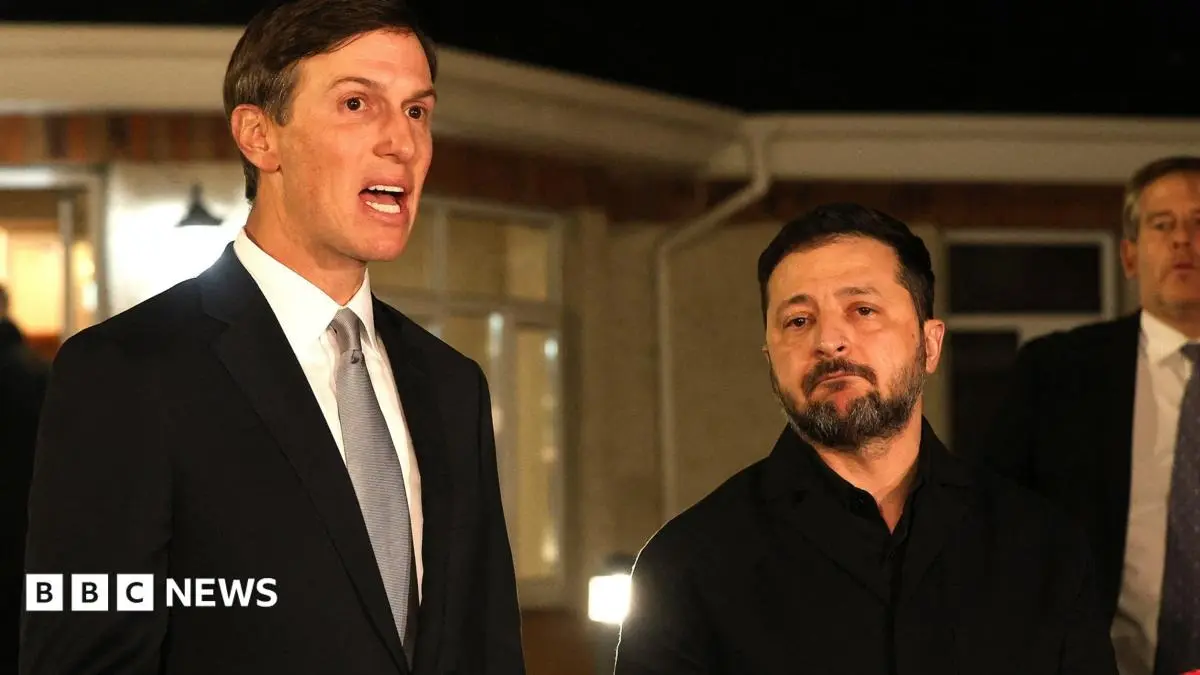
The proposal was reportedly raised during a whirlwind diplomatic mission led by US envoys Jared Kushner and Steve Witkoff. The envoys held a round of talks in Moscow with Russian President Vladimir Putin before flying to Dublin, Ireland, on Thursday to meet with President Zelensky. The meetings appear to be part of a broader, high-pressure US push to de-escalate a conflict that has claimed thousands of lives and fundamentally altered the geopolitical landscape of Europe.
The Trade-off: Sovereignty for Security
For Kyiv, the prospect of Nato membership has long been the "holy grail" of its security strategy. Successive Ukrainian governments have sought the protection of the alliance’s Article 5 collective defense clause, viewing it as the only viable deterrent against future Russian aggression. However, the alliance itself remains divided on the matter, and Russia has consistently cited the potential for a Nato presence on its border as a primary justification for its "special military operation."
"The Americans raised a question: ‘What if Ukraine joins Nato? Would Ukraine withdraw from Donbas?’ This was the first time this had been raised," Zelensky said.
The president maintained a cautious stance regarding the offer, stating that he would only consider putting such a deal to the Ukrainian people via a national referendum if it included ironclad security guarantees, no constraints on the size or capability of the Ukrainian military, and a robust financial package to facilitate the country’s post-war reconstruction.
The Donbas region, which consists primarily of the Donetsk and Luhansk industrial areas, has been the epicenter of the fighting for years. Russia currently occupies roughly one-fifth of Ukrainian territory, including the majority of the Donbas. Zelensky has historically been staunch in his refusal to cede sovereign territory, arguing that the loss of land would only embolden further Russian expansionism.
Diplomatic Friction and "Red Lines"
The latest talks in Abu Dhabi and the subsequent visits to Moscow and Dublin reflect a period of strained relations between Kyiv and Washington. Tensions have simmered over several issues, including Ukrainian drone strikes on oil facilities deep within Russian territory—actions that the Trump administration reportedly requested Kyiv to pause to help stabilize global fuel prices by facilitating the flow of Russian diesel.
The friction has occasionally manifested in public spats. President Zelensky has previously accused US officials of limiting Ukraine’s access to the Starlink satellite network, a critical tool for coordinating defensive operations on the front lines. Conversely, rhetoric from Washington has also grown sharp; reports indicate that the former US president has openly suggested it was "time for Ukraine to get a new president" and called for fresh elections.
While elections are currently suspended under Ukraine’s martial law, Zelensky has previously signaled a willingness to step down and hold elections within months of a peace deal, provided his country receives the necessary security assurances to ensure its long-term survival.
Moscow’s Unchanged Position
Despite the flurry of diplomatic activity, there is little evidence to suggest that the Kremlin has moderated its objectives. Russian officials continue to advocate for a "new European security architecture"—a term long interpreted by Western intelligence as code for a significantly weakened Nato, devoid of its eastern flank.
Moscow has repeatedly signaled that its terms for a ceasefire remain "maximalist." These include formal territorial concessions, guaranteed neutrality for Ukraine—effectively barring it from joining any military alliance—and strict limitations on the size and scope of the Ukrainian armed forces. Kyiv has consistently rejected these conditions, arguing that such constraints would render the country defenseless and leave it vulnerable to a future, even more devastating invasion.
The current diplomatic impasse is further complicated by Russia’s insistence that it will not entertain a ceasefire until a final, comprehensive peace deal is reached. This would require Ukraine not only to formalize the loss of the Donbas but also to recognize the illegal annexation of the Crimean peninsula, which Moscow seized in 2014.
Navigating a "Difficult Conversation"
In the wake of Zelensky’s public disclosure, Jared Kushner appeared to push back against the notion of a formal offer, urging the parties to maintain "confidentiality" in what he described as an incredibly sensitive process. Kushner noted that "maximalist" proposals were often leaked or reported in the heat of negotiations, characterizing the current atmosphere as one defined by "strong political rhetoric."
"We are having private discussions aimed at exploring new ideas about ending this horrible war," Kushner stated, expressing a hope that the current dialogue might eventually lead to a breakthrough.
Some analysts suggest that President Zelensky may have gone public with the proposal to force an open discussion on a topic that had previously been considered a "closed door." By framing the idea as being "back on the agenda," Zelensky is signaling to both his domestic audience and international partners that he is navigating an "extremely difficult conversation" regarding European security, while simultaneously pushing back against the narrative that Ukraine is solely responsible for the lack of progress toward peace.
The reality, as understood by observers in Kyiv, is that the US appears to be testing the limits of Ukraine’s "red lines." With the war entering a grinding phase, the US administration is clearly eager to secure a deal, even if that requires making painful compromises that were unthinkable in the earlier stages of the conflict.
Whether this diplomatic maneuver will lead to a viable roadmap for peace or merely highlight the deep-seated mistrust between the involved parties remains to be seen. For now, the front lines in the Donbas remain active, and the debate over the future of the region—and the security of the Ukrainian state—continues to dominate the discourse in both Washington and Kyiv. As the negotiations proceed behind closed doors, the international community watches closely to see if the promise of Nato membership can bridge the divide between a desperate need for peace and the preservation of national sovereignty.