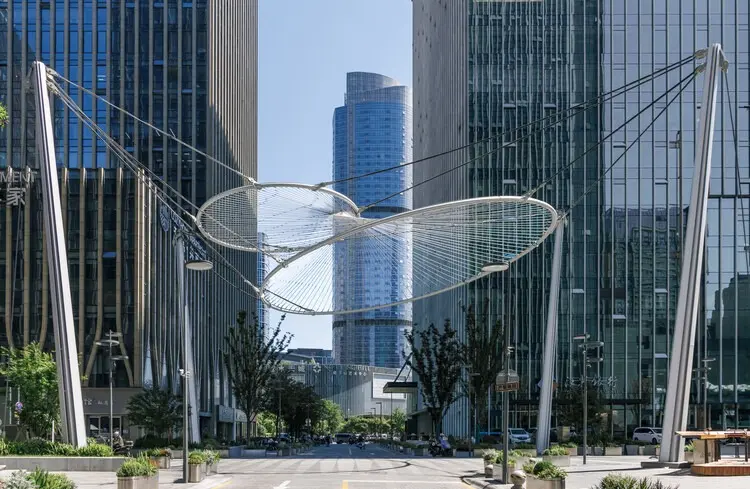
Urban renewal has increasingly become a critical focus for modern metropolitan areas striving to balance high-density commercial growth with human-centric public spaces. A prime example of this ongoing evolution can be found in the core area of Qianjiang Century City in Hangzhou, China, where the Yuelang Road Block has undergone a comprehensive quality enhancement designed by the TJAD Original Design Studio. Long treated as a utilitarian backstreet primarily burdened by vehicular traffic and logistical congestion, the approximately 330-meter internal street has been successfully reimagined as a dynamic, continuous public realm that harmonizes everyday circulation with vibrant social and commercial life.
Before the intervention, Yuelang Road faced a distinct set of urban challenges typical of high-density commercial and office districts. The street is closely flanked by six towering commercial and office developments, generating heavy daily pressures from office commuting, garage access, temporary parking, and building logistics. In its original configuration, the limited road space was forced to accommodate a chaotic mix of motor vehicles, bicycles, pedestrians, and loading activities simultaneously. Furthermore, the building frontage spaces on both sides of the street were heavily fragmented. Disjointed elements such as fences, grade changes, varied paving materials, and isolated planting beds created physical and visual barriers. The resulting environment was a typical high-density backstreet dominated purely by transit and movement, leaving virtually no room for pedestrians to pause, rest, or engage in social interaction.
Recognizing the untapped potential of this urban corridor, the design team approached the project through a comprehensive framework that integrated the roadway, pedestrian pathways, and building frontages into a unified system. Rather than treating these elements in isolation, the renewal strategy sought to heal the fractured relationship between the architecture and the street. A foundational step in this transformation involved reorganizing the street section and systematically relocating surface parking to alleviate the severe congestion that once plagued the corridor. By clearing out chaotic surface parking and streamlining vehicular movement, the designers reclaimed valuable spatial real estate for the public realm.
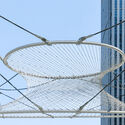
With the spatial bottlenecks addressed, the project focused heavily on opening up the previously enclosed building frontages. Removing restrictive fences and smoothing out level changes allowed the indoor commercial activities of the adjacent towers to spill outward, establishing a fluid and continuous connection between the buildings and the street. To support this newfound spatial continuity, the design introduced a variety of urban amenities, including dedicated seating areas, outdoor dining spaces, and flexible public gathering zones. These additions successfully converted what was once a purely functional thoroughfare into an inviting social destination where office workers, residents, and visitors can linger, dine, and interact throughout the day.
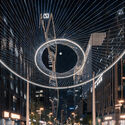
Beyond addressing daytime circulation and social needs, the comprehensive enhancement also considers the distinct character of Yuelang Road after dark. Building upon the area’s existing metropolitan nightscape, the design team incorporated a poetic yet cohesive thematic element inspired by lunar phases. This recurring motif is subtly integrated into the architecture, structural details, bespoke lighting fixtures, and street furniture throughout the block. By weaving the theme of lunar phases into the physical fabric of the street, the design establishes a distinct visual identity that enhances the evening atmosphere, encouraging continued use for nighttime activity, social gatherings, and relaxed outdoor dining long after the traditional workday has ended.

Through this thoughtful and holistic intervention, TJAD Original Design Studio has demonstrated how overlooked backstreets in high-density urban centers can be successfully revitalized. By balancing the practical necessities of vehicular access and building logistics with the human-centric needs of pedestrian comfort, commercial vitality, and public leisure, the Yuelang Road Block comprehensive quality enhancement sets a forward-thinking benchmark for urban regeneration in Hangzhou and beyond.