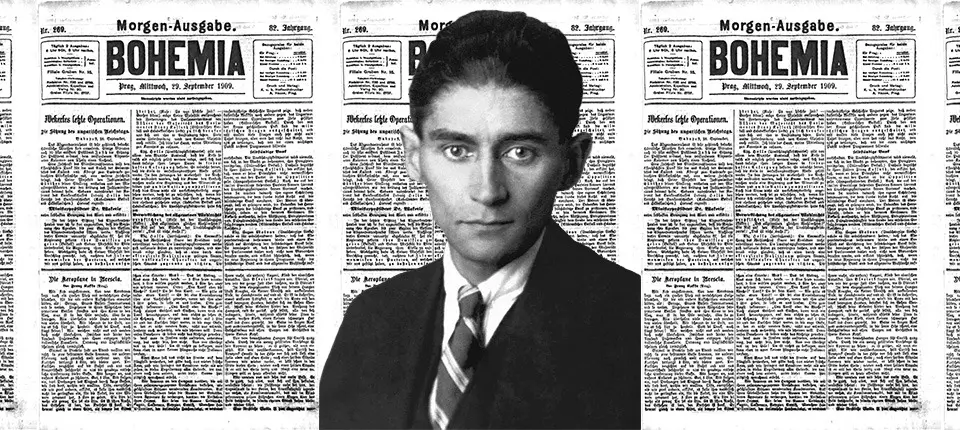
TODAY: In 1909, Franz Kafka’s short story “The Aeroplanes at Brescia” is published in the Prague newspaper Bohemia.
As readers and scholars reflect on the rich history of modern literature, anniversaries often provide a fascinating lens through which to examine the early works of legendary authors before they achieved global renown. Today marks a significant milestone in the early publishing history of one of the twentieth century’s most celebrated and enigmatic writers. On this day in 1909, the Prague-based newspaper Bohemia published Franz Kafka’s short piece “The Aeroplanes at Brescia,” offering contemporary audiences a glimpse into a lesser-known facet of the author’s diverse literary output.
Long before the publication of masterworks such as The Metamorphosis, The Trial, and The Castle, Kafka was a young writer navigating the cultural and literary landscape of early twentieth-century Prague. Working day-to-day as an insurance employee, he found time to observe the rapid technological and social changes sweeping across Europe. The early 1900s represented an era of intense modernization, marked by the birth of cinema, the expansion of railways, and, crucially, the advent of aviation. These sweeping technological advancements captured the imagination of artists, intellectuals, and the general public alike, prompting widespread commentary in the periodical press.
The publication of “The Aeroplanes at Brescia” in Bohemia placed Kafka’s observant prose directly into the hands of daily newspaper readers. At the time, Bohemia was a prominent German-language daily newspaper published in Prague, serving as an important cultural and intellectual forum for the city’s diverse German-speaking community. Newspapers and literary journals of this period frequently featured feuilletons—short, evocative essays, sketches, or journalistic pieces that blended observation with literary flair. This format allowed writers to experiment with style and voice while engaging with current events, cultural exhibitions, and public spectacles.
Kafka’s engagement with the subject of aviation at Brescia reflects a moment of profound wonder and technological fascination. The aviation meeting at Brescia, held in northern Italy in September 1909, was one of the earliest and most celebrated air shows in history, drawing massive crowds eager to witness pioneering aviators take to the skies in fragile, experimental flying machines. Prominent figures of the era, including the famous Italian poet Gabriele D’Annunzio and aviation pioneers like Glenn Curtiss, were present at the event, turning it into a major cultural and media spectacle. Kafka, attending the event as a spectator, captured the sensory experience and the psychological impact of witnessing humanity take flight for the first time.
In “The Aeroplanes at Brescia,” Kafka moves beyond simple journalistic reporting to explore the deeper human implications of this new technology. Rather than focusing purely on the mechanics of the aircraft, his writing captures the tension between human ambition and the vast, indifferent sky, a theme that resonates subtly with the existential concerns that would later dominate his major fiction. The piece highlights his acute observational powers and his ability to translate complex modern phenomena into striking literary imagery.
Although “The Aeroplanes at Brescia” remains a niche entry within Kafka’s extensive bibliography compared to his famous parables and novels, its publication in Bohemia on this day in 1909 remains a notable touchstone for literary historians. It illustrates the intersection of early twentieth-century journalism and modernist literature, showing how newspapers served as an essential incubator for writers who were just beginning to find their distinct voices. As readers today revisit the literary internet and explore historical milestones, the anniversary of this publication offers a valuable reminder of Kafka’s early engagement with a rapidly modernizing world.