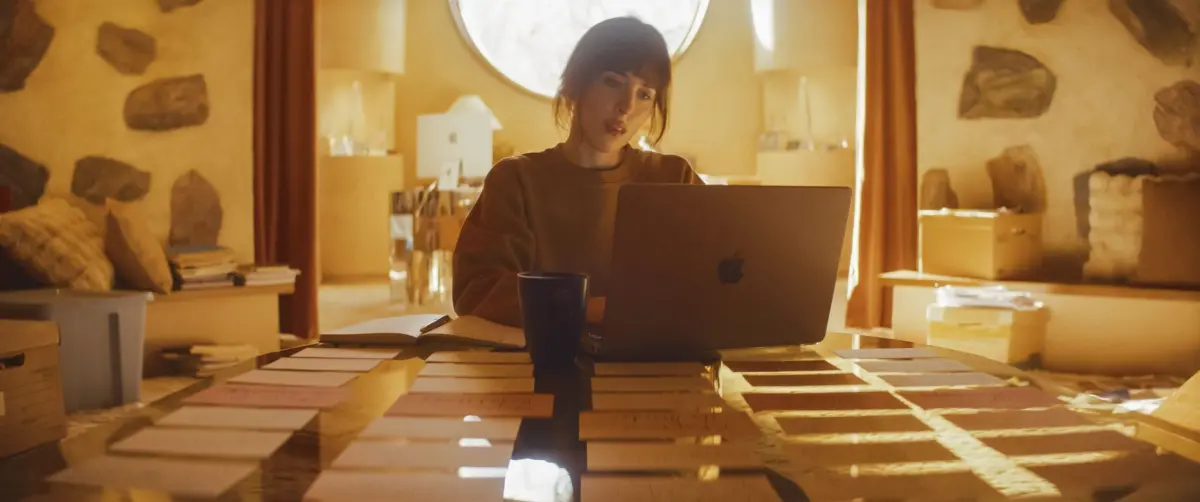
The atmospheric, tension-filled world of Verity—the highly anticipated adaptation of Colleen Hoover’s New York Times bestselling novel—is defined as much by its physical environment as it is by its psychological twists. Starring Anne Hathaway as the enigmatic author Verity Crawford and Dakota Johnson as the struggling writer Lowen Ashleigh, the film transports viewers from the bustling, impersonal streets of New York City to the suffocating isolation of a rural Vermont home. In the production notes, the Crawford residence is described not merely as a set piece, but as a supporting character, exerting a gravitational pull on the narrative as Lowen descends into the dark, hidden life of her predecessor.
The story follows Lowen, who is recruited to ghostwrite the remaining books in a successful series after Verity suffers a debilitating injury. Upon arriving at the secluded Vermont estate, Lowen finds herself stepping into the void left by the author, moving from the professional confines of an office into the deeply personal space of the marital bedroom. As she begins to uncover the terrifying secrets buried within an unfinished autobiography, the house—and the secrets it holds—becomes a central point of obsession. "A writer’s words should be honest and bloody and a little bit terrifying," Verity declares in the film, a mantra that underscores the visceral, unsettling tone the production team sought to achieve.
Finding the Villain’s Lair: Beyond the Vermont Woods
While the narrative places the Crawford family in the quiet, wooded hills of Vermont, the reality of film production required a more accessible, yet equally haunting, location. Location manager Elizabeth Krekel and production designer Amy Williams were tasked with finding a property that could embody the modern, ominous spirit of the book. The result was the discovery of a sprawling architectural marvel in Westchester County, New York, which provided the perfect backdrop for the story’s unfolding mystery.

The search for the "villain’s lair" was a complex endeavor. Because the book does not provide a granular architectural description of the home, the production team faced the challenge of translating readers’ collective imaginations into a tangible reality. Williams admitted that the team was initially nervous about how fans would receive their creative choices, fearing that readers might have envisioned a more traditional, classic structure. However, the decision to go with a sharp, modern, and angular design proved to be a defining creative swing for the film. The house’s unique V-shaped windows, which serve as a subtle visual nod to the name "Verity," anchored the film’s visual language in something distinct and unsettling.
According to Williams, the production crew worked across multiple seasons to capture the shifting moods of the story, filming in various locations throughout upstate New York as well as Manhattan, Brooklyn, and Queens. The result is a film that feels both anchored in the gritty reality of New York City and untethered from safety once the protagonist reaches the rural sanctuary of the Crawford home.
From Brooklyn Bookshops to Midtown Hustle
The film’s journey begins in the familiar landscape of New York City, where Lowen is struggling to find her footing as an author. Her introduction to the audience occurs in the back room of a local bookstore, where she reads an excerpt of her work to a sparse audience. For residents of Brooklyn, the setting is instantly recognizable: the scene was filmed at Books Are Magic in the Carroll Gardens neighborhood. While patrons of the shop won’t find any of Lowen Ashleigh’s fictional titles on the shelves, the location serves as a grounded, authentic start to her character arc.

The film quickly pivots to a more frantic pace as Lowen experiences a life-altering encounter in Midtown Manhattan. After a promising call with her agent, Corey, played by Ismael Cruz Córdova, Lowen heads to the Hachette Book Group offices. Her journey is interrupted at the intersection of Park Avenue and East 41st Street, where she witnesses a tragic car accident and encounters Jeremy Crawford, the man who will soon become the catalyst for her relocation to Vermont. Williams noted that the choice of this specific location was intentional; it is one of the city’s most congested and "film-unfriendly" spots, but the resulting footage provided the necessary texture and intensity to capture the overwhelming nature of the Midtown experience.
The subsequent scenes at the Hachette offices offered a unique level of access. The production team was granted permission to film inside the actual offices of Colleen Hoover’s publisher. To prepare the space for the camera, the crew redecorated the interior, adorning the walls with framed book jackets from the fictional literary canon of Verity Crawford. Eagle-eyed fans of the source material may also catch a cameo by Colleen Hoover herself, who appears in the scene as the office receptionist.
Flashbacks and Culinary Cues
As Lowen delves deeper into the contents of the manuscript, the narrative shifts between the present day and the past. One such flashback takes viewers to a chic Manhattan bar where Verity and Jeremy first meet. The scene was filmed at Laissez Faire, a high-end cocktail lounge located within the historic Beekman Hotel in the Financial District. The venue’s architectural character and its functional back-alley exit were essential for the scene’s choreography, allowing the characters to make a dramatic, swift departure into a waiting limousine.

Food also plays a subtle role in the film’s geography. When Lowen meets with her agent to discuss the potential for her career, the scene takes place at Rolo’s, a popular dining establishment in Ridgewood, Queens. Later, when Jeremy takes Lowen out for a birthday dinner, the pair visits a local Bavarian restaurant. While the book version of this scene occurs at an Italian eatery, the film production shifted the location to Zum Stammtisch in Glendale, New York. Williams described the restaurant as a "charming, historic" spot that felt right for the scene, noting that the crew became quite fond of the menu—specifically the pretzels—during their time filming there.
The Architecture of Deception
The Crawford home, known as the Beckoning Path property in Armonk, New York, is a masterpiece of design created by Danish sculptor and designer Jens Quinsgaard. The property includes a swimming pool and a dedicated tai chi studio, offering a stark contrast to the dark events that unfold within its walls. Amy Williams recalls that when she was initially hesitant about taking on the project due to scheduling conflicts, a look at photos of this specific home convinced her to clear her calendar immediately.
The production team took an active approach to the home’s interior, adding walls and extensive bookshelves to create the atmosphere of a prolific writer’s sanctuary. While the real kitchen and several living spaces were utilized, the crucial office set was constructed on a sound stage to allow for precise control over the environment. Working closely with director Michael Showalter and Anne Hathaway, who also served as a producer, the team designed the office to feel "womb-like and feminine," yet infused with a "glammy" aesthetic that felt like a villain’s lair. Mirrors were placed throughout the room, and the color palette focused on pink hues designed to complement Hathaway’s features.

The house itself, described by Williams as "like a shipwreck at sea," serves as a physical manifestation of the story’s themes. This metaphor extends to the environment surrounding the house as well. The property’s natural lake allowed the crew to capture a key scene involving a canoe ride, which was filmed during the summer months to contrast with the wintery, melancholic feel of the majority of the film. By blending these diverse New York locations with the carefully curated aesthetic of the Crawford home, the production team has created a setting that is as unsettling as the story it houses, ensuring that Verity remains a deeply immersive experience for the audience.