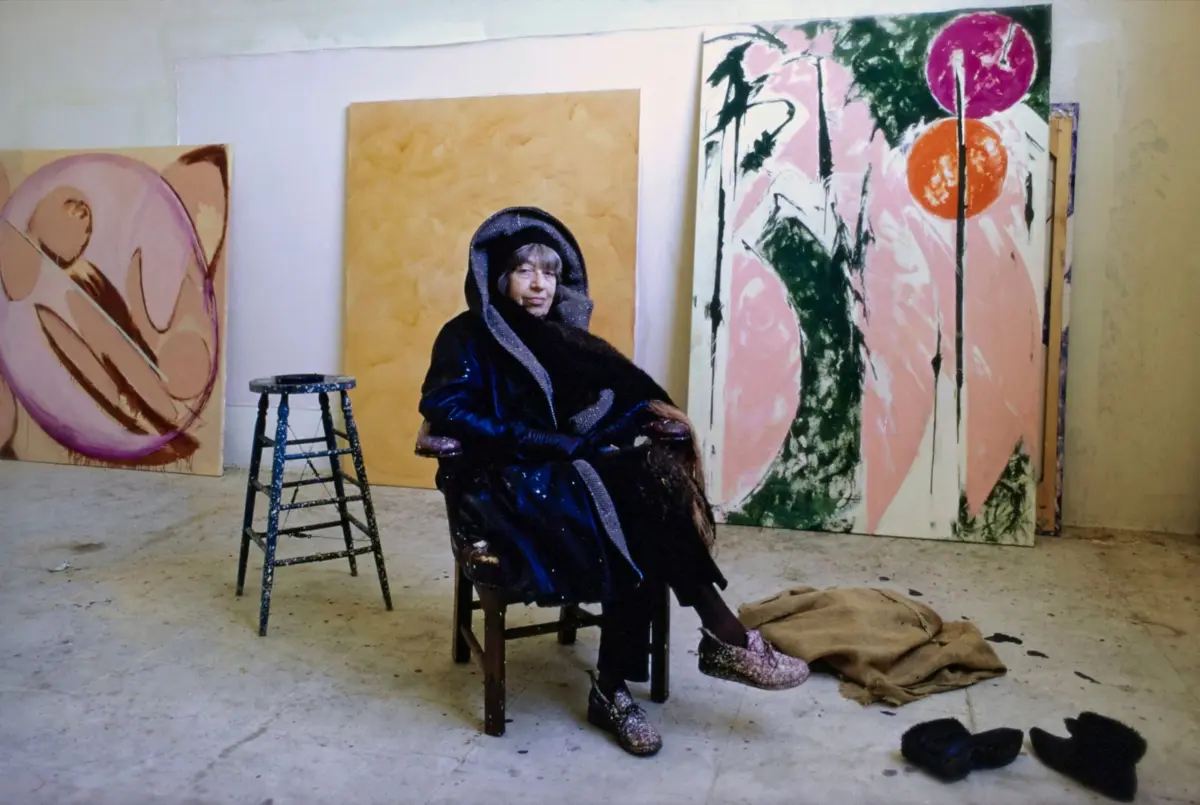
Originally published in the June 1972 issue of Vogue by renowned art historian and critic Barbara Rose, an insightful profile on artist Lee Krasner captures a pivotal era when New York ascended as the undisputed art capital of the world. At the very center of this mid-century artistic upheaval stood Jackson Pollock and his wife, Lee Krasner—an intense, forceful woman with steady gray-blue eyes that reflected a carefully tended independence. Their revolutionary painting style, Abstract Expressionism, utilized physical gestures, bold images, and rich painterly surfaces that swept away the prevailing European Cubist aesthetic. What Paris had been to American writing in the 1920s, New York suddenly became to American painting in the 1940s and 1950s. Yet, unlike Zelda Fitzgerald and the wives of many other American men in the art and literary worlds between the World Wars, Lee Krasner was entirely her own woman and an accomplished artist in her own right.
Although much curiosity and speculation have long surrounded the formidable personality of Lee Pollock, the widow of the great American painter, very little has historically been known about Lee Krasner—the artist who fought the same battles, exhibited in the same galleries, and painted side by side with her legendary husband. For critics like Barbara Rose, Lee Krasner remains one of the most significant painters of the twentieth century, an artist whose true importance is only beginning to be properly recognized by the broader public and cultural institutions.
Reflecting on the gender dynamics of the era, Rose recalls asking Krasner why she was not included among the "Irascible Eighteen," the famous group of New York School artists who signed a 1940s petition protesting the virtual absence of American art in The Metropolitan Museum of Art. Krasner’s response was characteristically blunt: "I wasn’t asked to sign. Barney Newman [Barnett Newman, the prominent organizer who died in 1970] called, and when I answered the phone, he asked for Jackson. He didn’t even bother to inform me of the protest."
For decades, that dynamic defined her public perception, with Lee Krasner the painter constantly eclipsed by Mrs. Jackson Pollock. Yet behind closed doors, the reality of their marriage was far more egalitarian than public myth suggested. Despite his rugged, macho public persona, Pollock treated Lee Krasner as an equal—a serious professional artist whose work he deeply admired. Within their household, Krasner was at least as much a painter and artistic comrade as she was a wife. In fact, Pollock stands out as the only major American artist of the great 1940s generation to marry another avant-garde artist of his caliber.
Unlike many of his patriarchal contemporaries who turned primarily to Freud for inspiration, Pollock investigated the myths of female creativity. He painted feminine archetypes—such as "The She-Wolf" and "Pasiphaë"—alongside totems and symbols designed to balance the masculine principle, drawing heavily on Jungian subject matter that gave profound emphasis to earth goddesses and primal feminine creativity. Pollock was not intimidated by strong women, and Lee Krasner was undeniably one of the most courageous, outspoken, and tenacious women of her generation.
In many respects, Krasner’s formal education surpassed Pollock’s. A native New Yorker who studied at Cooper Union and the National Academy School of Fine Arts, she had discovered modern art during the 1930s while Pollock was still painting traditional American Scene canvases under the tutelage of Thomas Hart Benton, the Missouri artist who attempted to romanticize rural America through provincial interpretations of old masters. Many art historians have credited Krasner with guiding Pollock’s attention away from Benton and steering it toward the great modern European masters. When asked about this influence, Krasner remained characteristically reticent. "When I first met Pollock, we disagreed on many things," she admitted. "Pero as struck as I was by the revelation his paintings were to me, still I couldn’t believe he was discussing Benton that seriously. I can’t say if I affected Pollock’s views at all. I know that Pollock affected me enormously; I dare say I must have had some effect on him."

Speaking with Krasner laid bare the immense inner strength required to forge a career as an abstract painter while navigating the steep obstacles thrown in her path. Initially, she joined the small contingent of American modernists fighting against academicism and conventional illustration. Surviving the Great Depression, she battled to forge a style that transcended European Cubism, championing a freer, more spontaneously emotional approach that eventually coalesced into Abstract Expressionism. Whether facing the antagonism of male peers whose wives worked to support them, the indifference of mainstream museums, or the profound tragedy of her husband’s untimely death followed by endless litigation over his estate, Krasner never stopped painting. Through periods of depression, insomnia, and illness, she continued her work. In later years, she entered a prolific phase marked by canvases featuring pure radiant color contrasted against large, open spaces of bright white. While floral imagery often dominated, swirling circular motifs linked these later works back to the physical rhythms and powerful energy of her earliest creations.
"I have just given all the Pollock material to Eugene Thaw and Virginia Allen, who are preparing the definitive catalogue raisonné," she noted with evident relief. "Now I can once again concentrate on being Lee Krasner the painter." Krasner’s life spanned nearly every defining moment in the evolution of postwar American painting: a youth spent in bohemian Greenwich Village, studies under Hans Hofmann—who imported European modern-art theories to New York—employment as one of the few women in the W.P.A. federal art project during the Depression, marriage to Pollock, and eventual recognition as a formidable painter in her own right.
Dividing her time between the Long Island home in Springs, East Hampton, that she once shared with Pollock and a light-filled apartment on Manhattan’s Upper East Side, Krasner surrounded herself with the plants, shells, rocks, and art-nouveau pieces that mirrored the circling organic forms found in her paintings. In an extensive interview, she reflected on her four-decade career and the bitter-sweet experiences of being married to America’s most celebrated painter.
Discussing the realities of being a woman artist during the 1930s, 1940s, and 1950s, Krasner noted a distinct lack of positive affirmation. When she first met Hans Hofmann, his supposed highest compliment was, "Zis is so good you would not know it was done by a woman." Krasner observed that this underlying bias was deeply embedded in Western thought, contrasting it with Eastern traditions. "Those are facts not to be denied. I had an awareness of this way back, somewhere when I was studying at Cooper Union. But it didn’t hit me too hard until the recent women’s movement. Now, there is an attempt to get a number of women on the scene. For me, it comes a little late."
Addressing Pollock’s supportive attitude toward her work, Krasner emphasized that creative independence was non-negotiable. "I don’t know how I would have felt if he’d said, ‘I don’t want you to paint,’ or acted it out in any way. The issue, of course, never arose; but it’s inconceivable to me that I would have stopped painting if my husband hadn’t approved. Since Pollock was a turbulent man, living with him was never very calm. But the question—should I paint, shouldn’t I paint—never arose. I didn’t hide my paintings in a closet; they hung on the wall next to his. Since his death, of course, being ‘Mrs. Jackson Pollock’ has become something of a burden—an art-world burden, that is. It was never that while Pollock was alive."
Krasner also challenged the popular media caricature of Pollock as a two-fisted, all-American cowboy. Far from avoiding domestic labor, Pollock frequently handled household chores. "Jackson always did the baking. If he wanted apple pie, he baked it. I didn’t know how to bake. I usually cooked—but he cooked, too. He also did other necessary household chores. Perhaps if we’d had more money, we would have hired people to do things. But we didn’t, so we had to do everything ourselves, and we shared the work."
Reflecting on the meteoric rise of the New York School, chronicled by Irving Sandler as The Triumph of American Painting, Krasner expressed mixed feelings about the rapid commercialization of the art world. "I feel what has happened is quite fantastic. How did it quickly cycle into a scene so foreign… what happened? In the fifties, there was still vitality and warmth in the art world—it was alive and meaningful. In the sixties, I don’t know what happened. It wasn’t that long ago that Arshile Gorky didn’t have a gallery, de Kooning didn’t have a gallery. Who had galleries? Now overnight, young artists have whole museums. A mushroom can’t blow up that fast!"

Krasner’s artistic sensibilities were always international rather than provincial. Rejecting narrow nationalist labels in art, she recalled her disdain for institutional parochialism. "By definition, it is the American Whitney. And I can’t be an American anything. Art is art no matter where it is. When it’s happening in Paris, you acknowledge that. The last argument I had on this subject was with Mr. Clement Greenberg about the phrase ‘American-type painting.’ It offends me. The minute you send up a slogan, you can put anything in the bag and the slogan carries it. That’s boring and provincial in thought and concept, and the antithesis of what I mean by art."
Sharing a similar skepticism toward separatist labels within the feminist art movement, she added, "I don’t know what’s meant by ‘feminine’ subject matter, any more than I understand what’s meant by ‘masculine’ subject matter. I’m sympathetic to the women’s movement, but I could never support anything called ‘American’ art."
Recalling her primary artistic influences alongside Mondrian, Picasso, and Matisse, Krasner highlighted the profound impact of her late husband. "After meeting Pollock, I gave up the model and still life. I began with a blank canvas and nothing in front of me. Trying to break up the Cubist grid, I started covering the canvas with paint until there was a pile-up of gray matter. This didn’t change until I began the Little Image paintings after we had finished cleaning up the house in Springs in 1946. In Pollock, I felt a force that once more moved me as strongly as the impact of Matisse or Picasso."
Their relocation to Long Island in November 1945 marked a major turning point. Initially visiting East Hampton over the summer, Krasner suggested renting a country home for the winter to escape the city. Pollock’s initial reaction was disbelief, but within weeks he insisted on buying a house and abandoning New York entirely—despite the couple having only forty dollars between them. They successfully acquired the property in Springs, eventually moving the barn behind the house to serve as Pollock’s dedicated studio while Krasner worked out of a bedroom.
Regarding their artistic relationship, Krasner noted that critique was strictly by invitation. "I always responded to his invitation. Sometimes I had to invite him three times to come to mine, but he eventually did come. I always admired what I saw in his studio; I never said, ‘Change that corner’ or ‘clip that edge.’" The last time Pollock visited her studio before her first trip to Europe in 1956, she had just finished a painting titled "Prophecy." After reviewing it, he told her, "Fine. Leave it alone. Except for this," pointing to an eye-like form scratched into the wet paint with the back of a brush. Though he advised her to remove it, Krasner chose to leave it intact.
While contemporary female artists increasingly embraced Lee Krasner’s lifestyle and professional commitments, blazing that trail required exceptional courage. Just as her visionary paintings provided mysterious insights into an artist’s inner life, Krasner herself stood out as a revolutionary and visionary personality.
The first major breakthrough in public recognition for her work came in 1965 with a retrospective organized by Bryan Robertson at London’s Whitechapel Gallery, which earned widespread critical acclaim in the British press. America, however, has taken considerably longer to fully acknowledge that Krasner’s work shares the exact same aesthetic, content, history, and caliber as that of her male colleagues in the foundational generation of New York painters. Because those artists styled themselves as "heroic," and society has historically been slower to honor its heroines than its heroes, this recognition was delayed. Yet, throughout American history, brave and self-reliant women have continually forged unknown paths—and Lee Krasner remains one of the finest examples of that enduring legacy.