La Foret, the legendary teeny-bopper shopping mall nestled in the vibrant heart of Harajuku, provided a remarkably fitting and theatrical stage for designer Mikio Sakabe to debut a collection centered around the relentless human pursuit of fantasy. Known for his ability to translate unconventional underground subcultures into high-fashion statements with widespread commercial appeal, Sakabe drew inspiration from a distinct and left-field starting point: Japan’s gravure magazines. These vaguely erotic, male-marketed publications traditionally feature bambi-eyed models posing seductively in a mix of lingerie, swimwear, and elaborate cosplay, creating an aesthetic that is at once hyper-stylized and culturally pervasive.
For this season’s presentation, Sakabe envisioned the event through the conceptual lens of a swimsuit show held entirely within the fluorescent-lit, consumer-driven confines of a shopping mall. Explaining the emotional undercurrent of the concept, the designer noted that there is a compelling paradox inherent to staging a fashion presentation in such a distinctly Japanese commercial environment. It feels inherently bright, flashy, and performative, yet it carries an undercurrent of melancholy.
To visually reinforce this bittersweet atmosphere, the runway was intentionally scattered with discarded coffee cups and drink cans, bridging the gap between polished fashion spectacle and the mundane, everyday reality of urban consumerism. This friction between fantasy and reality served as the conceptual anchor for the entire collection, which explored humanity’s persistent desire to escape the mundane restrictions of everyday life alongside the ultimate futility of attempting to do so.
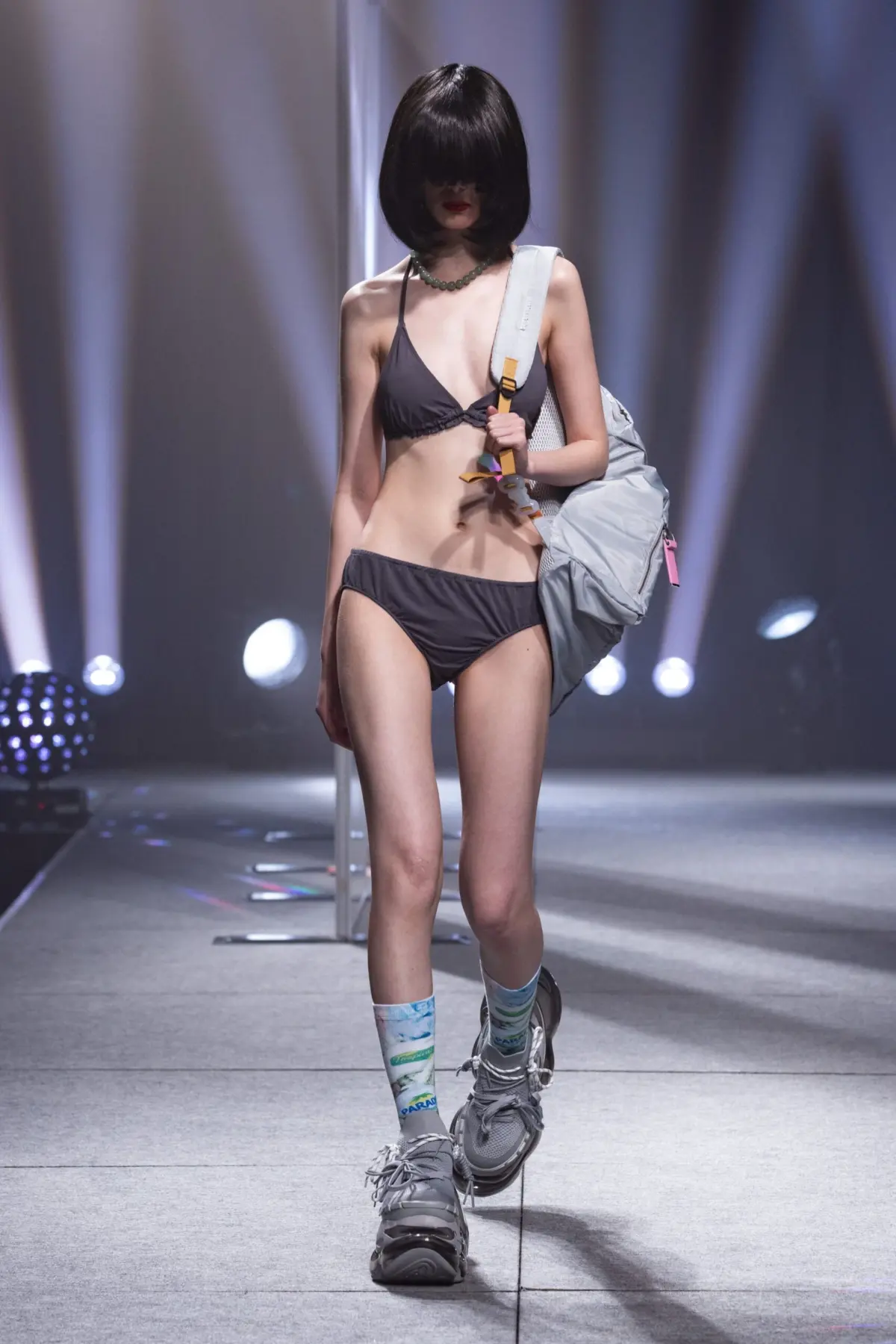
Alternating with straightforward, high-cut bikinis, models emerged onto the runway dressed in Sakabe’s trademark deconstructed, oversized tailoring and shirting. These garments were aggressively slashed and layered into chaotic, asymmetrical shapes, some festooned with delicate frills while others featured whimsical, floppy appendages that bore a striking resemblance to oversized bunny ears. The styling choices emphasized a deliberate clash of textures, eras, and silhouettes, playing on the tension between exposure and concealment that is central both to swimwear and the tropes of gravure culture.
Unifying the diverse lineup of looks were the distinctive, eye-obscuring, helmet-like wigs that have become a definitive signature of Sakabe’s recent runway presentations. When asked about his continued reliance on these opaque headpieces, the designer offered a characteristically straightforward assessment, admitting simply that he has grown to really like them. These sculptural, face-concealing wigs served to depersonalize the models, transforming them into anonymous figures wandering through a commercial dreamscape and further heightening the surreal atmosphere of the show.
Further tying the collection together was footwear sourced directly from Sakabe’s smash-hit, contemporary footwear project, Grounds. Founded in 2019 and recognized instantly by its signature chunky, bubble-soled platforms, the brand has experienced rapid international growth over the past several years and now employs approximately one hundred people globally. The gravity-defying, translucent bubble soles provided a futuristic, buoyant foundation for the chaotic tailoring above, cementing the footwear line’s vital role in the designer’s modern aesthetic ecosystem.
Sakabe, who famously shares an educational background as a classmate of fashion icon Demna during their formative years in Antwerp, has long established himself as an expert at mining the deeper recesses of underground youth culture. He possesses a rare talent for twisting subversive and sometimes jarring references into ironic fashion statements that retain a powerful commercial desirability, particularly across a dedicated and expansive fan base throughout Asia.
Like a significant portion of Sakabe’s broader body of work, this latest collection served as a meditative exploration of escapism. It contrasted the hyper-real, airbrushed superficiality of magazine pages against the distinctly banal context of a modern shopping mall, highlighting the friction that occurs when private fantasies are dragged into the harsh light of public commercial spaces.
The narrative of the presentation culminated with a striking final look: a half-worn shirtdress that brought the collection’s central thematic elements into sharp focus. Decorated with strategic slits of shimmering silver fabric, the garment appeared less like traditional clothing and more like physical portals opening up to an entirely different universe, leaving audiences to ponder the fragile boundaries between reality and the imaginary worlds we construct for ourselves.