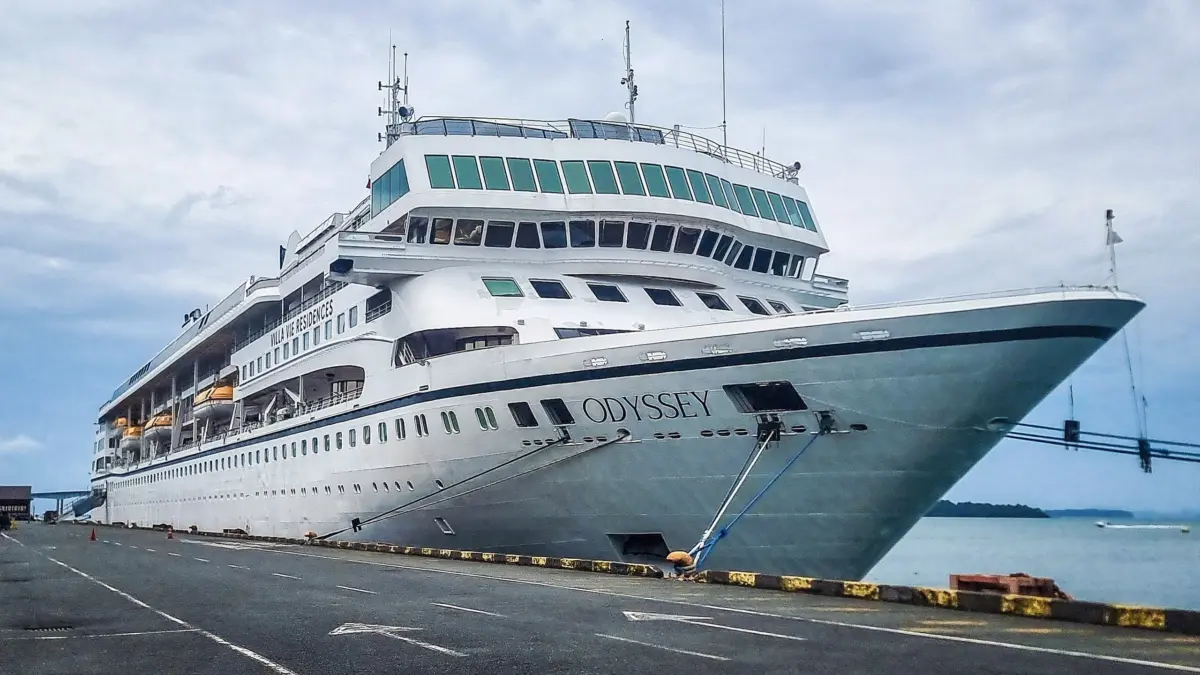
Kit Cassingham relies heavily on her daily yoga practice and her extensive background as a professional life coach to keep her grounded during turbulent times. These days, she has more than enough reasons to put those skills to the ultimate test. Earlier this week, Cassingham and her husband, Randy, received the jarring news that they were being forced to permanently disembark from the Villa Vie Residences Odyssey, the cruise ship they had called home for the past two years.
The couple, alongside roughly 200 fellow passengers who had paid significant sums to live out their retirement years traveling the globe, were informed that the company had completely run out of funds. Without the necessary capital to purchase fuel, the voyage was over, leaving passengers scrambling to collect their personal belongings and secure immediate alternative housing in a foreign port.
The Cassinghams’ grand maritime adventure began more than two years ago when they made the monumental decision to sell the custom dream home they had built and nurtured in Colorado. The move was born out of necessity rather than mere wanderlust. Randy had developed severe, debilitating environmental allergies that made everyday life in their home state unbearable.
"Randy realized he was allergic to Colorado," Cassingham explained. "He was allergic to four-legged animals, mold, dust, grasses, weeds, pinyon, and juniper trees. And we lived in a pinyon-juniper forest. His allergies got worse and worse, and even his allergists couldn’t stay on top of it."
Desperate for a solution, the couple concluded that a perpetual, never-ending cruise might be the single best environment where Randy could finally find relief from the relentless scourge of grass and tree allergens.
Their path to the high seas was fraught with complications from the very beginning. The Cassinghams initially placed a substantial financial deposit with Victoria Cruises, only to discover later that the company did not actually own a ship—a troubling reality that persists today, even as the enterprise continues to market and sell cabins to prospective buyers. By the time they uncovered the truth, however, they had already parted ways with their Colorado home and embarked on an extended pre-cruise road trip across the country to bid a final farewell to close friends and family members. Left with few options and committed to their new lifestyle, they intensified their search for a legitimate alternative.
That was when they discovered Villa Vie Residences and its flagship vessel, the Odyssey, which marketed an enticing promise: the opportunity for travelers to purchase a cabin and cruise the oceans for the rest of their lives.
Drawn by the vision of a permanent floating community, the Cassinghams purchased a balcony cabin located on the ship’s seventh-floor deck for $369,000. Their monthly operational charges—designed to cover housekeeping, laundry, fuel, and three daily meals—were initially set at $8,000. To offset these costs, the couple invested further by purchasing corporate stock in the company, securing "founder" status which successfully reduced their monthly maintenance fees to $6,000.
From the outset, however, the venture was plagued by operational hurdles. The Odyssey was originally scheduled to set sail in May 2024, but persistent mechanical malfunctions and repair delays kept the vessel docked in Belfast, Northern Ireland, until October 2024. Looking back, Cassingham recognizes that prolonged stay as the moment she began realizing the company’s leadership was severely out of their depth.
"We were gonna go up to the Amazon, and it turns out our boat was too big," she recalled. "And they just weren’t paying attention to some details."
Cassingham firmly believes that the extensive delays in Belfast put the company on an immediate financial backfoot from which it could never recover. Because the ship remained docked for months, management poured vast amounts of money into addressing mechanical breakdowns. Every time the crew managed to fix one critical issue, two additional problems seemed to emerge in its place, plunging the business deep into debt before it had even cleared European waters.
External geopolitical factors soon compounded these internal financial strains. When conflict erupted in the Middle East in February and the critical Strait of Hormuz was subsequently closed, global fuel markets reacted violently.
"Our fuel bills doubled and then tripled," Cassingham said. "And so if you already are spending more than you’re making, having it double and triple was insane. They did ask several times for us to pay fuel charges."
Despite the mounting pressures and financial instability, Cassingham noted that the internal atmosphere among the passengers remained remarkably resilient for quite some time. The community spirit aboard the ship stayed strong simply because the travelers were doing what they genuinely loved and wanted to do with their lives.
This spirit of camaraderie extended well beyond the ship’s walls. When the Odyssey arrived in the Philippines just days after a devastating typhoon struck the region, the passengers immediately organized an onboard fundraiser and contributed generously to care packages for local victims.
"We’re doing this kind of community stuff, and have no problem raising money for that," Cassingham reflected. "We just got tired of raising money for stuff we thought we were already paying for."
The situation deteriorated rapidly once the vessel reached Thailand, where founder Mikael Petterson informed passengers that he would not leave the country until he had successfully secured a new financial investor. Shortly thereafter, the ship abruptly shifted locations to Cambodia, a move that Cassingham viewed with deep skepticism.
"Next thing we know, he’s pulling up the stakes, and off we go to Cambodia where there’s no Starlink, the cell service is bad, and the fuel is expensive," she said.
According to official estimates provided by Villa Vie, per-cabin fuel expenses skyrocketed from $1,800 to somewhere between $6,000 and $8,000 per month, placing the entire corporate operating model under unsustainable financial pressure. In a public corporate statement, the company elaborated on the crisis, noting that management had implemented drastic measures to conserve resources.
"Since the conflict began in late February, we have taken significant steps to reduce fuel consumption, including slowing the itinerary and spending more time in port," the statement read. "Those measures have not been enough to offset the extraordinary increase in fuel costs, and we have been unable to continue carrying the resulting operating losses."
In an interview, Villa Vie Residences founder Mikael Petterson openly characterized his role in the unfolding corporate drama, bluntly labeling himself "the villain in the story."
"Nobody that’s tried residential cruising has succeeded, and we have gone further than anyone else," Petterson stated. "I think we would have been absolutely fine and we would have seen this through, if there was no [Middle East] war."
Red Flags Before the Shutdown
In hindsight, Cassingham admits that there were numerous warning signs pointing toward an inevitable collapse long before the ship was forced to halt operations in Cambodia.
"I personally had red flags because when we would talk to Mikael, he could never look into the camera," she recalled. "His eyes were always shifting back and forth and mysterious—off into space."
Additional warning signs quickly piled up. Cassingham pointed to a constant, revolving door of administrative employees and deeply concerning accounting practices that made financial transparency nearly impossible to achieve.
"Another red flag for me was the revolving door on their employees. Other red flags were invoices… Our monthly invoices were never correct. We always triple-checked them if we could get them. Because they were using, it turns out, a spreadsheet to manage the company. Now I’m no bookkeeper, but I know a spreadsheet’s not what you use to manage a large business."
Following the sudden shutdown, the Cassinghams have decided they have no immediate plans to return to the United States. This hesitation is driven in part by medical realities, as Randy is currently in the middle of ongoing treatment for prostate cancer. The couple intends to monitor the legal and operational developments surrounding the ship closely, with Randy scheduled to undergo further cancer-related medical evaluations in Thailand this December.
Meanwhile, a dedicated coalition of stranded passengers has formed a limited liability company (LLC) to explore potential avenues for rescuing the vessel and bringing it back into operational order. However, industry observers and passengers alike believe that a resolution is unlikely to materialize for at least another 60 to 90 days.
Despite the profound uncertainty of their current predicament, Cassingham maintains a surprisingly calm and optimistic outlook. Her background as a transformation life coach and her dedicated meditation and yoga routines continue to serve her well as she navigates uncharted waters once more.
"When the pioneers headed West from the East Coast, they didn’t know what was ahead of them," she said. "You make it or you don’t."