Factory-original engineering often hits a sweet spot between reliability, efficiency, and cost, but for true automotive enthusiasts, stepping outside the boundaries of conventional design is where the real passion lies. Across the automotive landscape, obscure engine swaps have long served as the ultimate canvas for builders who crave a unique challenge or simply want to create something entirely one-of-a-kind. While automotive circles frequently document dream conversions and standard modifications, certain projects capture attention not just for their mechanical audacity, but for the profound auditory and visual confusion they inflict on unsuspecting bystanders.
The most captivating engine swaps are those that completely upend expectations, frequently rewarding onlookers with an exhaust note that no one could ever anticipate coming from a particular chassis. From a VR6-swapped Porsche 911 pushing
numbers well into the four-digit horsepower territory to a Korean city car packing a General Motors-sourced V6 under its minuscule hood, these creations test the limits of custom fabrication. A common thread uniting the most impressive projects is a commitment to the "sleeper" aesthetic—retaining a largely stock exterior appearance that gives away virtually none of the mechanical bedlam resting just beneath the sheet metal. Avoiding protruding superchargers and overtly flashy body modifications, these builds rely entirely on the element of surprise.
Ferrari-Powered DeLorean
Almost everything about the factory-original DeLorean DMC-12 inspires a sense of nostalgic awe, from its brushed stainless steel bodywork and rakish lines to its immortal pop-culture status as Doc Brown’s time machine. Yet, its factory powerplant—a 130-horsepower, 2.8-liter V6 developed jointly by Peugeot, Renault, and Volvo (PRV)—has historically drawn criticism from drivers who felt the iconic sports car’s performance fell desperately short of its futuristic styling.
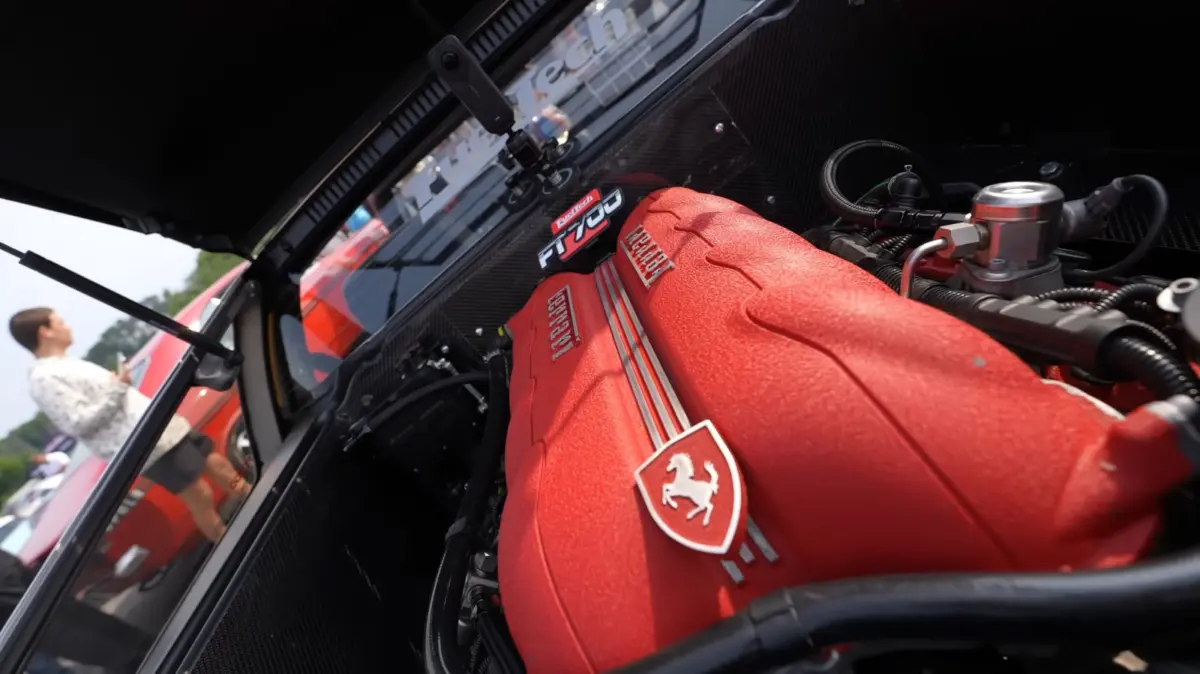
A firm known as FuelTech decided to rectify this historical grievance. When they acquired the vehicle, it was rolling without an engine and required extensive restoration. Rather than sourcing a replacement PRV or restoring it to factory specifications, the team dropped in a much more exotic 4.3-liter V8 sourced directly from a Ferrari California. This Italian mill pumps out a formidable 453 horsepower and 358 pound-feet of torque, completely transforming the driving dynamics and replacing the car’s pedestrian idle with an unmistakable high-revving Ferrari soundtrack.
To manage the substantial leap in power, the builders fitted a six-speed Tiptronic transmission harvested from a Porsche 911. Handling upgrades were addressed via a comprehensive KW suspension kit, while a larger aftermarket brake kit ensures the car can safely slow down from high speeds. While most DeLorean owners fiercely protect the originality of their vehicles or convert them into exact time machine replicas, this particular build rescued a derelict chassis from obscurity, offering a compelling blend of Italian flair and stainless steel iconoclasm.
Cummins-Swapped Prius
Toyota’s pioneering hybrid platform is universally recognized for its steadfast commitment to fuel economy and quiet, eco-friendly commuting, but one particularly unhinged build has permanently altered the reputation of the unassuming hatchback. Created by enthusiast Ben Schulz, this heavily modified Toyota Prius traded its original 1.5-liter inline-four hybrid system and complex wiring harness for a completely different kind of propulsion: a turbocharged 3.9-liter inline-four diesel Cummins engine.
The transformation required a massive undertaking, stripping out the entire interior and a significant portion of the internal structure to make room for the industrial-grade powerplant. Running on a heavy-duty setup, the Cummins engine put down a staggering 360 horsepower and 550 pound-feet of torque on the dyno. While a Volkswagen TDI engine and front-wheel drive layout were briefly considered during the planning phases, Schulz ultimately leaned into the absurdity of a rear-wheel-drive diesel conversion.
The visual dissonance of the car remains its greatest asset. From the outside, the Prius retains a remarkably stock appearance, with the builder even widening the factory rear wheels rather than swapping them out, all to preserve the deceptive sleeper look. Hearing the unmistakable thunder of a heavy-duty turbo diesel engine—traditionally found in agricultural and commercial applications—emanating from a compact hatchback shrouded in black smoke makes for one of the most remarkable double-takes in custom automotive history.
K24-Swapped C6 Corvette
The Chevrolet Corvette has a rich history deeply intertwined with American V8 engines, dating back to its early days with the Blue Flame inline-six and stretching through generations of legendary small-block and big-block powerplants. However, a factory four-cylinder Corvette has never existed. Challenging this long-standing tradition, the engineers at Unruly Motorsports built precisely that by yanking the 6.0-liter LS2 V8 out of a C6 Corvette and replacing it with a turbocharged Honda K24 four-cylinder engine.
While a standard C6 Corvette churns out a respectable 400 horsepower, the builders had far more ambitious performance targets in mind. Before finding a home in the Corvette’s engine bay, the heavily built K24 already generated 828 horsepower on 20 pounds of boost, courtesy of forged internals, a closed-deck block, and a 67mm ceramic ball-bearing turbocharger. Once fully integrated into the Chevrolet chassis and paired with a built two-speed Powerglide transmission, the setup peaked at an astonishing 917 horsepower and 563 pound-feet of torque on the dyno.
Designed strictly for performance rather than to simply provoke purists, the car frequently lays down quarter-mile passes in the low 11-second range. It effortlessly turns heads at the drag strip and on the street, largely because the high-strung, un-GM-like soundtrack of the Japanese four-cylinder stands in stark contrast to the traditional deep rumble of a standard Corvette.
Volvo 5-Cylinder-Powered Miata
Mazda’s iconic roadster has served as the foundation for countless engine swaps over the decades, ranging from high-revving naturally aspirated four-cylinders to roaring V8 conversions. Yet, amid the landscape of highly modified lightweight sports cars, a Volvo-motivated first-generation Miata manages to stand out through sheer creative resourcefulness.
Externally, the car looks like a typical, weathered project car frequently found sitting in a driveway. Beneath the factory bonnet, however, lies a B2544T engine belonging to Volvo’s revered T5 family. Displacing 2.4 liters across five cylinders and fed by a single turbocharger, the powerplant was chosen because it offered a much easier physical fit than Volvo’s larger inline-six T6 engine, while delivering an aggressive, distinctive exhaust note capable of pushing between 300 and 400 horsepower.
To handle the immense torque output, the engine is mated to a manual six-speed transmission sourced from a BMW 1 Series. This project highlights a fundamental truth of car culture: ingenuity often triumphs over an inflated budget. Combining an inexpensive Mazda chassis with a junkyard Volvo motor and a robust European transmission yields a driving experience that rivals far more expensive custom builds.
Rich Rebuilds’ V8-Swapped Tesla
Automotive content creator Rich Rebuilds captured global attention when he took a flood-damaged Tesla Model S and subjected it to the ultimate mechanical heresy by transplanting a 6.2-liter LS3 V8 engine from a Chevrolet Camaro into its front trunk. Finished in a purposefully polarizing brown vinyl wrap—a clever nod to the car’s "ICE-T" moniker, combining internal combustion engines with Tesla’s branding—the car was engineered to look as unassuming as possible from a distance.
When the ignition is turned, the thunderous roar of the V8 echoing from the vehicle’s side-exit exhaust completely shatters any preconceptions about what is moving down the road. The LS3 was coupled with a sequential six-speed manual transmission routed through a custom-built transmission tunnel, putting out roughly 440 horsepower.
While the conversion initially drew considerable online ire from purists who viewed it as a sacrilegious modification of an electric vehicle, the project ultimately saved a severely water-damaged shell from the scrap heap. After changing hands multiple times across the YouTube community over a span of five years, the car eventually returned to its creator equipped with a Magnuson supercharger, ensuring that its unpredictable evolution will continue to draw stares.
Turbo VR6-Powered Porsche 996 Turbo
The Porsche 911 996 Turbo is a formidable performance machine straight out of the factory, delivering 415 horsepower and 413 pound-feet of torque from its twin-turbocharged 3.6-liter Mezger flat-six. Known for its exceptional tuning potential, the Mezger engine can easily be modified to produce staggering figures. However, the specialists at Speed Density Motorsports took a radically unconventional path to unlock up to 1,500 horsepower from the same chassis.
Instead of tuning the factory boxer engine, the team removed it entirely, dropping in a heavily modified 3.2-liter Volkswagen VR6 engine—a legendary powerplant that has proven its versatility across the Volkswagen lineup for over three decades. Upgraded with billet aluminum components, forged internals, and a massive Precision 8565 ball-bearing turbocharger running on methanol fuel, the resulting high-boost configuration is engineered to handle extreme loads.
Demonstrated through shop vehicles running advanced tuning packages capable of surpassing 1,300 horsepower on E85 fuel, the VR6 swap trades the traditional Porsche exhaust note for the unmistakable, aggressive warble of Volkswagen’s narrow-angle six-cylinder. It stands as one of the most mechanically intense and sonically distinct conversions ever performed on a modern 911 chassis.
V6-Swapped Daewoo Matiz
Compact city cars are rarely built with high-performance aspirations in mind, and the Daewoo Matiz—a diminutive four-door hatchback produced from the late 1990s onward—was designed strictly for affordable, utilitarian transit. Originally powered by a modest 52-horsepower, 0.8-liter inline-three engine, the Matiz prioritized economy above all else.
Rejecting conventional automotive wisdom, one enthusiast decided to test the ultimate engineering challenge: fitting the largest possible engine into the smallest available car. The donor engine chosen was a naturally aspirated 3.2-liter V6 from a Vauxhall Vectra, producing 208 horsepower and 221 pound-feet of torque. Given that a stock Matiz tips the scales at a mere 1,711 pounds, the resulting power-to-weight ratio transforms the humble economy car into an unexpected powerhouse.
Accommodating the massive V6 under the tiny front bonnet required custom engine mounts and a modified intake manifold, though the builder managed to retain the factory airbox. Stopping power was significantly upgraded through a custom big-brake kit featuring Ford Focus RS rotors and Mitsubishi Lancer Evolution VI calipers hidden behind 18-inch Porsche alloy wheels. Complete with a lightened flywheel, a limited-slip differential, and a Vauxhall gear-shifter while maintaining a completely stock interior, the V6 Matiz delivers an astonishingly chaotic driving experience that completely redefines the city car segment.