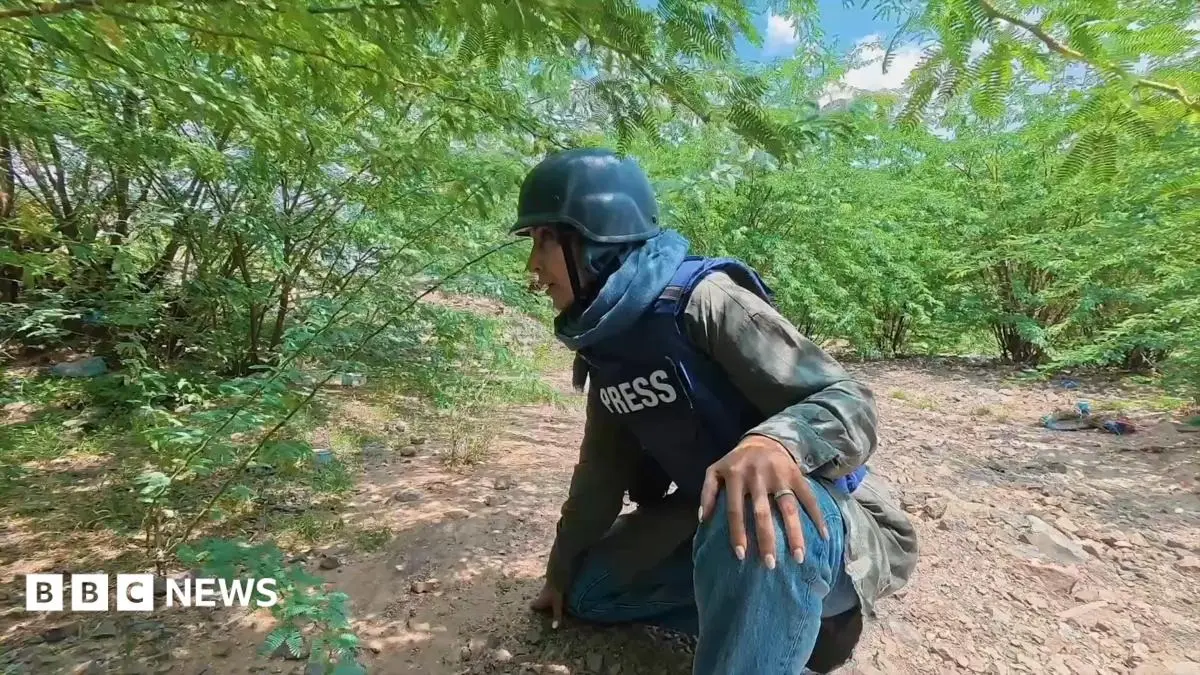
In a rare and precarious venture into the heart of Yemen’s fractured landscape, the BBC has gained unprecedented access to the frontlines of a conflict that has largely remained shielded from the eyes of the international community. Traveling alongside Saudi-backed government forces, the crew navigated the jagged, treacherous terrain stretching from the city of Taiz—a city long besieged and divided—through a gauntlet of military checkpoints that demarcate the shifting boundaries of power in this brutal civil war.
The journey leads to the stark, silent divide where the reach of the internationally recognized government abruptly ends, giving way to the contested expanse of no man’s land. This is the jagged edge of a war that has intensified significantly in recent weeks, following a strategic shift that has seen Houthi fighters surge down the Red Sea coast. By seizing control of key shipping chokepoints, the Houthi forces have not only expanded their territorial footprint but have also injected a new sense of urgency and volatility into a conflict that has already claimed thousands of lives and triggered one of the world’s most acute humanitarian crises.
For the soldiers tasked with holding these positions, the environment is defined by a perpetual state of vigilance. The landscape is a patchwork of crumbling infrastructure and abandoned outposts, where the air is thick with the dust of moving convoys and the palpable tension of an unseen enemy. As the BBC crew moved through these frontline zones, the reality of the threat became hauntingly tangible. High above the barren terrain, the unmistakable, mechanical hum of a drone—a sound now synonymous with the modern theater of war—began to echo through the silence.
A soldier accompanying the crew, seasoned by the relentless grind of this conflict, offered a grim assessment of the situation: the presence of a drone is rarely a coincidence. In this sector of south-western Yemen, such aerial reconnaissance is almost invariably the precursor to a kinetic strike. It is a calculated prelude, a sign that target acquisition is underway and that the window for safety is rapidly closing.
The reality of that warning manifested with terrifying precision. Within ten minutes of the crew departing the immediate vicinity of the frontline position, the quiet was shattered by the rhythmic, percussive thuds of incoming strikes. The intensity and speed of the bombardment served as a stark reminder of how quickly the situation on the ground can deteriorate from a tense standoff into a full-scale tactical engagement. Nawal Al-Maghafi, the BBC’s senior international investigations correspondent, reporting from the scene, underscored the inherent danger of documenting this conflict. The proximity of the strikes to the area recently occupied by the crew highlights the vulnerability of both combatants and civilians in a war zone where the frontlines are fluid, and the reach of aerial weaponry is indiscriminate.
The escalation along the Red Sea coast is a development of significant geopolitical consequence. The waterway, a critical artery for global trade, has become the latest theater in a power struggle that draws in regional actors and complicates the prospects for a lasting peace. For the pro-government forces, the objective is clear: to push back against the Houthi advance and reclaim the strategic vantage points that ensure the flow of commerce and the security of the coast. However, the terrain is unforgiving, and the Houthi fighters have proven to be resilient adversaries, adept at utilizing the rugged geography to their advantage.
The situation in Taiz, the starting point of the crew’s journey, encapsulates the broader tragedy of Yemen. Once a cultural and intellectual hub, Taiz has been trapped in a state of suspended animation, with its residents caught between the warring factions. The checkpoints through which the BBC crew traveled are the physical manifestations of this division. Each one represents a microcosm of the conflict, controlled by different factions, requiring complex negotiations for passage, and serving as a reminder that for the people living in these zones, the war is not a distant phenomenon but a daily barrier to movement, resources, and basic survival.
As the government forces attempt to regain momentum, the civilian population remains in the crosshairs. The intensification of the fighting along the coast threatens to exacerbate the already dire humanitarian situation, where food insecurity, a collapsing healthcare system, and the displacement of millions have become the hallmarks of the Yemeni experience. The strategic importance of the shipping chokepoints suggests that this area will remain a focal point for the conflict for the foreseeable future, as both sides recognize that control over these waters is essential for their respective leverage in any potential future negotiations.
The drone strikes witnessed by the crew are symptomatic of a broader shift in how this war is being waged. The reliance on unmanned aerial vehicles for reconnaissance and target acquisition has transformed the nature of the frontline. No longer confined to direct fire engagements between infantry, the battlefield is now dominated by the threat from above, forcing combatants to operate under the constant shadow of potential bombardment. This evolution in tactics has made the work of journalists and aid workers increasingly hazardous, as the distinction between a military target and a civilian presence becomes increasingly blurred in the chaos of battle.
The reports from the frontlines paint a picture of a conflict that is far from reaching a resolution. The resilience of the pro-government forces, bolstered by Saudi support, is being tested by a Houthi insurgency that shows no sign of yielding its recently acquired positions. The volatility of the Red Sea coast ensures that the regional and international stakes remain high, drawing the attention of global powers concerned with the stability of one of the world’s most important maritime corridors.
For the soldiers on the ground, the conflict is measured in inches and hours—the time it takes to move between checkpoints, the distance gained in a skirmish, and the minutes between the appearance of a drone and the descent of munitions. The BBC’s access to these areas provides a rare, unfiltered look at the tactical reality of the Yemeni civil war, striping away the abstract discussions of international policy to reveal the brutal mechanics of a conflict that continues to burn with unrelenting intensity.
As the smoke cleared from the strikes following the crew’s departure, the landscape returned to its uneasy, watchful state. The soldiers remained at their posts, eyes scanning the horizon for the next sign of movement, while the people of the region continued to navigate the precarious existence of living in the shadow of war. The events of that day serve as a sobering testament to the volatility of the frontlines in south-western Yemen, where every sound in the sky carries a warning and every journey is a gamble against the sudden, violent reality of a war that refuses to be ignored. The situation remains fluid, with the eyes of the world now turned toward the coastal reaches, waiting to see if the recent escalations will lead to a broader conflagration or a stalemate that persists into an uncertain future.