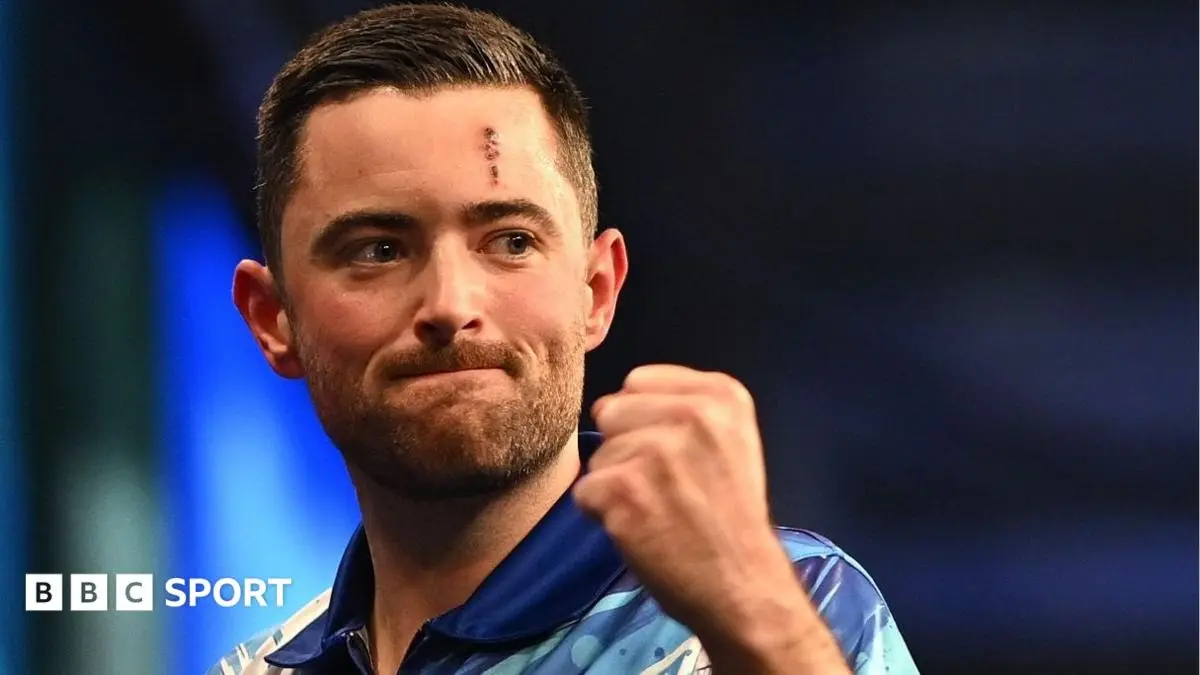
The drama of the World Grand Prix intensified in Leicester on Thursday night as reigning champion Luke Humphries navigated his way into the quarter-finals with a clinical display. While the tournament’s unique “double-in, double-out” format continues to claim high-profile victims, the world number two demonstrated the composure required to keep his title defense alive, joined in the final eight by seasoned veteran James Wade and the rising Dutch contingent of Gian van Veen and Niels Zonneveld.
Humphries, who ascended to the pinnacle of the sport with his world title win in 2023, arrived at this tournament under significant pressure to replicate his form from the previous season. His opponent, Jermaine Wattimena, was expected to provide a stern test, but Humphries dictated the pace from the outset. With a commanding 3-0 victory, the Englishman reaffirmed his status as the man to beat in Leicester, delivering a performance defined by efficiency and tactical precision.
The stats underlined the dominance of the world number two. Humphries fired in three maximum 180s during the contest, a tally that ensured he consistently put Wattimena under pressure on the scoring front. Perhaps most importantly for a tournament that rewards clinical finishing, Humphries produced a high checkout of 129, a moment of brilliance that effectively stifled any potential momentum Wattimena hoped to build.
Speaking to Sky Sports following the conclusion of the match, Humphries offered a measured assessment of his display. "It wasn’t the best performance, but it was a good performance," he noted, acknowledging that while his scoring may not have reached the stratospheric heights he has occasionally scaled this year, his fundamental game remains rock solid.
The secret to his success, according to Humphries, lies in his consistency at the start of each leg. In the World Grand Prix, players must start every leg with a double, a requirement that frequently leads to prolonged stalemates and unforced errors. "I think I got in every time with my first three [darts]," Humphries explained. "When you are doing stuff like that, it is going to take a top performance to beat you."
Looking ahead, the road to the trophy remains challenging. Humphries is slated to face the Netherlands’ Niels Zonneveld in the next round, a player who signaled his intent with a spirited 3-1 victory over the legendary Gary Anderson. Despite the bracket shifting and the pressure mounting, Humphries remains confident in his trajectory. "I’ve got a good chance of winning this," he added. "At the moment I am a bit up and down, but if I can put that right I am going to be tough to beat."
The victory serves as a vital psychological boost for Humphries, particularly after the sting of his defeat to the teenage sensation Luke Littler in last year’s final. With Littler now eliminated from this year’s edition, the path has cleared slightly, though the remaining field is packed with players who possess the pedigree to thrive under the unique pressures of the Grand Prix format.
Elsewhere on the stage, the veteran presence of James Wade reminded the darting world that experience remains an invaluable asset. Wade, a two-time World Grand Prix champion with titles captured in 2007 and 2010, is hunting a third crown that would further cement his legacy in the sport. His match against Stephen Bunting was a grueling test of nerves and accuracy, which Wade ultimately navigated to secure a 3-1 win.
The format of the World Grand Prix is notoriously unforgiving, and the contest between Wade and Bunting highlighted exactly why. Every leg requires a double to start and finish, meaning a player can lose their rhythm in a heartbeat if their starting darts fail to find their mark. Wade took control of the contest early, securing the first two sets with a display of disciplined darts. While Bunting managed to claw back a set, demonstrating his own capacity for pressure-heavy play, Wade remained unruffled. He regained his focus in the fourth set to secure the victory, proving once again that his tactical understanding of the game is as sharp as ever.
The quarter-final stage will now see Wade face Gian van Veen, a match that promises to be a fascinating clash of styles and generations. Van Veen, who garnered significant attention for his run to the PDC World Championship final in January, has been identified as one of the sport’s most promising talents. His progression to the quarter-finals was anything but straightforward, requiring him to dig deep against Ryan Searle.
The encounter between Van Veen and Searle was one of the most unpredictable matches of the night. Van Veen began with confidence, taking the first set and appearing to have the measure of his opponent. However, the momentum swung violently in favor of Searle, who surged to a 2-1 lead. At that juncture, the young Dutchman was staring down the barrel of an early exit. Yet, showing a level of maturity that belies his age, Van Veen recovered to level the match at two sets apiece. The deciding set was a high-stakes affair, but it was Van Veen who managed to find the necessary accuracy under pressure, clinching the final leg to set up his showdown with Wade.
The stakes for Van Veen go beyond just the World Grand Prix title. Given the current ranking landscape, the young Dutchman is in a position where he could potentially challenge for the world number two spot, provided that Humphries does not lift the trophy in Leicester. This adds an extra layer of intensity to his upcoming match against Wade, as the veteran looks to block the path of the rising star.
As the tournament moves into the quarter-final stage, the focus shifts to the small margins. The World Grand Prix has historically been a tournament where the favorites are often tested by the nuances of the double-in rule, and the remaining players—Humphries, Zonneveld, Wade, and Van Veen—represent a mix of established dominance and emerging hunger.
Humphries’ assessment that he is currently "up and down" mirrors the general atmosphere of the tournament so far. The fans in Leicester have witnessed high-quality scoring interrupted by the occasional struggle to find the opening double, a reality that keeps every match competitive until the final dart hits the board. For Humphries, the goal is now to stabilize his game and minimize those fluctuating moments.
With the field thinning out, the intensity of the competition is set to ramp up. The upcoming quarter-final ties will test the resilience of the players, particularly those like Humphries and Wade who are managing the weight of expectation. For the younger contenders like Zonneveld and Van Veen, the stage offers a golden opportunity to claim a major title and leave an indelible mark on the sport’s history.
As the dust settles on this latest round of action, the narrative remains clear: the World Grand Prix is a test of temperament as much as it is a test of skill. Whether it is the cool, calculated scoring of the reigning champion or the gritty, battle-tested efficiency of a veteran like Wade, the players who survive the next few days will be those who can best adapt to the relentless pressure of the Leicester stage. The race for the title is far from over, and with the field now narrowed down to the final eight, the path to the trophy remains as treacherous as it is rewarding.