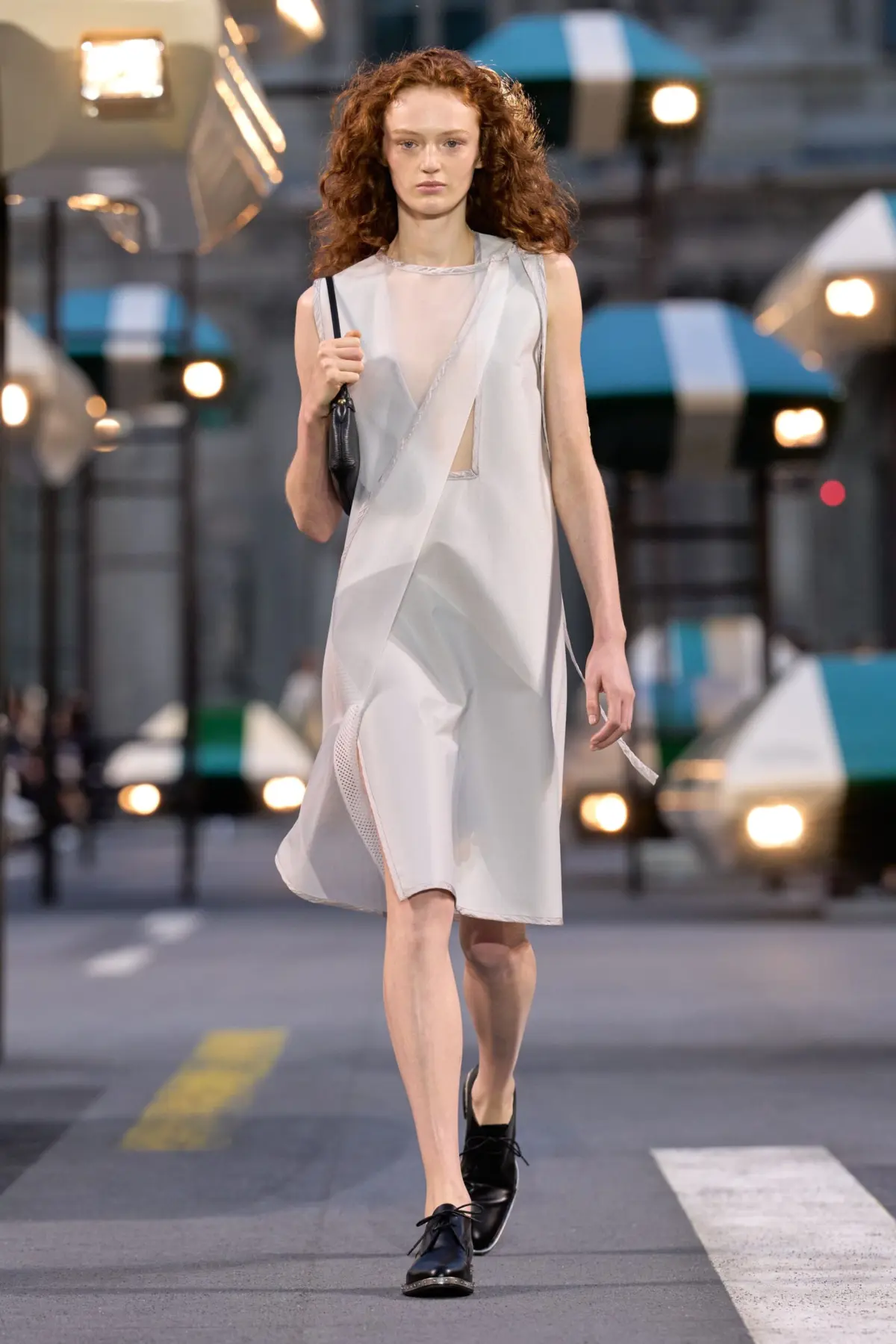
PARIS — The Louvre’s historic Cour Carrée was transformed into an airfield straight out of a mid-century futuristic cartoon, complete with hovering flying cars featuring glowing red tail lights and signature Damier check paint jobs that drifted above the audience before touching down on the ersatz macadam. Yet, beneath the cinematic, space-age runway set, a seismic shift was taking place. Nicolas Ghesquière, Louis Vuitton’s visionary artistic director of women’s collections, was not actually looking back to the future for his spring 2027 outing—marking, incidentally, two decades since he famously introduced his iconic C3PO leggings during his legendary tenure at Balenciaga. Instead, the acclaimed French designer was chasing something remarkably more down-to-earth: an ergonomic, body-first philosophy that prioritized unadorned wearability over theatrical spectacle.
This represents a striking and notable departure for a creator who has long defined his signature through architectural grandeur and temporal dissonance. The timing of this stylistic pivot arrives on the heels of major personal recognition. Just last week, Ghesquière was awarded the prestigious Légion d’Honneur by French President Emmanuel Macron at the Élysée Palace, honoring his profound and enduring impact on French fashion and culture. The designer’s ties to the highest echelons of French society are well-documented; notably, he has dressed France’s first lady, Brigitte Macron, ever since her husband’s initial presidential election victory. During the ceremony, President Macron delighted the assembled guests with a playful quip, remarking to much laughter that Ghesquière was essentially "the second man in her life," adding with a smile that he was not quite sure how to take that.
While his diplomatic and social standing remains firmly anchored in the upper tiers of Parisian prestige, Ghesquière’s recent runway presentations have frequently transported audiences to entirely different dimensions. Over past seasons, he has leaned heavily into larger-than-life silhouettes, crafting collections defined by traditional shepherd’s cloaks or dramatic, Dune-esque robes for resort wear. His penchant for out-of-time references has served as a persistent thread across his work, effortlessly bridging the stylistic gap between 1980s party-girl mufti and elaborate 18th-century panniered frocks.
Given this penchant for the grandiose, the opening moments of the spring 2027 show sent a clear, unexpected signal to the fashion world. The presentation commenced not with a monumental historical homage or a futuristic metallic carapace, but with a deceptively simple sleeveless white shift dress paired unassumingly with classic black men’s oxfords.
"I wanted to express a sensation of simplicity, a feeling of purity," Ghesquière explained backstage, shedding light on his newly minted design ethos. "It’s an impression of minimalism, but the work behind this construction, the simplification, making things extremely light, is really complex."
This dedication to restrained refinement rippled through the subsequent looks that followed down the runway. The collection unfolded with a series of understated ensembles, featuring collarless jackets and straight-leg trousers engineered with the clean, unadorned efficiency of a modern uniform. Floaty summer dresses drifted past in delicate, lettuce-edged layers of chiffon, while checked pantsuits were crafted with a featherlight touch, moving with the fluid grace of traditional flou tailoring.
Ghesquière noted that these pared-down instincts were born partly from a reaction to the prevailing chaos of the world outside the fashion bubble, though the designer is operating within a broader industry-wide chorus of change. The wider landscape of luxury fashion is currently navigating a profound and sweeping reset. This transitional period has ushered in a fresh generation of creative directors across major houses who are responding directly to shifting economic realities. Driven by the mounting pressures of the modern global marketplace—and a collective cultural realization that grounded, unstudied clothes simply resonate more powerfully right now—many designers are shifting focus toward customer-oriented, relatable collections. Naturally, observers are left to wonder whether this broader industry realignment played a role in recentering Ghesquière’s own creative compass.
Regardless of external market forces, the return to a more wearable Ghesquière carries a potent sense of nostalgia and renewed relevance for long-time industry insiders. Back during his foundational years at Balenciaga, fashion critics and ardent shoppers alike rhapsodized endlessly about his peerlessly cut trousers. Now, in 2026, the concept of a deeply wearable Ghesquière collection holds a remarkably fresh and appealing ring.
Among the standout moments of the season, a pair of embellished hammered satin elongated tanks accompanied by flowing, fluid pants emerged as a masterclass in modern eveningwear. To many in attendance, these sophisticated yet effortless pieces ranked securely among the finest evening looks presented in Paris this season, pointing toward an exciting, highly wearable horizon that many hope the designer will continue to explore in the chapters ahead.