The Tesla Roadster is back in the spotlight, though the vehicle that enthusiasts and early adopters thought they knew has fundamentally changed. When the second-generation sports car was first unveiled back in 2017, CEO Elon Musk famously bragged about its sub-two-second zero-to-sixty-mile-per-hour acceleration and an astonishing 620 miles of electric range. Those ambitious metrics have now taken a backseat. The thousands of customers who spent millions of dollars to preorder the vehicle years ago are looking at an entirely different machine.
Instead of focusing on conventional EV metrics like range, the newly reimagined second-generation Roadster leans heavily into Tesla’s corporate and technological relationship with SpaceX. Welcome, theoretically, to the age of consumer flying cars.
According to Musk and the live demonstrations held during Tesla’s recent re-reveal event, the updated Roadster actually flies. Tesla’s presentation included jaw-dropping claims: a zero-to-sixty time of just 0.81 seconds, a fan installation mounted beneath the vehicle to generate massive ground-effect downforce, and the headline-grabbing capability of short-burst flight. The redesigned vehicle is now strictly a two-seater, will be offered across three distinct trim levels depending on how aggressively outfitted a buyer wants their flying capabilities to be, and targets a production start date in 2028. When pressed on that timeline during the event, Musk insisted with brief emphasis: "Actually."
The New Design
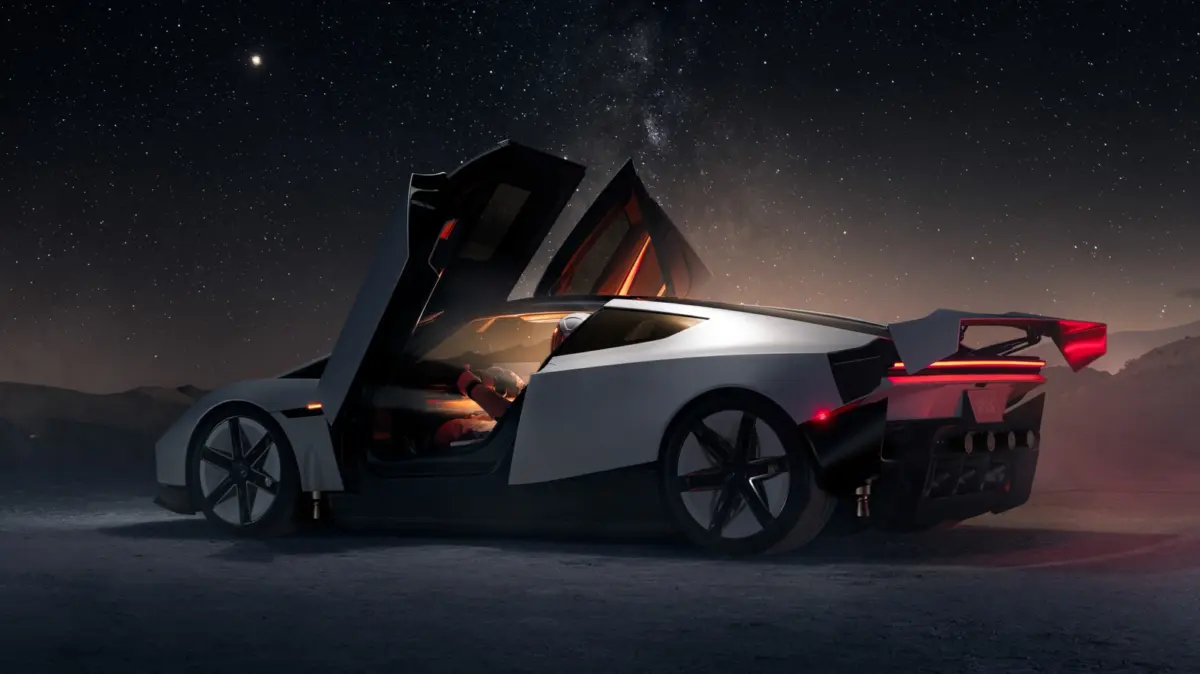
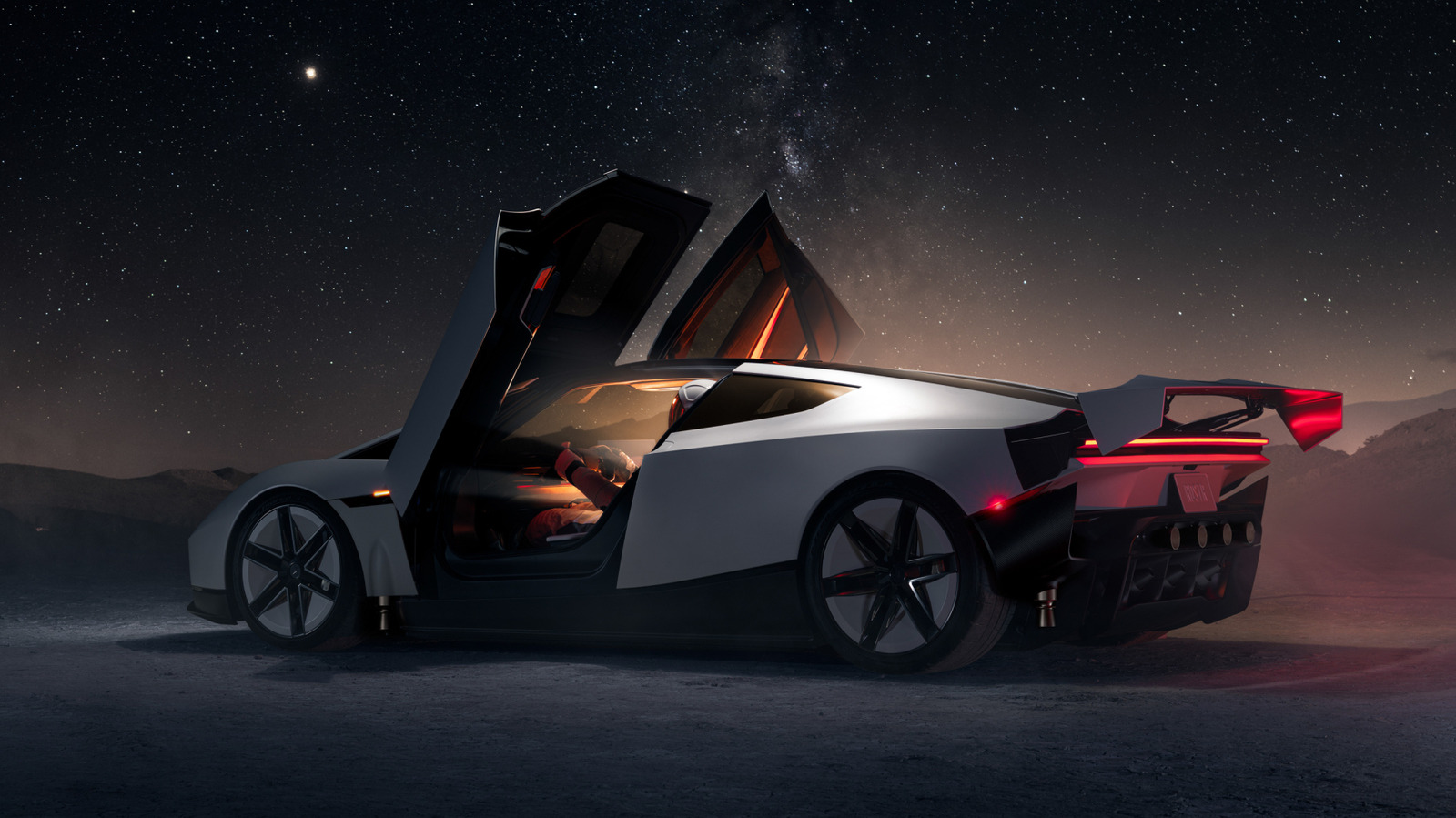
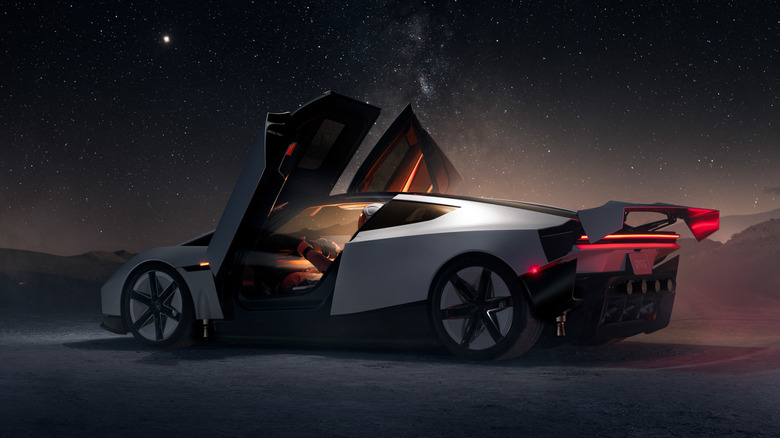
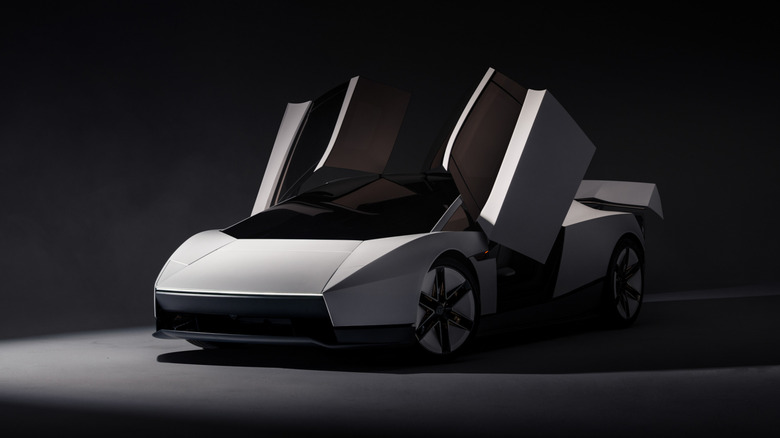
Before diving deep into the aeronautical and rocket-inspired technology, the visual identity of the new Roadster marks a complete departure from the prototype shown in 2017. Tesla executives explicitly cited military aircraft as direct design inspiration, pointing to the F-35 and SR-71 fighter jets, alongside the famous Wet Nellie lotus submarine from the James Bond film The Spy Who Loved Me. Most noticeably, however, the styling is heavily informed by spaceflight aesthetics, utilizing crisp white exterior paint and gold-tinted window glass intended to evoke the look of classic Apollo space suits.
Beneath the radical exterior panels, nearly every mechanical component has been revised. The vehicle features a prominent rear wing that matches active aerodynamics seen in recent Tesla patent filings, designed to extend both upward and rearward to manage airflow dynamically, much like contemporary hypercars. The front suspension has been shifted inboard, a packaging adjustment likely required to carve out physical space for an intricate network of internal air hoses. Inside the cabin, the layout has been entirely re-engineered. The Roadster is no longer a 2+2 grand tourer capable of carrying occasional rear passengers; it is now a strict two-seater with bucket seats molded directly into the vehicle’s carbon structure in a manner reminiscent of the Ford GT.
Okay, the Flying Car Thing
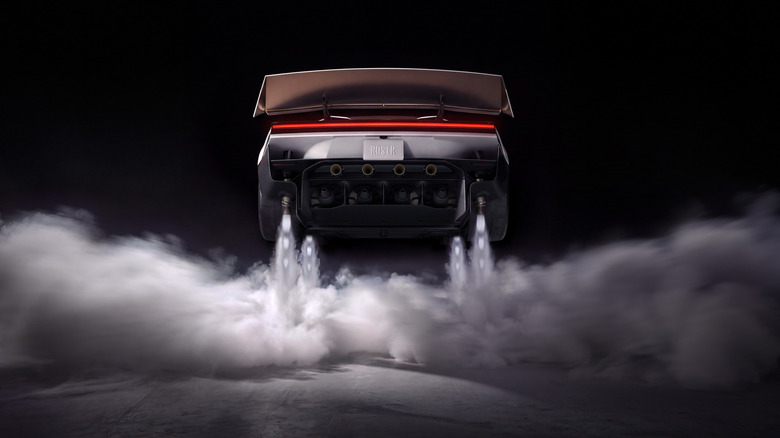
The most contentious and sensational aspect of the re-reveal was, without a doubt, the demonstration of flight. During the livestreamed presentation, Tesla showed footage of a Roadster executing a brief, airborne hop. The driving force behind these extreme maneuvers is a cold thruster system, centered around a 158-gallon carbon-wrapped tank positioned directly behind the cabin. This system compresses air and vents it explosively through ten distinct exhaust ports distributed across the vehicle: one at each corner to provide vertical lift, one on each front fender for lateral movement, and four integrated into the rear to propel the car forward.
Tesla’s demonstrations showed the vehicle sticking to an upside-down track, righting itself midair after launching off a ramp, jumping over obstacles, and performing a stationary flip. While the system appears capable of sustaining thruster activity for only fleeting moments—resulting in dramatic hops rather than sustained flight—the mechanical forces involved are undeniably immense. Tesla quoted the rear thrust output at over 80 kilonewtons, translating to roughly 4,500 pounds of force per thruster.
The vehicle’s tier structure dictates access to this technology. The base Performance trim omits the thrusters entirely, repurposing the space that would house the air tank for standard cargo room, though it retains the under-floor fan system. Step up to the limited Thrust trim, and buyers receive the four rear thrusters. Finally, the invite-only Rocket trim unlocks all ten thrusters, features a single-occupant layout, and includes an undefined "full flight system," leaving open questions about what occupies the passenger side in place of a second seat.
Performance Specs
Tesla backed up its presentation with a flurry of astonishing performance numbers. Alongside a recorded video showing a one-second run to sixty miles per hour, the company conducted a live demonstration during the event. Tesla claimed that this live run achieved sixty miles per hour in just 0.81 seconds, though no official or independent timing equipment was visible during the run. This acceleration is heavily dependent on the rear-facing thrusters. Interestingly, the vehicle used for the live acceleration test appeared to be the Thrust trim, lacking the visible downward-firing thrusters behind the front wheels that were clearly present on the dedicated jump car used for the media demonstrations. Musk noted that the final production version would likely improve upon that 0.81-second benchmark.
Furthermore, Tesla asserted that the production car will pull greater than two Gs of lateral cornering force and achieve top speeds exceeding 230 miles per hour. Musk immediately pushed those projections even further on stage, suggesting the production model should aim to "crack halfway to the speed of sound—Mach 0.5, maybe higher." Reaching Mach 0.5 translates to roughly 383 miles per hour, a velocity more than 100 miles per hour faster than any current production car record on Earth.
Does Any of This Matter?
Even Elon Musk acknowledged the speculative nature of the presentation during the event, telling the audience that success was far from guaranteed. He noted that while the technology would likely work, viewers should maintain a safe distance just in case. Tesla has a long history of introducing vehicle features that function as high-tech party tricks, but these new additions arguably compromise the everyday usability of the sports car. A functional trunk is a frequent priority for drivers, whereas the ability to execute a stationary vehicle flip holds questionable practical value. Furthermore, Tesla representatives explicitly noted that no human drivers were inside the vehicles during the stunt demonstrations, as the violent forces generated would likely cause severe physical harm to an occupant.
Skeptics point out that Tesla has frequently announced ambitious, unsubstantiated vehicle specifications in the past without immediate industry verification. The vehicles utilized for the dramatic stage demos appeared to be specialized prototypes or empty shells engineered exclusively to perform specific stunts under controlled conditions. The headline-grabbing 0.81-second zero-to-sixty claim lacked independent telemetry verification, and Tesla has yet to demonstrate how these aerospace systems can function safely within standard regulatory frameworks or everyday physics.
Meanwhile, official preorders for the Roadster have officially reopened, with the company collecting refundable $50,000 reservation checks for a vehicle scheduled to enter production two years from now. Tesla has not yet clarified how it intends to compensate or transition the thousands of customers who placed deposits on the entirely different grand tourer concept originally revealed nine years ago. As the company invites fresh capital under the Roadster name, questions remain regarding how these funds will be allocated across its broader corporate ecosystem as the automotive industry watches to see if these science-fiction promises ever materialize on public roads.