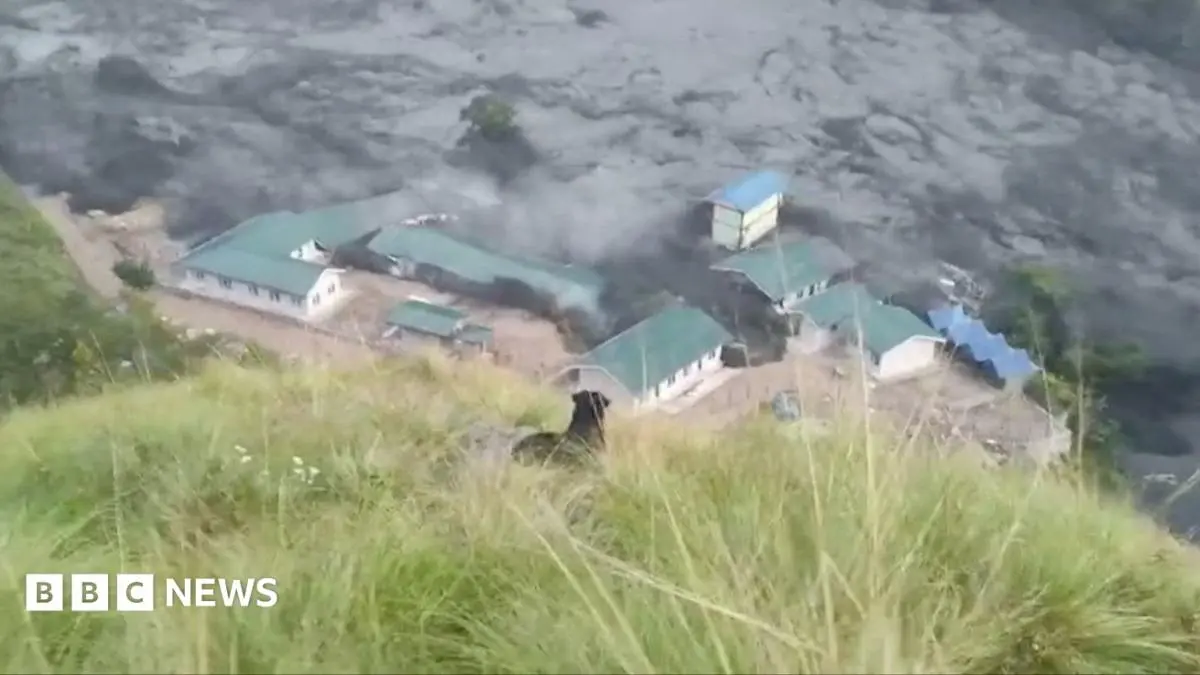
A major river in Nepal has surged with devastating force, sweeping away homes, critical infrastructure, and parts of a hydropower station, plunging the central Gorkha district into a state of emergency. As the nation grapples with the aftermath, authorities are working against the clock to locate the missing and provide relief to hundreds of families left displaced by the sudden catastrophe.
According to the Nepali army, at least 95 individuals—including nine foreign nationals—have been rescued along the banks of the Budhi Gandaki River. While no fatalities have been officially confirmed at this stage, the situation remains precarious, with five people currently reported missing. The disaster, which unfolded on Sunday, has sent shockwaves through a region already reeling from the trauma of previous environmental tragedies.
The scale of the destruction was captured in harrowing video footage, which shows the moment the raging torrents roared down the valley, engulfing and washing away an entire building complex. For the residents of Gorkha, the timing of the disaster was particularly cruel; it arrived just as families and communities were preparing to celebrate the first day of Dashain, the most significant festival in the Nepali calendar.
Official figures from Nepal’s Disaster Risk Reduction and Management Authority paint a grim picture of the impact: more than 200 homes have been damaged or destroyed, and over 650 people have been directly affected. The destruction of suspension bridges—vital lifelines in the rugged Himalayan terrain—has left several settlements completely cut off from the outside world. A local official speaking to The Kathmandu Post confirmed that many of these isolated communities are now accessible only by air, complicating the delivery of aid and the evacuation of the injured.
In response, the Nepali army has mobilized four helicopters to spearhead search and rescue operations, attempting to reach those stranded in the most inaccessible pockets of the district. For the thousands impacted, the immediate future is defined by uncertainty. Many families have been forced to flee their homes with little more than the clothes on their backs, now facing the daunting prospect of finding safe shelter and essential supplies in the wake of the deluge.
The sheer velocity and volume of the floodwaters caught even those living in the river’s path by surprise. Ganesh Karki, a resident of Jagatbagar, recounted the terrifying experience of receiving an early morning warning call about the approaching flood. Along with his neighbors, he scrambled to higher ground, taking refuge in a nearby forest about 500 meters (0.3 miles) uphill.
"We never imagined a flood of this size," Karki told The Kathmandu Post. "The water surged for about 15 minutes and then stopped, repeating this pattern throughout the morning. We are afraid to return home at night."
The hydrological data, where available, underscores the severity of the surge. Officials reported that in a single location, the water levels of the Budhi Gandaki rose from two meters (6ft 5in) to nearly 8.5 meters (27ft 9in) in just a matter of hours. The intensity of the flow was so great that it overwhelmed scientific monitoring equipment, leaving experts in the dark regarding real-time conditions.
"Our hydrological station was swept away, and we are not getting any data from that location," said Binod Parajuli, a meteorologist working with the Nepalese government.
Beyond the residential losses, the economic impact is significant. The flood decimated critical infrastructure, including several suspension bridges and a hydroelectric project. Construction equipment and heavy machinery were reportedly swept away by the current, signaling a long and costly road to recovery for the region’s energy sector.
While the exact cause of the flood remains a subject of ongoing investigation, several theories have emerged. Some experts suggest that a landslide may have blocked the river or one of its tributaries, creating a temporary dam that eventually burst under the pressure of the pent-up water. Others point to reports from locals living upstream who witnessed what appeared to be an ice-avalanche, which could have triggered the massive displacement of water and debris.
This incident is particularly alarming given the context of Nepal’s recent history with natural disasters. Only two months ago, the country was hit by catastrophic floods along its border towns with Tibet, a disaster that claimed more than 1,400 lives and left thousands missing. That tragedy was attributed to an avalanche of rock and ice near the peak of Langtang Lirung, a mountain on the Nepali side of the Himalayas.
The Budhi Gandaki, a tributary of the Trishuli River, flows downstream from a region where glacier collapses have become an increasing threat. For the people of Gorkha, the fear is palpable, as many residents have barely had time to recover from the psychological and physical scars left by the August mega-floods.
Humanitarian organizations are already mobilizing to mitigate the impact on the most vulnerable. Save the Children has begun deploying an emergency team to the affected areas, emphasizing the profound toll this disaster is taking on the younger generation.
"Children’s lives have been ripped apart in an instant yet again," said Tara Chettry, the charity’s director in Nepal. "We are yet to see the full scale of the damage, but they may have lost their homes, schools, and communities. Many children in Gorkha will still be in shock and distress after the mega-floods in August, barely having a chance to get back on their feet."
The recurring nature of these events has reignited a national conversation about the impact of climate change on the Himalayan landscape. Experts note that as global temperatures rise, glaciers are melting at an accelerated rate, significantly increasing the risk of glacial lake outbursts, ice avalanches, and subsequent flash floods. This unpredictable environmental reality leaves local communities, often living in remote and steep terrain, increasingly vulnerable to disasters that strike with little to no warning.
As the sun sets on the Gorkha district, the focus remains firmly on the search for the five missing individuals and the provision of emergency aid to those displaced. The government remains on high alert, with disaster management teams monitoring river levels and weather patterns, wary of further instability.
For now, the people of Gorkha are left to navigate the aftermath of a disaster that has once again highlighted the fragile balance between life in the shadow of the Himalayas and the increasingly volatile forces of nature. With the Dashain festival interrupted and homes lost, the focus of the community has shifted entirely to survival, recovery, and the long, uncertain process of rebuilding their lives amidst the wreckage.