What in tarnation do you need a 102.4-liter engine for? If your mind immediately jumps to unfathomable horsepower figures, think again. This massive 102.4-liter inline-eight-cylinder turbodiesel was delivered to the U.K. Air Ministry in Scotland just after the conclusion of World War II. While it easily qualifies as one of the largest engines ever built, its primary mission was never about speed or acceleration.
The true purpose of this mechanical monolith was power generation. It was deployed as a stationary generator, most likely serving on a Royal Air Force base during a period when reliable, heavy-duty electrical generation infrastructure was vital. The engine in question, the Mirrlees Blackstone JS8, belonged to a renowned series of industrial power plants manufactured by a company with a rich history in heavy engineering. These robust power plants scaled all the way up to 16 cylinders, capable of producing up to 2,446 horsepower.
Yet, when evaluating the JS8 through the lens of modern automotive engineering, its power-per-liter output reveals a stark contrast. Consider that a modern high-performance powerplant, such as the engine found in the 2023 Dodge Challenger Demon 170, can generate an astonishing 1,025 horsepower from a minuscule 3.0-liter displacement. That efficiency translates to an impressive 341 horsepower per liter. In sharp contrast, the Mirrlees Blackstone J-series of engines, even when operating at their highest output capacities, delivered a paltry 24 horsepower per liter.
Sometimes, however, the true value and historical significance of an engineering marvel are not measured by sheer muscle alone. Mirrlees specialized in building heavy-duty diesel engines designed specifically for locomotives and demanding industrial applications, establishing itself as a true pioneer of the technology. By the time the company was manufacturing the J-series engines, its engineers had spent well over half a century refining the art of heavy diesel design.
Furthermore, the JS8 generated its substantial work capability at exceptionally low operating speeds, running at under 1,000 revolutions per minute. To put that into perspective, an enthusiast has to spin a high-output modern car engine up to 6,500 rpm to extract its maximum potential. The Mirrlees engine operated with a slow, deliberate, and relentless rhythm that prioritized longevity and endurance over high-revving thrills.
Still, as automotive and machinery restoration enthusiast Joe Hewes—known to his substantial following as Mr Hewes on YouTube—discovered the hard way, a JS8 that has sat abandoned, rusting, and decomposing for several decades does not easily stir back to life. While Hewes is certainly accustomed to daunting mechanical challenges, typically rescuing massive powertrains embedded in vintage military machinery, the JS8 presented unique obstacles. It was never designed to be brought to life through anything resembling a standard automotive ignition system. Instead, it relies on a pneumatic method known as an air start.
When Compressed Air Fails to Wake the Beast
Upon inspecting the historic engine, Hewes found that the Mirrlees unit had logged a mere 720 hours of operational service time. In industrial terms, this meant the engine was barely broken in, especially considering that the manufacturer originally trialed these specific powerplants at intervals reaching 1,650 hours. Despite its low operational hours, simply getting the enormous mechanical components to turn over proved to be a monumental journey. The decades of neglect had taken a severe toll: the engine suffered from frozen internal valves, and compartments that should have been lubricated with clean engine oil were instead filled with accumulated water.
In the detailed documentation of the project shared on his YouTube channel, viewers can witness the initial attempts to start the engine using compressed air. This pneumatic method was the standard procedure for how the JS8 would have been fired up back when it actively served as a military base generator. However, the initial attempts ended in failure. There simply was not enough internal pressure or pneumatic force to kick the massive Mirrlees to life. Diesel engines rely entirely on extreme compression rather than an electric spark to ignite fuel, a thermodynamic process that requires an immense amount of initial mechanical force.
To truly comprehend the scale of the difficulty, one only needs to look at the sheer physical dimensions of the engine’s internal parts. The J-series features an enormous bore measuring 9.75 inches, paired with a 10.5-inch stroke. To put those measurements into perspective, one can compare them to General Motors’ legendary family of LS engines. The latest variants of the LS engine family feature a bore of just 103.25 millimeters—roughly four inches—and a stroke of a similar dimension. A conventional car engine of that scale can easily be turned over by a small electric starter motor.
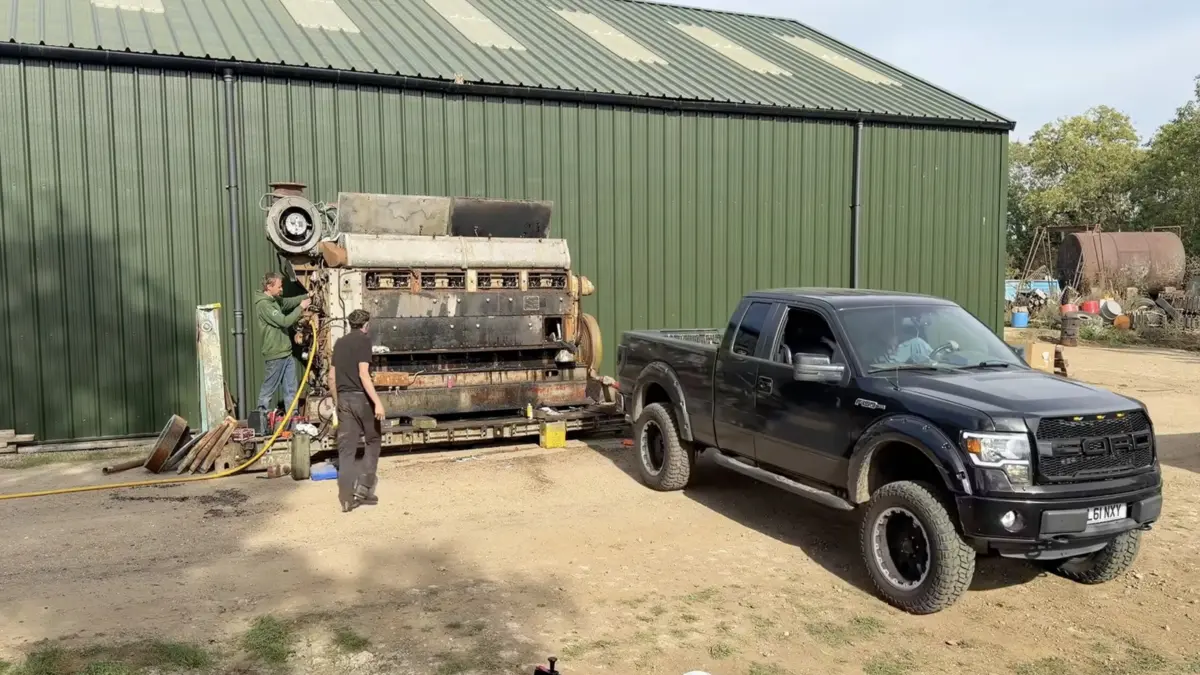
Reviving something as gargantuan as the JS8, however, required a decidedly unconventional approach. Overcoming the friction of those massive pistons and the water-damaged cylinders called for brute force. The solution ultimately involved wrapping a heavy-duty ratchet strap securely around the massive flywheel and using a Ford F-Series truck to pull and spin the engine into motion. Once that daring mechanical feat was achieved and the internal components finally began to move, Hewes stood by the roaring machinery, meticulously fine-tuning the vintage engine while steadily becoming coated in oil, fully immersed in his element.