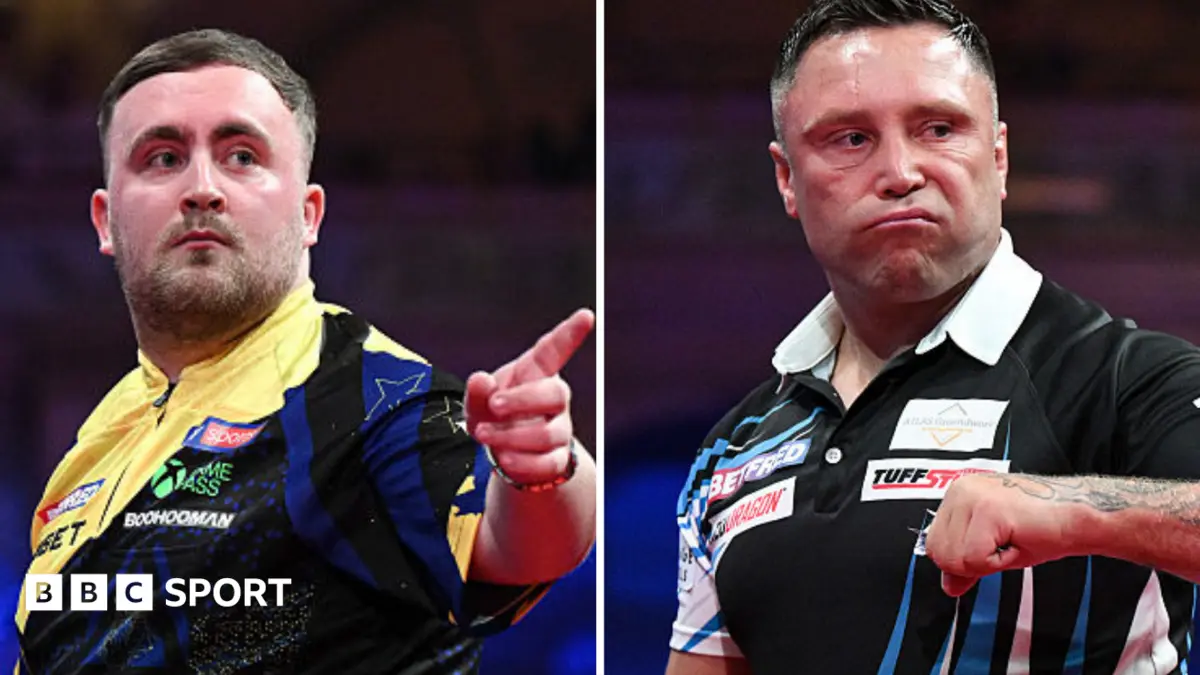
The Grand Slam of Darts at the Aldersley Leisure Village in Wolverhampton delivered a night of high-stakes drama that oscillated between the sublime and the surreal. As the group stages reached their frantic conclusion, two of the sport’s most prominent figures, Gerwyn Price and Luke Littler, secured their passage into the knockout stages. However, their respective journeys to the next round were marked by vastly different spectacles: one defined by an act of sheer, improbable technical mastery, and the other by a baffling officiating error that has sparked widespread debate within the professional darting community.
For the 19-year-old sensation Luke Littler, the night was a testament to his burgeoning reputation as a player capable of producing magic under extreme pressure. Facing Dutchman Niels Zonneveld, Littler entered the arena knowing exactly what he needed to do. While the match itself resulted in a 5-4 defeat for the teenager, the primary objective was achieved; Littler successfully claimed the three legs necessary to navigate his way out of the group stage and into the tournament’s final phase.
The defining moment of Littler’s encounter, and arguably the highlight of the evening, arrived in the eighth leg. With the score tied at 3-3, the pressure was mounting as the Aldersley crowd roared their support for the young prodigy. In a display of raw talent that silenced the venue, Littler set up a 150 checkout with a level of composure that belies his tender age. With the eyes of the sporting world upon him, he landed three consecutive darts in the bullseye—a feat rarely seen even at the highest level of the professional game. The remarkable 150 finish brought the match to 4-4, sending the crowd into a frenzy. Although Zonneveld ultimately held his nerve to clinch the deciding leg and win the match, the result was academic for the teenager, who had already done the hard work required to punch his ticket to the knockout rounds.
While Littler’s drama was rooted in his own brilliance, the narrative surrounding Gerwyn Price’s evening took a turn into the bizarre. The Welshman, a former world champion and a perennial contender at the Grand Slam, secured a 5-2 victory over Poland’s Sebastian Bialecki. On paper, it was a routine result that confirmed Price’s dominance in his group. However, the victory was marred—or perhaps facilitated—by a significant mathematical blunder committed by the match official, Charlie Corstorphine.
The controversy unfolded in the fourth leg of the match. At the time, Price held a 2-1 lead over Bialecki and was staring down a challenging checkout of 135. In the high-intensity environment of a professional darts match, players rely heavily on the referee to maintain the integrity of the score, focusing their mental energy on their throw rather than the arithmetic of the remaining total. Price opened his visit with a treble 19, leaving him with 78 remaining. It was at this juncture that the Welshman, perhaps momentarily losing track of the board or seeking confirmation, turned to referee Corstorphine to ask for his remaining total.
In a mistake that would have immediate and lasting consequences, the referee incorrectly announced that Price had 88 remaining. Trusting the official’s calculation implicitly, Price approached the oche and executed a clean sequence: a treble 16 followed by a double 20. The referee promptly signaled "game shot," and the leg was awarded to Price.
The reality, however, was that by scoring 145 on a 135 checkout, Price had effectively bust himself. Had the arithmetic been performed correctly, the visit would have been ruled invalid, and the leg would have continued under different circumstances. Instead, the match proceeded as if the score were legitimate, ultimately allowing Price to maintain his momentum and secure the win.
The aftermath of the match saw the Professional Darts Corporation (PDC) address the incident with a formal statement. Clarifying the status of the result, the governing body acknowledged the gravity of the error while explaining the regulatory constraints that prevented a reversal of the outcome. "A rare scoring error was made by the referee in the fourth leg of the match between Gerwyn Price and Sebastian Bialecki," the PDC statement read. "Under Darts Regulation Authority (DRA) rule 6.4, as the error was not corrected before the next leg began, the leg score stands as announced."
This regulatory framework is designed to ensure that matches do not descend into chaos by retroactively altering scores once play has moved forward. By codifying that an error must be addressed in real-time, the DRA prioritizes the flow of the tournament, even when that necessity results in a demonstrably incorrect score remaining on the record.
For his part, Gerwyn Price maintained that he was entirely unaware of the error as it occurred. Speaking to the media during the post-match press conference, the Welshman expressed relief that he had not been privy to the referee’s mistake at the time, noting that such knowledge might have disrupted his focus during the match. "I hit the first treble and I asked what have I got left and he said 88, so I threw treble 16 and double top then he said game shot," Price explained. "I’m glad I didn’t know because it probably would have played on my mind."
The incident has highlighted the immense pressure not just on the players, but on the officials who manage the rapid-fire calculations of a professional darts match. In a sport where the margin between victory and defeat is often measured in millimeters, the reliance on human accuracy remains absolute. While modern technology assists with tracking scores, the vocal communication between the referee and the player remains the final authority on the oche.
As the tournament moves into the knockout stages, the focus will undoubtedly shift back to the dartboard. Luke Littler enters the next phase carrying the momentum of his triple-bull checkout, a moment of individual flair that reminded fans why he is considered the sport’s brightest rising star. Meanwhile, Gerwyn Price advances with a victory that will be long remembered, not necessarily for the quality of the darts, but for the officiating anomaly that defined his path.
The Grand Slam of Darts continues to prove itself as one of the most unpredictable events on the calendar. Whether through the sheer technical brilliance demonstrated by the youth of the sport or the human fallibility that can alter the course of a match in an instant, the tournament remains a high-pressure crucible. With the group stages concluded and the bracket set for the knockout rounds, the players must now look ahead, leaving the mathematical errors and the statistical wonders of the opening nights in the rearview mirror.
For the players, the objective remains singular: to progress through the bracket and secure the title. For the officials and the governing bodies, the events of the evening will likely prompt internal reviews regarding the protocols for scoring verification. Yet, as the lights remain on at the Aldersley venue, the primary sentiment among those involved is one of moving forward. Price and Littler remain in the hunt, their spots in the next round secured, setting the stage for what promises to be a gripping continuation of the Grand Slam. The focus of the sport now turns to the next set of challenges, where every dart, every score, and every official’s call will once again be subject to the intense scrutiny of the professional stage.