A coalition of independent booksellers from across the United States has issued an urgent open letter to the American Booksellers Association (ABA) and the American Booksellers for Free Expression (ABFE), warning of a severe and escalating threat to the industry. The collective concern centers on the Trump administration’s National Security Presidential Memorandum-7 (NSPM-7), an anti-antifascist security directive issued last year that specifically targets leftist ideas disseminated through books, zines, and other independent publications.
For an industry already grappling with a nationwide wave of traditional book bans and legislative challenges, the signatories argue that NSPM-7 represents a dangerous escalation. The directive moves past standard censorship and into the realm of potential criminal prosecution for those who produce, stock, or distribute targeted literature.
"As we continue opposing book bans and other legislative challenges, we must also prepare for the potential criminalization of those in our industry," the open letter states.
The letter was authored and signed by a prominent network of independent bookstores, including Firestorm Books in Asheville, North Carolina; Autumn Leaves Books in Ithaca, New York; Boneshaker Books and Moon Palace Books in Minneapolis, Minnesota; Burning Books in Buffalo, New York; Charis Books & More in Decatur, Georgia; Pilsen Community Books in Chicago, Illinois; and Word Up Community Bookshop/Librería Comunitaria in New York City.
Emphasizing the dangers of remaining passive, the booksellers urge national industry organizations to adopt much stronger, highly public stances against both local and national attempts to criminalize free expression. "Bullies thrive in an environment of silence and isolation," the letter warns, calling on leadership to break their silence and actively defend the rights of booksellers and their patrons.
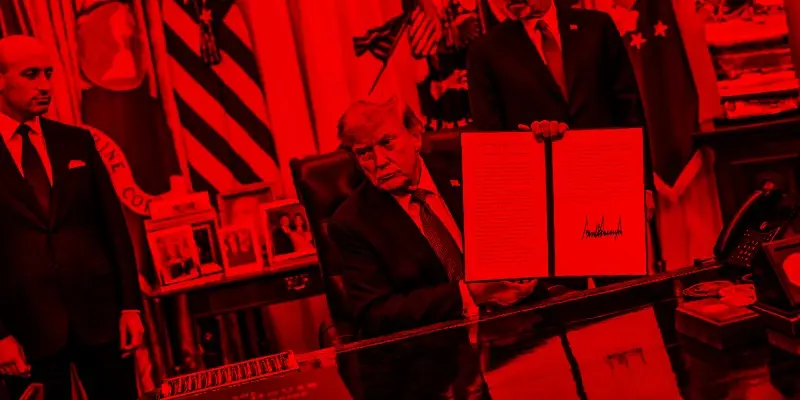
The primary catalyst for this urgent warning is NSPM-7, titled "Countering Domestic Terrorism and Organized Political Violence," which was issued by the Trump administration on September 25, 2025, in the immediate wake of the murder of Charlie Kirk. Framed by the administration as a necessary response to surging political violence, the memorandum has been heavily criticized by civil liberties advocates as a sweeping, politically motivated attack on freedom of expression and thought.
The memo attempts to establish its premise by binding together disparate incidents of protest, political activism, and civil unrest, framing them under an overly broad and nebulously defined umbrella of left-wing extremism. According to the state’s text, these varied occurrences are connected as part of "a culmination of sophisticated, organized campaigns" by "domestic terrorists to wage a violent assault against democratic institutions, constitutional rights, and fundamental American liberties." However, the document presents no concrete evidence detailing who is coordinating these alleged campaigns, the methods being used, or the underlying motivations.
Under the text of NSPM-7, these so-called assaults are funneled into a broad definition of "anti-fascism," which the administration explicitly equates with anti-American sentiment. The memorandum outlines common animating threads behind this alleged conduct, listing anti-Americanism, anti-capitalism, and anti-Christianity; support for the overthrow of the United States government; extremism concerning migration, race, and gender; and hostility toward traditional American views on family, religion, and morality.
Legal scholars and civil rights advocates have pointed out that the language used throughout the document is intentionally and excessively broad. Phrases such as "traditional American views on family" are so vague that they effectively lack any legal precision, granting the state sweeping discretionary power to classify almost any form of conduct, speech, or independent thought as a national security threat. This lack of clear definition lays the groundwork for authorized state repression against virtually any dissenting voice.
Crucially, booksellers emphasize that the dangers outlined in NSPM-7 are not merely theoretical exercises in policy, but are already translating into severe legal consequences. As noted in the open letter, the administration has already utilized the memo to target a group of demonstrators who participated in a July 4, 2025 protest outside the Prairieland ICE detention facility in Texas.
Detailed reporting by The Guardian revealed that nine protesters were arrested during the demonstration. Subsequently, a federal jury found eight of the nine individuals guilty of "providing material support to terrorists." The federal government successfully argued that this "material support" included the ownership of a "printing press" utilized for producing anarchist zines, alongside the defendants’ participation in a local leftist book club.
In reality, the described "printing press" consisted entirely of standard office equipment: an ordinary office printer, a paper cutter, and basic bookbinding supplies. Furthermore, federal prosecutors placed heavy emphasis on the defendants’ possession of standard modern security and privacy measures, including Faraday bags designed to block wireless signals and prevent electronic surveillance, the use of the encrypted messaging application Signal, and the wearing of all-black clothing during demonstrations.
Civil rights activists have expressed deep alarm at how the broad mandate of NSPM-7 allows routine, everyday items and privacy tools to be reframeds as instruments of an invented terrorist ideology. By stretching definitions to their breaking point, the administration effectively transforms standard office supplies and privacy accessories into terror-related contraband, using them to justify the full weight of state power and prosecutorial violence.
The resulting legal penalties for the Prairieland protesters have been remarkably harsh. The eight convicted individuals received prison sentences ranging from thirty to one hundred years—effectively functioning as life sentences handed down under the banner of national security.
In an interview with Grace Byron for The Nation, Autumn Hill—one of the Prairieland protesters who was sentenced to 50 years in prison, a term longer than those handed down to many participants in the January 6 Capitol riot—spoke about her experiences. Hill, a transgender woman currently incarcerated in a men’s prison, articulated her political beliefs and personal motivations with thoughtfulness, contrasting sharply with the violent and antisocial rhetoric the administration attributes to such activists.
"My whole life is driven by this radical love and by this urgent need to see justice done," Hill told The Nation, highlighting a worldview rooted in community hospitality and compassion rather than subversion.
For the coalition of independent booksellers, the severe sentences handed down in the Prairieland case serve as a chilling preview of what could soon face the literary community. The open letter warns that if the policy goes unchecked, the administration could easily pivot its focus and bring similar material support or extremism charges against members of the American Booksellers Association, stretching NSPM-7’s already expansive definitions to target bookstores, publishers, and independent distributors.
Consequently, bookstore workers are demanding concrete action from industry leadership. The open letter calls on the ABFE and the ABA to conduct a thorough examination of the Prairieland case, its direct relationship to NSPM-7, and its ominous implications for bookstores and their customers. The signatories argue that these escalating attacks on freedom of expression deserve to be addressed publicly by the ABFE, and that the ABA should explicitly communicate its institutional intention to defend its members from politically motivated federal prosecution.
Critics of the policy point out that this style of state action is fundamentally ahistorical, driven entirely by political grievance and authoritarian impulses rather than genuine security concerns. Commentators have noted the deep irony in targeting radical publications and political pamphlets in a nation that was quite literally founded on revolutionary ideas distributed through short, radical printed works. Historians and literary advocates have long defended America’s rich tradition of radical pamphleteering, a legacy explored by authors such as Howard Zinn in works like Artists in Times of War.
From the historic pamphlets of the American Revolution to modern zines and independent bookstore offerings, small-format political literature has remained an essential element of American public discourse. As the debate over NSPM-7 continues to unfold, independent booksellers are urging both their national trade organizations and the broader public to recognize the stakes, keeping the words of activists like Autumn Hill in mind as they confront an uncertain legal landscape and the pressing need to defend freedom of expression.